Part of Figure 1 from Follette et al. (2013), comparing the Hubble (HST) image (top) to their image (bottom) of the protoplanetary disk.

Part of Figure 1 from Follette et al. (2013), comparing the Hubble (HST) image (top) to their image (bottom) of the protoplanetary disk.

Today in journal club, we discussed two papers.

The first one was Follette+ (2013), which presented the first images of a protoplanetary disk taken using a new adaptive optics instrument on the Magellan telescope.

This disk (shown at right) is a collection of gas and dust orbiting a young star, only a few million years old. Studying these kinds of young disks help astronomers understand what the early solar system was like, when our planets were still forming.

In addition to providing new images of this disk, this paper also presented evidence that, although the disk is young, the accumulation of dust particles that gives rise to planets may already be underway. This result means that, although astronomers have thought this particular disk may show us the very earliest conditions in a protoplanetary disk, instead this disk may be fairly far along in its evolution and the process of planet formation.

The second paper we discussed was Storch & Lai (2013), which studied the origin of hot Jupiters — gas giant planets (like Jupiter) but orbiting hundreds of times closer to their host stars than the Earth does the Sun.

The origins of these planets are still unclear, but they are so close to their stars that they undergo very strong tidal interactions. These tidal interactions distort the shapes of the planets, dissipating orbital energy within the planets’ interiors and causing the orbits to shrink over time.

Determining the rates and processes of tidal dissipation are key to understanding the origins and fates of these planets: Too much tidal dissipation will overheat the planets’ interiors and blow them up; too little, and the planets wouldn’t reside in the orbits in which we see them today.

Storch & Lai (2013) include the effects of dissipation within the planets’ icy and rocky cores, which they show can help explain the origins of the planets.

Figure 4 from Perez-Becker & Chiang (2013), showing the how the mass loss rate depends on the amount of dust in the atmosphere (x_dust).

Figure 4 from Perez-Becker & Chiang (2013), showing the how the mass loss rate depends on the amount of dust in the atmosphere (x_dust).

Today in Journal Club, we discussed a paper by Perez-Becker & Chiang (2013).

This paper looked at the mass lost by a rocky extrasolar planet so close to its host star that its surface is melted and a liquid rock lake has formed on the planet’s day side. This work was motivated by Rappaport et al. (2012), which claimed to have discovered a roughly Mercury-sized extrasolar planet candidate orbiting the star KIC 12557548 in data from the Kepler mission. The planet seems to be disintegrating and may disappear in the next few million years.

An atmosphere of rocky vapor likely forms over the liquid rock lake and can actually escape from the planet, owing to the planet’s very low surface gravity. As the gas escapes, it cools (through adiabatic expansion) and can potentially condense into little dust grains, which are then swept out into space by the escaping gas. This putative cloud of dust can help explain some of the observations from Rappaport et al. (2012).

As interesting as the paper is, though, it raises some big questions that we talked about in journal club. For example, the dust should be strongly heated by the starlight and should reach high temperatures (> 2000 K or 3140 degrees F). If the planet’s surface is hot enough that the rocky surface evaporates, why doesn’t the dust also evaporate?

Unfortunately, the star KIC 12557548 is very dim, so it’s hard to observe with other telescopes and learn more about the planet candidate. However, the upcoming TESS mission will probably find more planets like this one, and so we might be able to see other rocky planets that are disintegrating before our eyes.

We also discussed an older paper by Gaudi (2004), which predicts that the Kepler mission might have observed a handful of stellar occultations by Kuiper belt objects (KBOs). During such an occultation, a KBO will block out the light from a background star in a way that depends on its size and how far it is from the Sun. Since Kepler has been staring at about 150,000 stars over 3.5 years, there’s a good chance that a few of those stars were occulted by KBOs. Unfortunately, because Kepler wasn’t designed to look for such signals, it might be very hard to spot them in the data.

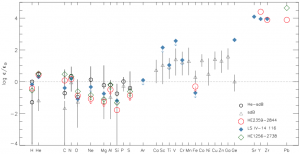
This figure shows chemical abundances for several stars relative to the Sun. The compositions for the unusually lead-rich stars are shown as a red circle, blue diamond, and green diamond.

This figure from Naslim N. et al. (2013) shows chemical abundances for several stars relative to the Sun. The compositions for the unusually lead-rich stars are shown as a red circle, blue diamond, and green diamond.

Today in journal club, we discussed two papers.

We started with Schlichting et al. (2013), which looked at the size distribution of Kuiper belt objects (KBOs) to figure out how they formed and evolved over the history of our solar system.

Since, as the paper says, the Kuiper belt “is a remnant from the early solar system”, its size distribution depends on the accretion processes that gave rise to planets and also on the collision processes that affect many aspects of planetary formation and evolution.

KBOs range in size from unobservabley small to about a thousand kilometers (km) in radius (Pluto-sized), but the numbers of objects of a given size depend on how the objects formed and on the nature of the collisions among the objects (which can break up the smallest objects).

Schlichting and colleagues argue that the size distribution of KBOs suggests that smaller objects (less than about 30 km in radius) have been dominated by collisions, while bigger objects are much less affected by collisions. So the bigger objects may provide a glimpse into the early history of our solar system.

The other paper was Naslim N. et al. (2013), which announced the discovery of the most lead-rich stars ever found. The stars discussed in the paper are sub-dwarf stars — essentially very small, retired stars — and have thousands of times more lead in their atmospheres than our Sun.

Not only is the amount of lead surprising, it’s surprising that we can see the lead at all. Since lead is so much heavier than the hydrogen and helium that make up most of the stars’ atmospheres, we would expect the lead to settle out of the atmospheres, deep enough in the star that we couldn’t see it.

However, something has caused the lead in these stars to remain suspended in their atmospheres, but not other heavy elements. The authors suggest preferential radiative levitation (essentially some kind of interaction between the atoms and the stellar light) keeps the lead suspended but not other heavy elements.

Figure 2 from McQuillan+ (2013) showing rotation periods of host stars (P_rot) vs. orbital periods of planetary candidates (P_orb). The size of the circle indicates the size of the planetary candidate, and the colors indicate stellar temperature.

Figure 2 from McQuillan+ (2013) showing rotation periods of host stars (P_rot) vs. orbital periods of planetary candidates (P_orb). The size of the circle indicates the size of the planetary candidate, and the colors indicate stellar temperature.

In journal club today, we first discussed the recent tenth release of data from the third Sloan Digital Sky Survey (SDSS III). The survey basically takes a mammoth picture of the sky every night and provides a wealth of astronomical data that can be used to map the Milky Way, search for extrasolar planets, and solve the mystery of dark energy. According to the wikipedia, SDSS collects about 200 GB of data every night, so, over the last year, the survey has collected tens of terabytes of data.

We also talked about a recent paper by McQuillan, Mazeh, and Aigrain. These authors analyze the brightness variations of many stars observed by the Kepler mission that are orbited by planetary candidates.

Like the Sun, many stars have star spots, cooler and darker regions on their faces, and these spots rotate in and out of view as the stars rotate, just like those on the Sun. When the spots rotate into view, the star appears to darken slightly, and so you can use  brightness variations to determine the star’s rotation rate. (Watching the motion of sun spots is how the Sun’s rotation rate was first determined.)

The authors suggest a correlation between the rotation periods of these host stars and the orbital periods of their planetary candidate companions: there is a dearth of planetary candidates with short orbital periods around stars with short rotation periods.

Our journal club group raised several questions about these results. Among them, we wondered whether there are any biases in the sample of studied stars that could account for the correlation. Also, could it be harder to find planetary candidates around faster rotating stars (faster rotating stars could exhibit brightness variations rapid enough that they confuse the Kepler transit search for planets) — could this idea account for the correlation?

However, if no underlying biases or sampling issues account for the correlation, then the results say something interesting about the connection between planets and stars. Why do planets close to their stars (i.e., with short periods) seem to prefer orbiting stars that rotate slowly?

Figure 20 from Jackson et al. (2013) showing the distance from their host stars at which planets would be torn apart.

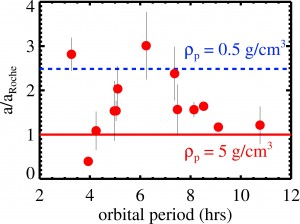
Figure 20 from Jackson et al. (2013) showing the distance from their host stars at which planets would be torn apart (solid red line).

Today I submitted a new paper for publication, “A Survey for Very Short-Period Planets in the Kepler Data.” Our new survey of data from the Kepler planet-hunting mission has revealed planetary candidates with orbital periods as short as three hours, so close to their host stars they are nearly skimming the stellar surface.

We used data from the Kepler mission, which finds planets using the transit method — by looking for their shadows as the planets pass between their host stars and the Earth. Since the planets are so far from the Earth, we can’t see them directly and instead only see the little dip in brightness of the host star as the planet passes in front of it.

Over the last few decades, astronomers have found a breath-taking menagerie of exotic planetary systems, and the candidate planets we found in this paper are no exception: more than 100 times closer to their host stars than the Earth is to the Sun, if these candidates turn out to be rocky planets, their surface are baking at nearly 5,000 degrees F (3000 K), producing giant lakes of molten rock.

In fact, these planets are so close to their host stars that they are on the verge of being torn apart by the stars’ gravity. The figure at left shows the orbital distances for these planets (red dots) relative to the distance at which they would be torn apart (shown by the red line). The blue line shows where they would have been torn apart if, instead of being rocky, they were more like hot gas giant planets.

We’ve still got some work to do to make sure these candidates are actually planets, but if confirmed, they would be some of the closest planets to their stars ever discovered, once again overturning what astronomers thought we knew about where planets can live and what they’re like.

The false-color, infrared image of the GJ 504 system. The star (center) has been blocked out, and the planet appears a white blob at the upper right.

The false-color, infrared image of the GJ 504 system. The star (center) has been blocked out, and the planet appears a white blob at the upper right.

At today’s journal club, we discussed the recent paper Kuzuhara et al. (2013), which reports the discovery of an extrasolar planet with a mass of about 4 times Jupiter’s mass but in an orbit more distant from its sun than Neptune is from ours.

The image at left shows one of the discovery images, taken at infrared wavelengths. At these wavelengths, usually a planetary host star is shining much less brightly than at visible wavelengths, which makes it easier to see radiation from the planet. However, for the kind coronagraphic imaging here, the star still has to be blocked out to prevent the glare from masking the planet (and blocking out the star completely is hard to do, as evidenced by the orange and blue speckles in the image).

This planet is particularly interesting because it is the oldest planet (it’s at least 160 million years old) to be observed with this kind of direct imaging technique. Younger planets are usually hotter and emit more radiation, and so it’s easier to see them when they’re younger.

Although this system is one of the oldest directly imaged, it’s still very young compared to our solar system, which is about 4.5672 billion years old. 160 million years after our Sun formed (and the solar system got its start), the Earth and other planets had already formed, but the Earth was very different from the way it is today. For example, water may have already collected in the oceans, but our atmosphere was probably composed of carbon dioxide and water, with essentially no oxygen. Oxygen came later when life got started.

So studies like this one can allow us to peer back in time to figure out, among other things, what planets look like when they are very young and piece together to story of our solar system.


Spectrograph of 2004 Parkfield CA earthquake -- taken from http://geophysics.eas.gatech.edu/people/zpeng/EQ_Music/#part1_1

Spectrograph of 2004 Parkfield CA earthquake — taken from http://geophysics.eas.gatech.edu/people/zpeng/EQ_Music/#part1_1

Today’s DTM Seminar speaker was Prof. Zhigang Peng from GA Tech‘s Earth and Atmospheric Sciences Dept. He talked about a kind of earthquake (he called “tremors”) that is triggered when the seismic waves from another larger earthquake pass by. The relationship between earthquake duration and strength (as measured by the seismic moment) for these tremor quakes is apparently much different than for normal earthquakes, suggesting they result from different geophysical mechanisms.

The part of the talk that stuck out most for me was when Prof. Peng played the “sound” of an earthquake, generated by speeding up the seismic vibrations from measured earthquakes. This “earthquake music” is available on his website, but I have posted one such recording below. Apparently, different kinds of earthquakes make different sounds, and so these recordings can be used to tease out information about the quakes.

Sound of the 2004 Parkfield CA earthquake

Figure 2 from Cuk & Stewart (2012) showing the range of model outcomes for different impact conditions.

Figure 2 from Cuk & Stewart (2012) showing the range of model outcomes for different impact conditions.

In Friday’s DTM seminar, Sarah Stewart-Mukhopadhyay of Harvard gave a fascinating talk on the origin of the Moon and the effects of large impacts on the Earth’s volatile inventory.

Lots of evidence (geochemical and astronomical) say that the the Moon originated in a large impact between the proto-Earth and a roughly Mars-sized rogue planet (often called Theia). This explanation accounts for many of peculiarities of the Earth-Moon system, EXCEPT that geochemical data says that Earth and Moon probably formed out of the same material. Old models of the Moon’s formation showed that Moon should have formed mostly out of the impactor, Theia, which (like all other solar system planets) was probably compositionally distinct from the Earth. So the Moon SHOULDN’T be Earth’s compositional twin.

Instead, Stewart and Cuk suggested that the pre-impact Earth was spinning much faster than previously assumed, with a day that lasted about 2 hours, and so enough material from the proto-Earth could have been launched by the impact to make the Moon mostly out of the proto-Earth. Once the Moon formed, Stewart and Cuk suggested it could interact gravitationally with the Earth and the Sun to reduce the Earth-Moon angular momentum and bring it into line with what we see today, removing the one big objection to their fast-spinning proto-Earth idea.

In the last part of her talk, Stewart discussed what such large impacts might do to the gases trapped inside the young Earth. Contrary to popular thought, she suggested that these large impacts actually might NOT melt most of the Earth’s outermost layers, and so the Earth could retain in its interior much of the nebular gas that it was born with.

This idea could help explain geochemical data that suggest gas trapped in different parts of the Earth’s interior currently have different isotopic compositions and would mean that the Earth retains geochemical scars from its adolescence once thought completely erased by the violence of the early solar system.