Sanchis-Ojeda2013_Fig3

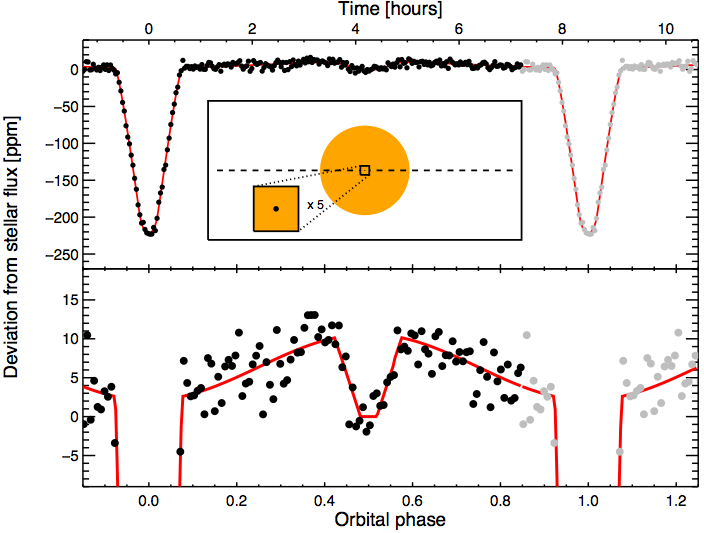
Figure 3 from Sanchis-Ojeda+ (2013) showing observations of the Kepler-78 b’s shadow as it passes in front of its host star.

I sat in on University of Maryland Astronomy’s colloquium, today given by Roberto Sanchis-Ojeda of the Kavli Institute at MIT. He discussed his recent paper announcing the discovery of Kepler-78 b, an Earth-sized planet with on orbital period of only 8.5-hours.  In such a short orbital period, this planet is only 0.01 AU distant from its host star, almost 100 times closer to its star than the Earth and 40 times closer than Mercury are to our Sun.

Unfortunately, since the planet is so small, we don’t have a direct estimate of its mass, but so close to its sun, the planet’s day side is baking at a temperature probably greater than 1,500 K (2,200 degrees F), above the melting point of rock — The planet’s day side is probably covered by a lake of molten rock.

Kepler-78 b is one of a few very hot rocky planets discovered so far and the shortest-period transiting planet confirmed. CoRoT-7 b was the first one (discovered by the CoRoT mission), and Kepler-10 b was the first rocky planet discovered by the Kepler mission. The origins of these very hot rocky planets are unclear — they probably didn’t FORM so close to their host stars (although some have suggested rocky planets MAY form very close to their host stars). In any case, they represent yet another entirely unexpected but exquisitely interesting discovery in extrasolar astronomy.

In journaDeming2013_Fig14l club this morning, we discussed the recent paper by Deming et al. (2013), just accepted for publication by the Astrophysical Journal. In this study, the authors observed the planetary transits of HD 209458 b and XO-1 b using the Hubble Space Telescope in the near-infrared (about 1-1.6 microns in wavelength) to look for spectral features of water and other molecules. These features tell us whether water and other molecules are present in a planet’s atmosphere, how abundant those molecules are, and even where the atmosphere they are located. In this case, the authors saw spectral absorption from water molecules (see the left portion of the figure at left), but the amount of absorption (the depth of the absorption band) isn’t as large as it would be if the atmosphere were clear. Instead, the relatively shallow absorption feature suggests that there are clouds or haze suspended high in the planet’s atmosphere.

The cartoon in the right portion of the figure shows how this works: Panel (a) illustrates the passage of light emitted by a planet-hosting star through a clear planetary atmosphere, on the way to the telescope. As the light passes through, the water molecules (blue circles) imprint their spectral absorption feature. By contrast, panel (c) illustrates the passage for a cloudy atmosphere. The clouds block a lot of the light before it reaches the telescope, and so only the photons that pass high above the clouds, where there’s not much water to absorb light, get to the telescope. As a result, the water spectral feature is less deep.

The new techniques developed in Deming et al. (2013) may open the door to totally new astronomical observations. For example, the authors suggest that the significantly improved sensitivity of their technique may allow astronomers to directly observe meteorological variability (weather) on these distant exoplanets.

Cleeves_Fig10

Figure 10 from Cleeves et al. (2013) showing the stellar wind driving cosmic rays away from the disk

In journal club this morning, we discussed a new paper by Cleeves, Adams, & Bergin that pointed out the important (and apparently previously unrecognized) role of stellar wind in the chemistry and dynamics of protoplanetary disks. Astronomers have long believed that cosmic rays induce significant ionization in protoplanetary gas disks around young stars. This ionization is important because (1) it drives chemical reactions, helping to set the initial compositions of planets, and (2) it causes the disk to interact with magnetic fields, producing turbulence in the disk, which affects where/how/when planets form. If, as suggested by the authors, the stellar wind can exclude cosmic rays from the inner reaches of the disk, then sufficient ionization to power these two effects requires some additional energy source. Cleeves and co. suggest decay of radio nuclides, which produces ionizing gamma radiation, may be able to take up the slack, but in our discussion, it was suggested that gamma rays might drive different chemistry from what was expected of cosmic rays.