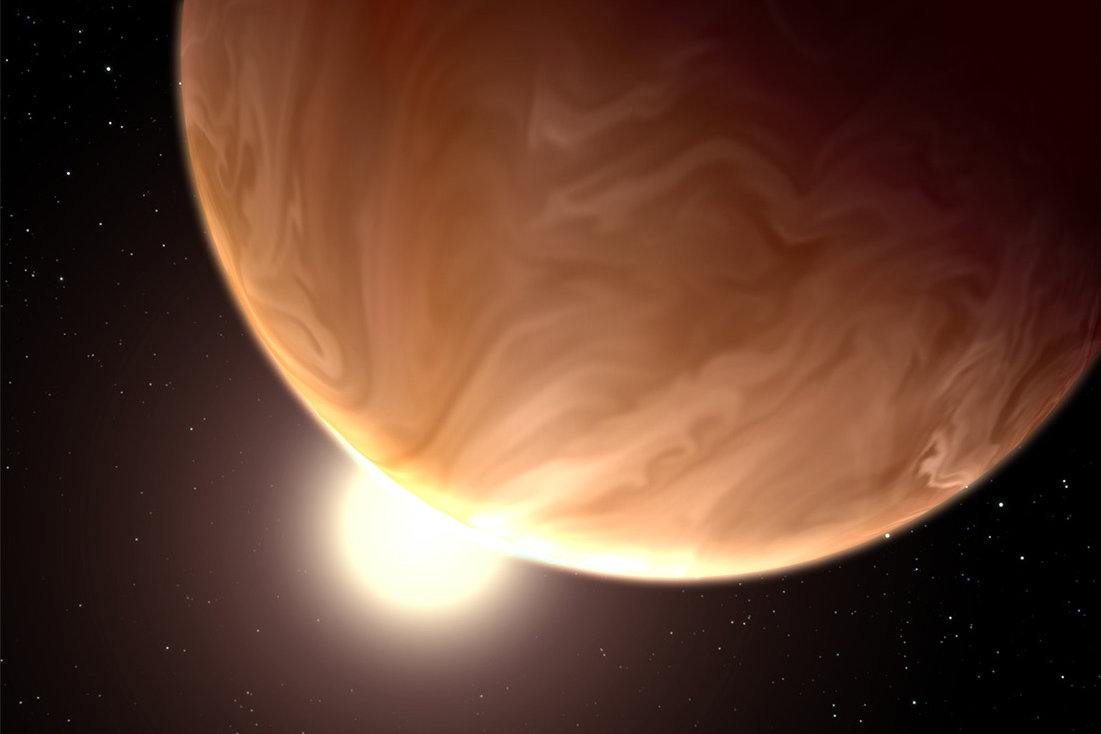
Artist's conception of cloudy GJ 1214 b. From http://www.nytimes.com/2014/01/07/science/space/the-forecast-on-gj-1214b-extremely-cloudy.html.

Artist’s conception of cloudy GJ 1214 b. From http://www.nytimes.com/2014/01/07/science/space/the-forecast-on-gj-1214b-extremely-cloudy.html.

At journal club this week, we discussed the recent discovery using data from the K2 mission of the sub-Neptune planet K2-28.

This planet, roughly twice the size of Earth, circles a very small M-dwarf star so closely that it only takes two days to complete one orbit. Even though the planet is very close to its star, the star is so cool (3000 K) and so small (30% the size of our Sun) that the planet’s temperature is only 600 K. (A planet in a similar orbit around our Sun would be 1200 K.)

The authors of the discovery paper point out that this planet is similar in many ways to another famous planet, GJ 1214 b. Like GJ 1214 b, K2-28 b is member of this puzzling but ubiquitous class of sub-Neptune planets — planets that fall somewhere between the Earth and Neptune in size and composition and do not exist in our solar system*. Both planets also orbit relatively nearby M-dwarfs, which means, like GJ 1214 b, K2-28 b might be amenable to follow-up observations.

Previous follow-up observations of GJ 1214 b indicated that planet’s atmosphere is very cloudy or hazy. So K2-28 b could provide another very important toehold along the road toward understanding this strange class of hybrid planet.

*unless Planet Nine turns out to be real
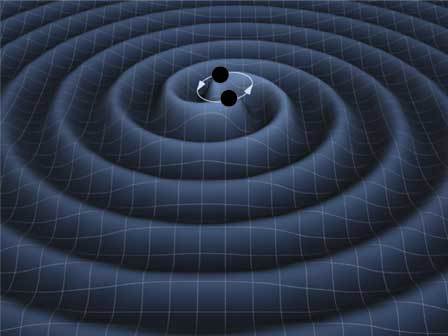
 

From http://www.redshift-live.com/binaries/asset/image/25908/image/Graviational_Waves.jpg.

From http://www.redshift-live.com/binaries/asset/image/25908/image/Graviational_Waves.jpg.

Nothing. They just waved.

Led by physics major Tyler Wade, this week’s astronomy journal club discussed the very exciting result from the LIGO collaboration, the first detection of gravitational waves.

Einstein predicted the existence of gravitational waves back in 1916. (If your differential geometry and German are any good, you can read the original paper here.) Essentially, gravitational waves are a consequence of that fact that mass can distort the shape of space (that’s what we call gravity).

The upshot of this is that any massive object in motion can excite gravitational waves, but only very massive objects (like, black hole-sized) produce waves big enough that we have any hope of measuring them.

And so for the last few decades, the LIGO project, along with other gravitational observatories, has been monitoring the space-time continuum, looking for tiny distortions due to rapid, oscillatory motion of massive celestial bodies.

LIGO attempts to detect these distortions by sending two laser beams, one each, out and back along two orthogonal 4-km tunnels. By measuring the travel time for each laser beam down each tunnel, they can determine their lengths to a ridiculous precision. A passing gravitational wave would VERY slightly modify the tunnel lengths in a particular way.

How slightly? The signal reported last week by LIGO corresponds to a change in the tunnel length by 0.0000000000000000000001 meters. That’s the equivalent of a change in the width of the Milky Way galaxy by 1 meter.

At two different observatory sites, one in Washington state and the other in Louisiana, the LIGO collaboration measured the distinctive signature of gravitational waves generated by two black holes, many times the mass of the Sun, as they completed their death spiral, merging into an even bigger black hole and radiating an enormous amount of energy.

Why is this important? Well, seeing gravitational waves is not going to allow us to control gravity (at least not yet), and the fact that they exist is not surprising. Instead, LIGO has provided us a brand-new way of doing astronomy.

It’s as if, up until now, we were doing astronomy colorblind, and suddenly LIGO built a color telescope. Of course, being able to see in color would open up vast and unexpected vistas on the universe. The detection of gravitational radiation is the same kind of revolutionary achievement.

NYT has a really great animation and video describing how the detection worked, which I’ve embedded below.

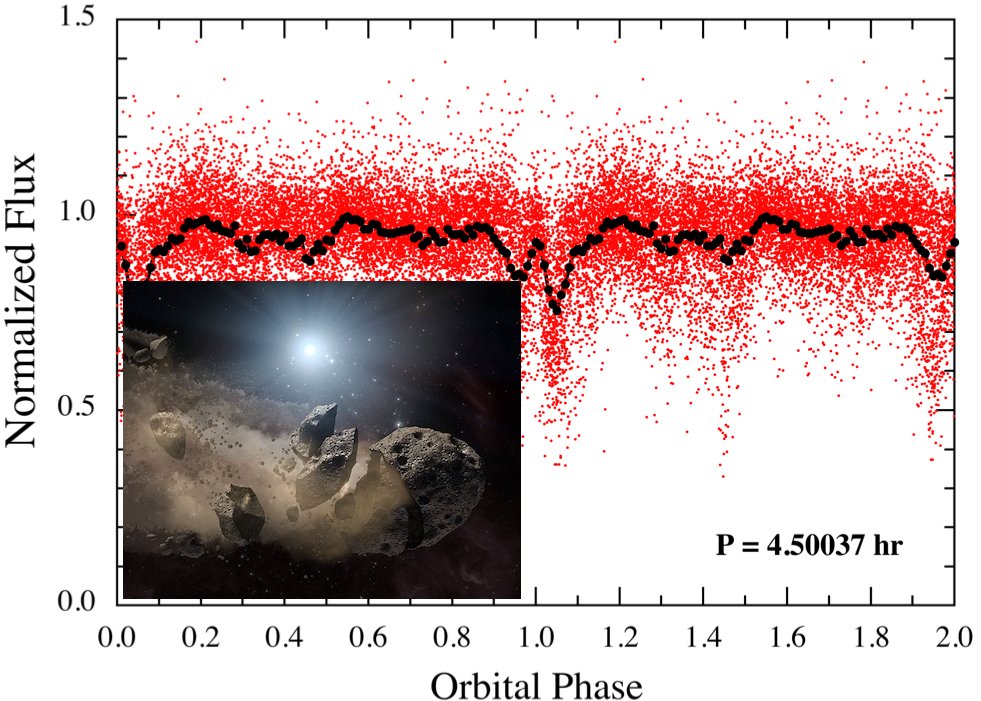
The red dots show the observations, with the dips due to asteroid chunks transiting the white dwarf. The inset shows an artist's conception of the disruption process.

The red dots show the observations from this study, with the dips due to asteroid chunks transiting the white dwarf. The inset shows an artist’s conception of the disruption process.

For our second journal club meeting this semester (didn’t manage to blog the first one), we discussed a study from Saul Rappaport and colleagues on observations of the white dwarf WD 1145+017, which continues to show evidence that it is eating a small asteroid.

A study last year from Vanderburg and colleagues (which we discussed last semester) presented observations from the K2 Mission showing distinctive but highly-variable transit signals coming from WD 1145+017. That group conducted follow-up observations that pointed to the presence of an asteroid very close to the star, being ripped apart by the star’s gravity.

As crazy as it sounds, the idea that some white dwarfs are eating asteroids is fairly well-established, but Vanderburg’s study was the first to present observations of the process clearly in action. The variability of the transit signals indicates that the violent process is dynamic and complicated.

This new study from Rappaport and colleagues continues the saga of WD 1145+017 and finds that the disruption process persists more than a year after the initial observations. And using the apparent drift rates of the different chunks of asteroid, Rappaport is able to constrain the mass of the parent asteroid to be about 1% that of Ceres in our solar system.

One of the most exciting aspects of this study for me is that the observations were made using a network of small, amateur telescopes. Some of the scopes used in the study were 25-cm, and so I’m hopeful that, in the near future, we will be able to use Boise State’s own Challis Observatory to conduct follow-up. Just gotta wait for a clear night.

Boise State’s Institute for STEM and Diversity Initiatives is hosting Aerospace Day here on campus today, a day to explore the science, engineering, and applications of aerospace technology.

I volunteered to give a talk on our group’s research looking for short-period exoplanets, and it seemed well-received. Lots of interesting questions afterward. I’ve posted the talk below.

During my talk, I mentioned the planethunters.org website, where the public can help find new exoplanets using data from the Kepler mission.

Thanks to Christine Chang Gillespie, Donna Llewellyn, and all the other organizers for the invitation to speak.

OCR OC-gain

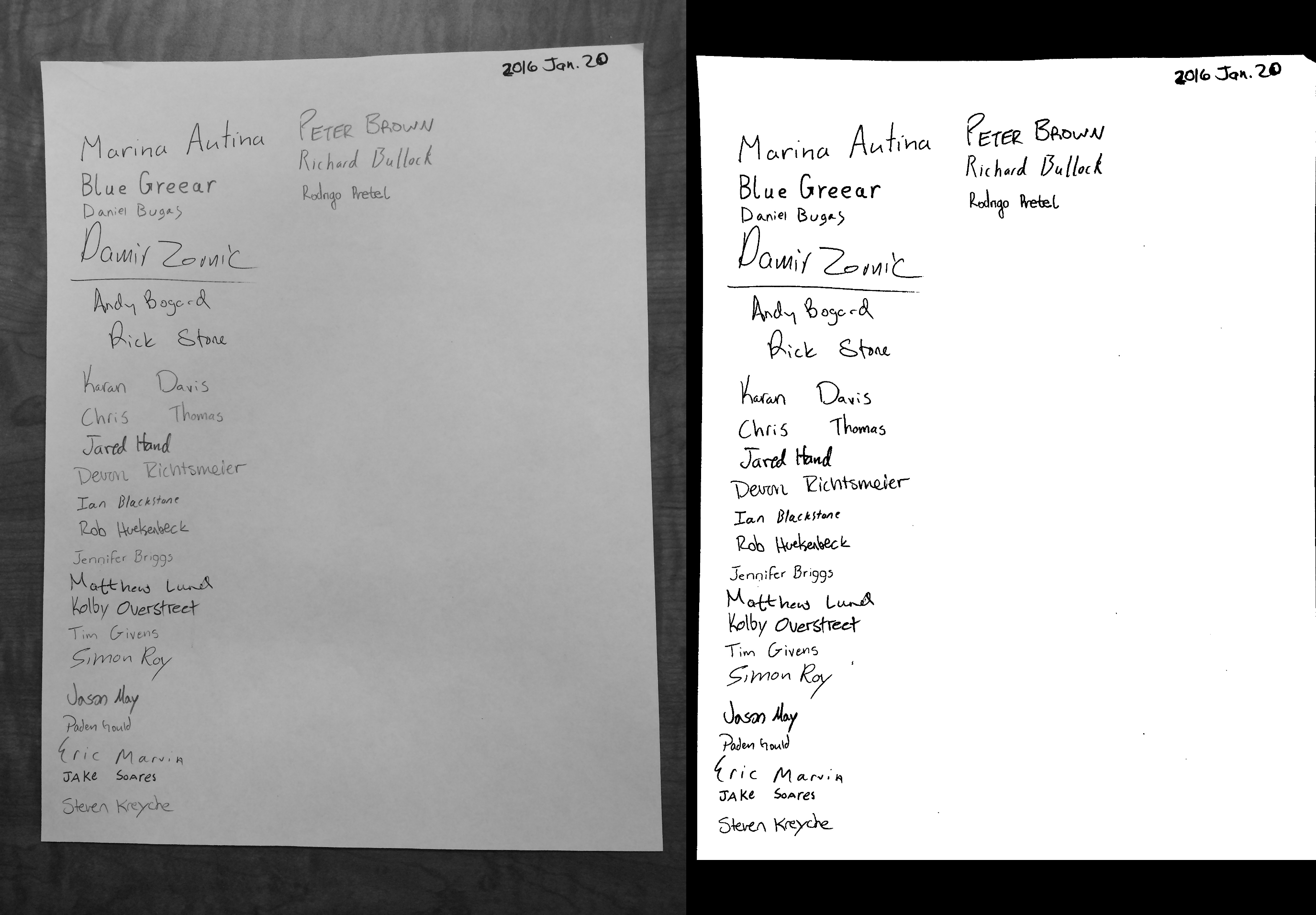
My PHYS341 students were interested to see how the OCR routine processed their attendance sheet, so I applied it, as shown below.

IMG_3707_orig-scannedThe left panel shows the original, the right the transformed version. The routine did a reasonable job of un-distorting the page (although it wasn’t too bad to begin with).

And here’s what the routine returns as text:

zolto J:)o<-&\
Qfick ${‘bt\L . .
1ZWrW(\ DQVCS
Onras Tkomag
Jam; I-Em!
De»-UV1, ?I‘L\M‘ovV\QJ3€,v'
Ia./I B,a,C/IHMC .
V.o\3 \3<<I°\Ser&eck
jengifcr Brigga
}VK°'('3E\V1c-rad LULAA
Mby Ouersfreci’ '
Tm (jivws ‘
gj)/VIOI/I  ‘
$030-4 “10u\J ‘
{NC /I/1a.V,,,,',q '
O”AKe So/ares
Skwm \<reyc}~e '

…not great.

I’m not totally sure what went wrong. Maybe I should have them write their student numbers instead.

UPDATE: 2016 Feb 5

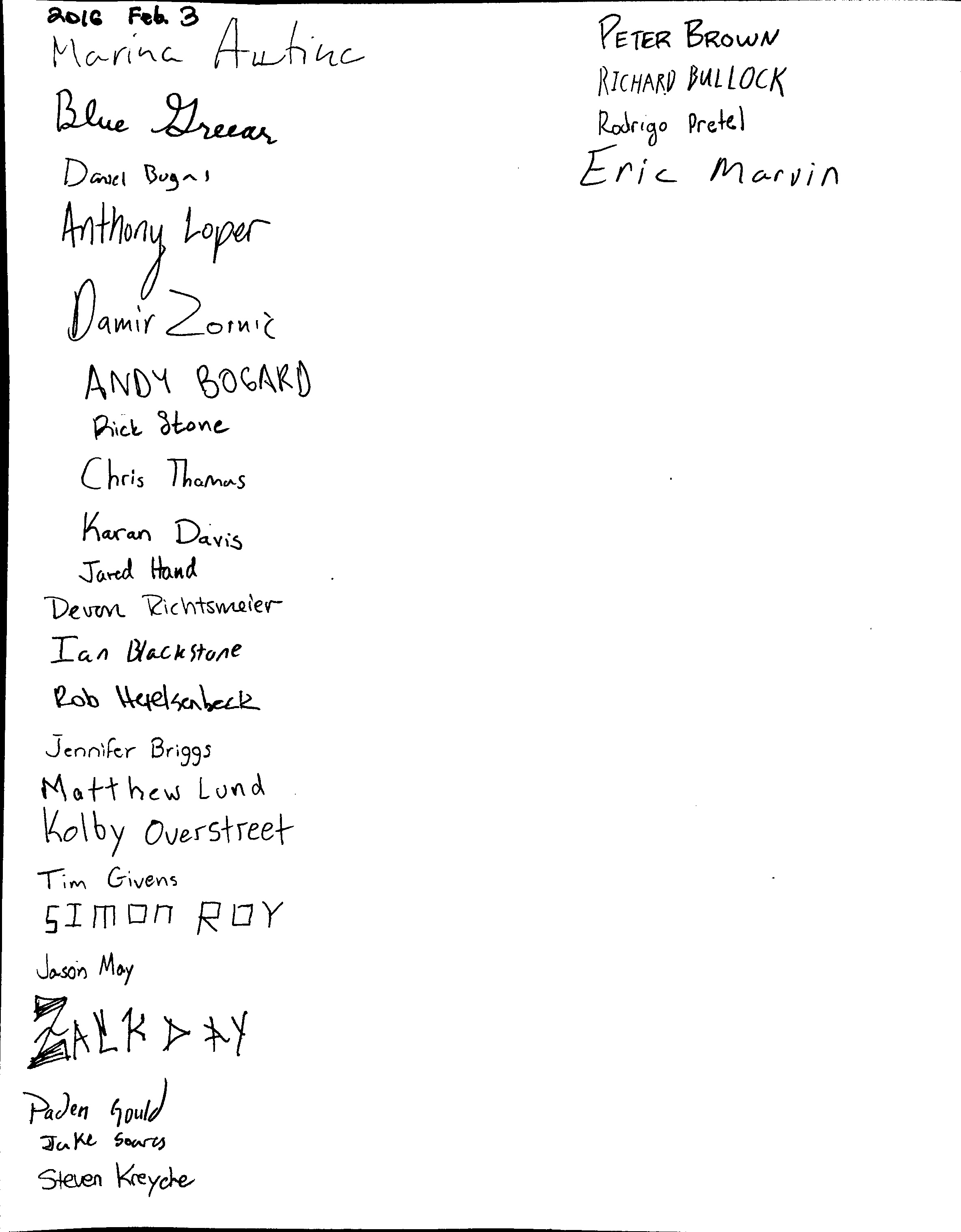
Here’s another go with a different attendance sheet. Not much better.

IMG_3784_scanned

I‘/\0,;/{¢r\(~  VETEK BROWN
E ? RICH/W} WLMC/(
“$2114!/~, lZoAr.‘%o Pratt.‘
D“""‘ 8'3"’ ' g/"It; /Vlar,//'/1
 Lolpef‘
kpdkl/n\‘f 2011/(IE
ANN <5©<J\M) Vfxit %'L0V\€z &}"-:5 _)_La/\/MAS _ Karm I>q'v‘-5
\Tou—o0l Hand _
'Dz\m/L ?\c\n'ksvvuu‘ev*
Ian I3/¢«'-Ckfia/If ¢
94% \5<<k*?l6<:x\.cLl¢ Jennifer BH995 N\o+‘\'V\c\.6 Luv\0\ . \/\0\\)y 0\,ers+reeJr ’\".m C"\\/Ens _ 51 m cm E 1: Y Jason May A ZPM > M
PIJW1 figu//
jam 5°0W'/J
34681 \4'€y¢}~¢>/

I’m prepping for my classical mechanics course, scheduled to start next week. One of the first things we discuss is uniform circular motion and how it looks projected along the x- and y-axes, so I thought it would be useful to have an animation showing that. I found a few animations online, but none really showed the x and y projections I was looking for.

So I decided to create my own using my go-to language of choice Python. Fortunately, python guru Jake Vanderplas has created a very nice animation module usable in iPython Notebooks.

Based on his example here, I put together the following code to generate the desired animation:

I spent the morning kludging together a python script to convert a grocery receipt into a spreadsheet as part of one of my New Year’s resolutions. There seem to be a few options out there for scanning and recording receipts, but it’s not clear that they apply an OCR technique to automatically convert them to spreadsheet.

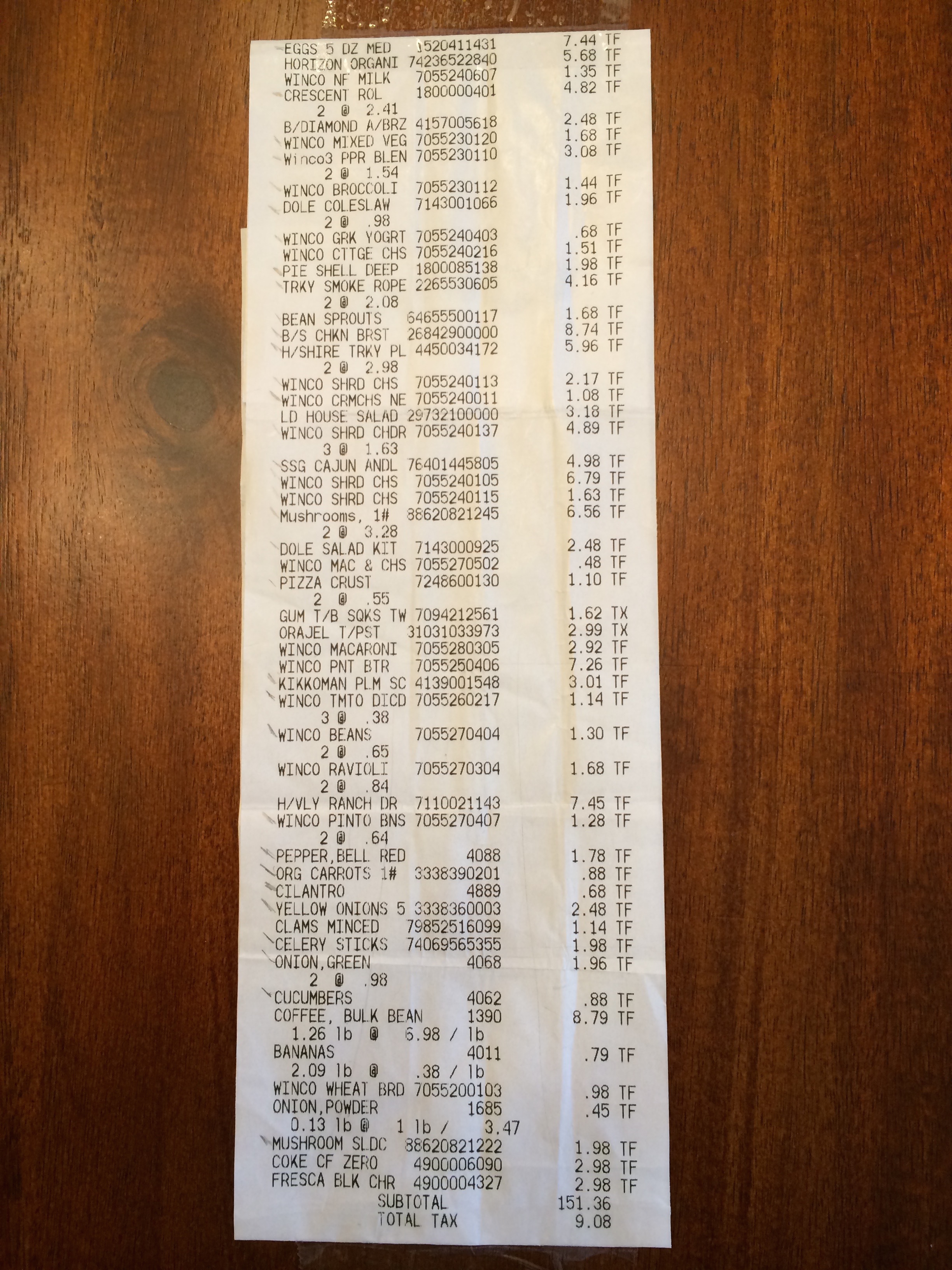
Here’s the receipt I used:

IMG_3497This website provided some python source code to detect edges in the image then the outline of the receipt and transform out any foreshortening or other viewing distortion —

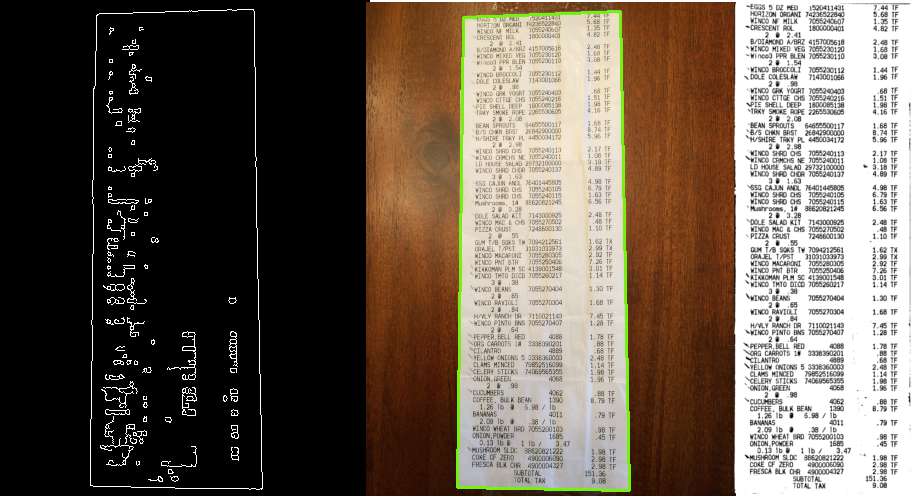
(left) Edge detection, (center) Outline detection, (right) Scanned version.

(left) Edge detection, (center) Outline detection, (right) Scanned version.

To detect edges, the code converts the color image to grayscale and applies the Canny edge detection scheme, which involves applying a Gaussian blur to suppress noise, calculating image derivatives, and looking for large values. The result is shown in the image above on the left, and more details on the algorithm here.

Next, the code finds the outline of the receipt by using the OpenCV‘s findContours, sorts the contours by area, and finds the contour with the largest area but with four vertices.

The code then applies a four-point transformation to warp the receipt to give it a rectangular shape and finally thresholds the grayscale to enhance the contrast. The rightmost panel in the above image shows the final result.

To convert the image to a table of text, I used PyTesseract, which provides OCR capabilities. I installed the package Tesseract using homebrew: “brew install tesseract”.

Then I just grabbed the code from this website to convert the final result into a text table:

st = pytesseract.image_to_string(Image.open(save_filename), config="-psm 6")

The “psm=6” option was required to return the text properly.

Unfortunately, the OCR analysis wasn’t perfect. For example,
IMG_3497_scanned_linewas converted to
‘*CRESgENT R01 1 1800000401 4.82 IF

The prices on all lines came back fine, but the description was often distorted. I decided I cared more about the price anyway. Fortunately, the WinCo receipt had “TF” or “TX” at the rightmost side, so I performed a regex search to find the beginning of that string and grabbed the characters to the left of that.

Finally, I converted the strings into a list of comma-separated values to load into Excel or Google Sheets, leaving a space between the corrupted description and price so I could enter my own description, giving
CRESgENTR0111,  , 4.82

On the off-chance it will be useful to someone else, I’ve posted the code here. Using my script will also require the source code for pyimagesearch, which requires submitting an e-mail address.

Job-In-Industry-After-Your-PhD-pyramid-academiaTo say getting a job in academia is difficult is an understatement — a recent study showed something like one in 8 PhDs will manage to find a faculty position. Fortunately, the overall unemployment rate among STEM PhDs is low, less than 2%, so there’s lots of good alternatives.

For myself, I was fortunate to have lots of support from family, friends, and colleagues, but the academic job search was excruciating. Usually the process of getting a faculty position involves a series of interviews, and among them, the phone interview was particularly stressful for me because it often lacked the non-verbal channel that constitutes a huge fraction of human communicative bandwidth — there’s nothing worse than interrupting one of your interviewers while they’re still trying to get a question out.

In prepping for my phone interviews, I came up with a few strategies that I’ve recently shared with friends who are currently applying for jobs. On the off-chance that they might be helpful generally, I’ve described them below.

Usually, the phone interview involves being asked a series of questions (sometimes scripted) from members of the hiring committee at the department to which you’ve applied. I found that I often struggled to come up with good answers on-the-fly, so, after a few poor performances, I wrote up answers to questions I’d gotten in previous interviews or ones I anticipated. Then I laid them out on tables in a circle around me in my office, so I could easily find an answer to a question, if asked.

I didn’t read the answers verbatim, but the notes were extremely helpful for keeping my answers concise. I found it very easy to ramble on, trying to find the words you think the committee is looking for.

Here’s my list of questions:

  • “How do you think your research program would fit into the department? Who would you work with here?” I had already done extensive research on every faculty member before an interview, even those not in my field of astronomy. Not that you’ll work with them, but unless you’re interviewing with a department that specializes in exactly your field, you’ll probably have some folks from different fields involved with your interviews.
  • “What classes could you teach?” For this question, I sifted through the course catalog so I could point to specific classes they already offered before suggesting new ones, but good chance they’ll ask about both kinds.
  • “Why do you want to work here?” I tried to mention specific things about the school and department, not just answer “because you’re hiring”.
  • “How will you involve students, grads and undergrads, in your research?” I had one or two specific projects in mind, as well as thoughts about how I would support the students’ career development.
  • “What resources will you need to continue your research?” Especially important when I interviewed with smaller places that didn’t have all the resources of a larger place.
  • “What are your public outreach plans?” In my case as an astronomer, I looked up and contacted local amateur astronomical societies to ask about what they were up to and how I might help if I came to town.
  • “How will you fund your research? What specific funding programs could you apply for?” In my case, I’d already applied for several grants and served on grant review panels, so I had some specific ideas.
  • “How would you fit into this town?” Especially important if you’re
    interviewing for a job in a smaller town since they might be concerned you’ll get bored and look for a new job soon after arriving.
  • “Where do you see yourself in five years? What goals do you have for your research/funding/teaching?” Pretty standard, but good to have specific ideas about how your research/teaching might develop. Most people know you can’t know exactly, but they’ll be interested in your broad vision.
  • “How will you balance teaching and research?” I got asked this one a lot, and it’s especially important to have an answer if you haven’t done much teaching before.

You should also have questions for the hiring committee:

  • “How many students are there in the department? What happens to them after they graduate?”
  • “What is there to do around town?/What’s the town like?”
  • “How does the department fit in at the university? How supportive is the university of the department?”
  • “Does the university and department have relationships or collaborations with other nearby schools?”
  • “Where in town do faculty live?”
  • “What is the timeline for hiring decisions?”
  • “Where is the department going in the next few years?” Always fun to turn this question back around on the hirers.

If you’ve got any comments or corrections, please pass them along. Happy Holidays.

UPDATED – 2018 Dec 5:

The illustrious Laura Kreidberg (https://twitter.com/lkreidberg/status/1070389734432743424) suggested adding the question “How would you support students from diverse backgrounds and encourage inclusion in the dept?”. I could imagine that being asked by the interviewers or it might be a good question for an interviewee to ask to gauge a department’s commitment to equity issues.

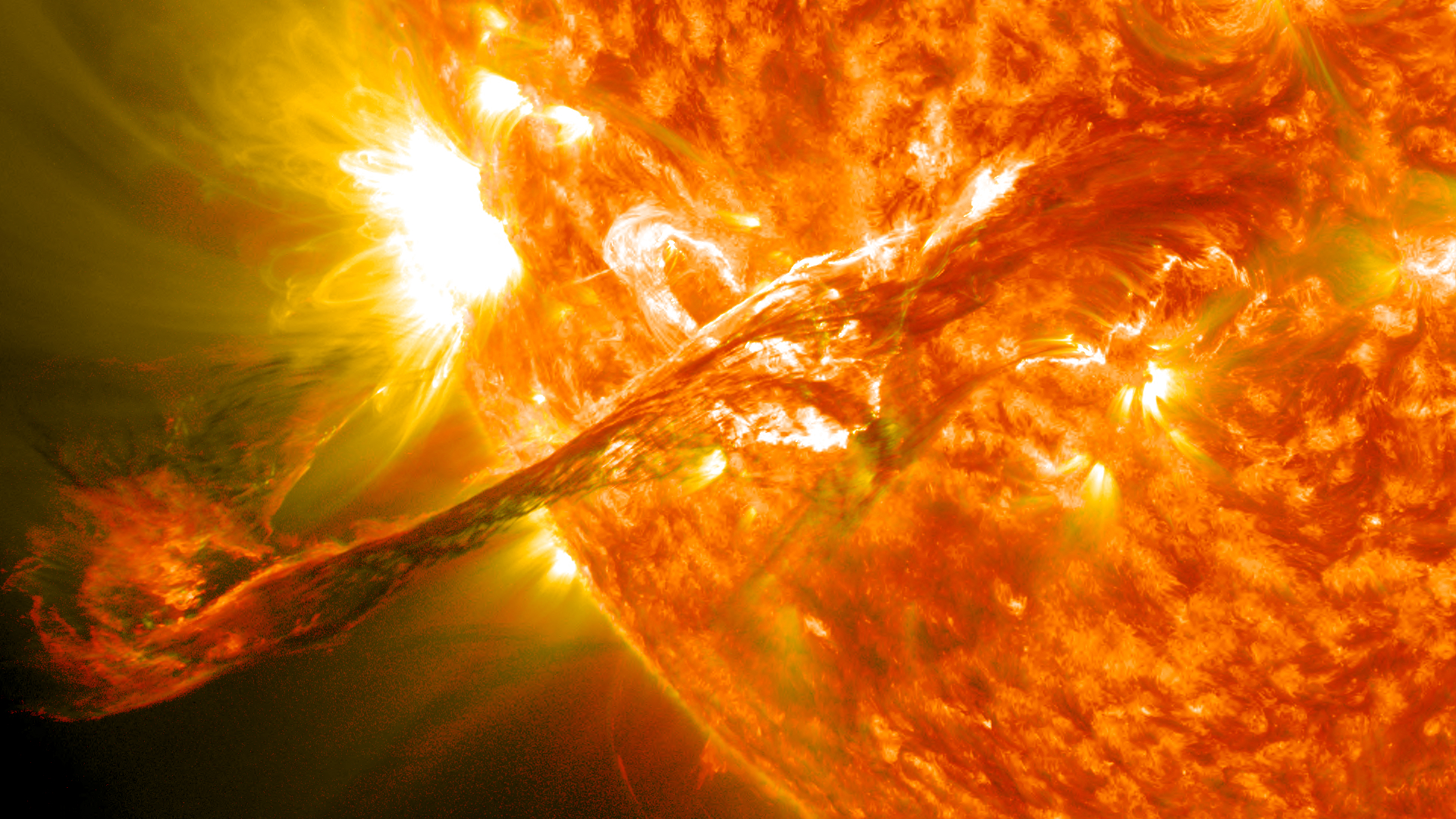
Solar coronal mass ejection. From https://en.wikipedia.org/wiki/Solar_flare.

Solar coronal mass ejection. From https://en.wikipedia.org/wiki/Solar_flare.

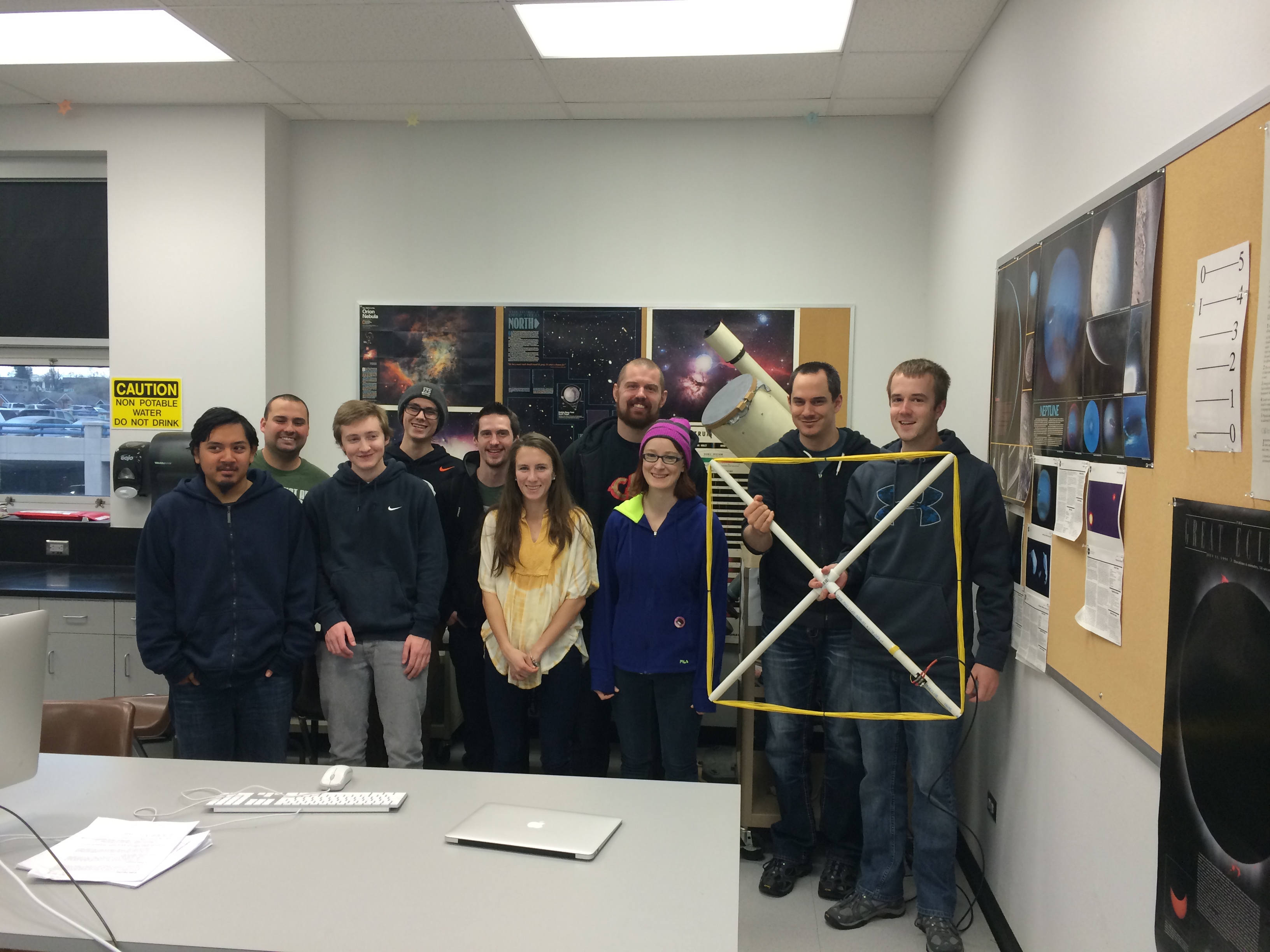
In my PHYS204 – Planetary Astronomy lab today, the students gave final presentations on their semester projects.

This semester is the first time we in the Physics Dept have offered the Planetary Astronomy class, and as an experiment, I asked the students to break into several groups and gave each group a research project. These projects are legitimate research projects, not simplified exercises, so they were quite challenging for the students, who have little to no research experience.

But the students did an excellent job, overcoming a variety of hurdles, from taming stellar evolution models  to wrapping hundreds of feet of wire to build a radio antenna to detect solar flares.

I asked the students to  keep a wiki, describing their projects and progress. Their presentations are also available.

Many of them will continue on into the PHYS205 – Stellar Astronomy class and keep pushing their projects forward.

IMG_3401

Last week, I had a lovely visit to the Astronomy Dept at New Mexico State University in beautiful Las Cruces. I was invited to give one of the dept’s weekly colloquia about our research group’s work on very short-period exoplanets. While there, I talked dust devil science with my host Prof. Jim Murphy, his student Kathryn Steakley, and Lynn Neakrase.

I also enjoyed some excellent Mexican food at the Double Eagle Restaurant, which has been haunted by the ghosts of two young lovers since just after the Mexican-American War.

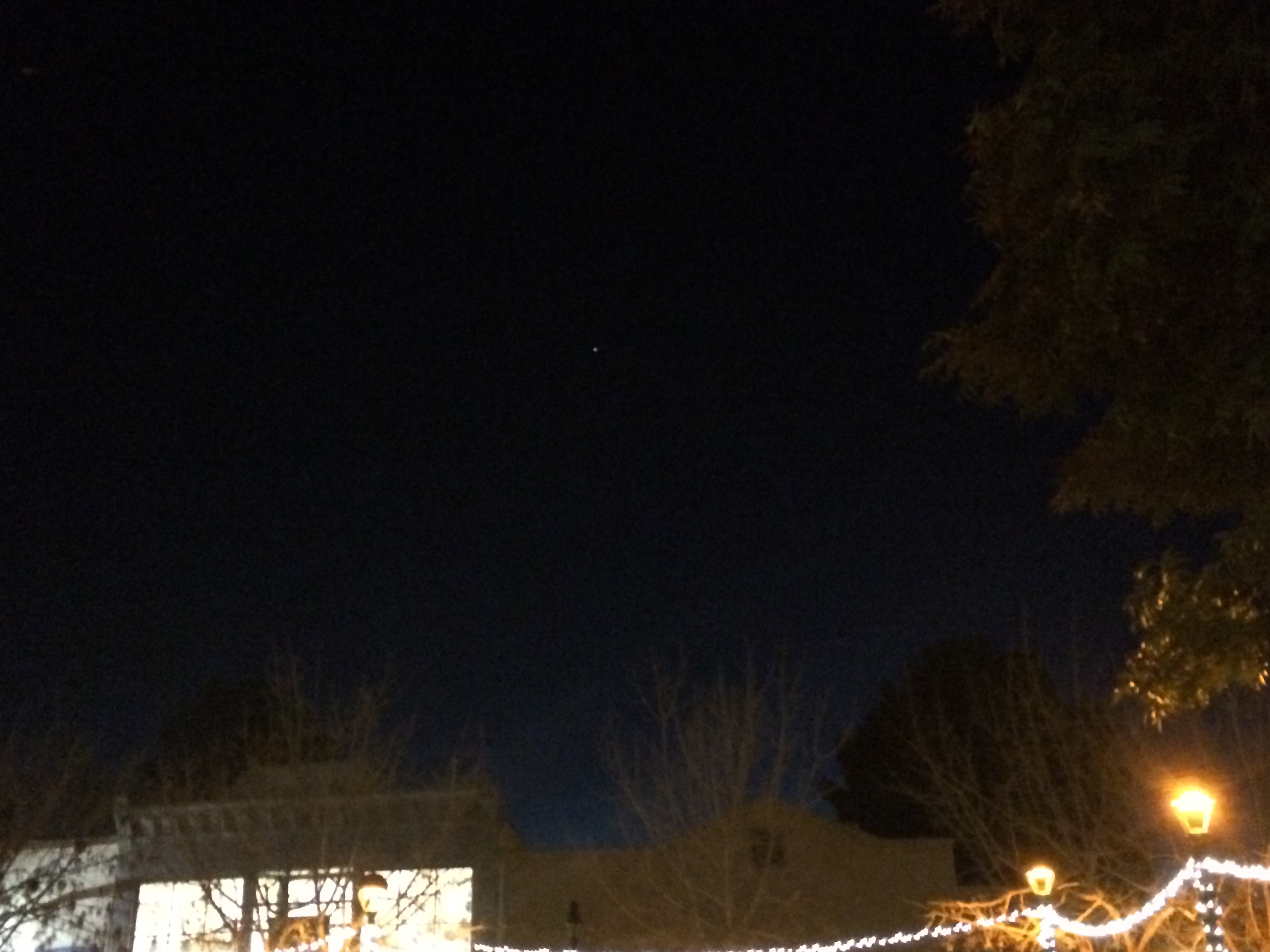
The International Space Station passing over Mesilla, NM on 2015 Dec 4.

The International Space Station passing over Mesilla, NM on 2015 Dec 4.

Just before dinner, the ISS also passed directly over our heads, and I got a very poor photo of it (left).

So, all in all, a great visit.


I’ve posted my abstract and presentation below.

On the Edge: Exoplanets with Orbital Periods Shorter Than a Peter Jackson Movie


From wispy gas giants to tiny rocky bodies, exoplanets with orbital periods of several days and less challenge theories of planet formation and evolution. Recent searches have found small rocky planets with orbits reaching almost down to their host stars’ surfaces, including an iron-rich Mars-sized body with an orbital period of only four hours. So close to their host stars that some of them are actively disintegrating, these objects’ origins remain unclear, and even formation models that allow significant migration have trouble accounting for their very short periods. Some are members of multi-planet system and may have been driven inward via secular excitation and tidal damping by their sibling planets. Others may be the fossil cores of former gas giants whose atmospheres were stripped by tides.

In this presentation, I’ll discuss the work of our Short-Period Planets Group (SuPerPiG), focused on finding and understanding this surprising new class of exoplanets. We are sifting data from the reincarnated Kepler Mission, K2, to search for additional short-period planets and have found several new candidates. We are also modeling the tidal decay and disruption of close-in gaseous planets to determine how we could identify their remnants, and preliminary results suggest the cores have a distinctive mass-period relationship that may be apparent in the observed population. Whatever their origins, short-period planets are particularly amenable to discovery and detailed follow-up by ongoing and future surveys, including the TESS mission.