Flux time series for Boyajian's star, showing the 4-year Kepler observations. From Boyajian et al. (2016).

Flux time series for Boyajian’s star, showing the 4-year Kepler observations. From Boyajian et al. (2016).

At journal club today, we discussed a recent study from Jason Wright and Steinn Sigurdsson at PSU astronomy on a strangely dimming star observed by the Kepler mission.

The star has been called the WTF star (‘Where’s the Flux?’), Tabby’s Star (and probably a few more colorful things by perplexed astronomers), but Wright and Sigurdsson invoke the long astronomical tradition of naming noteworthy stars with their discoverers’ last names — they call it Boyajian’s Star, after Dr. Tabetha Boyajian, astronomer royale at Yale.

The strange thing about Boyajian’s star is that the Kepler mission observed the star to dim dramatically several times over a few years, dropping by 20% over the course of a few days several times over a few hundred days. That would be like having a partial solar eclipse that lasted 96 hours every few months. Even stranger, recent analyses of 100+ year old photographic plates suggest the star has been dimming, unnoticed, for a long time.

Various explanations for this strange behavior have been proposed, from enormous swarms of comets obscuring the star to alien megastructures, and Wright does a very good job exploring the different possibilities on his blog.

But as usually happens in astronomy, the most exciting explanations are the least likely (probably not an alien Dyson sphere), and Wright and Sigurdsson favor the idea that some sort of interstellar material between the Earth and Boyajian’s star is obscuring the star. Wright and Sigurdsson point out that, by measuring the distance to the star, the Gaia mission will help us resolve the mystery.

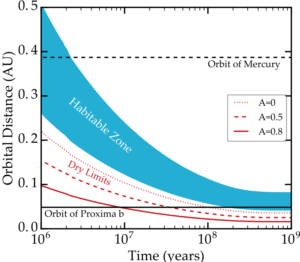
Fig. 11 from Barnes et al. (2016) showing evolution of the HZ (blue region) of Proxima Centauri, along with the orbits of Proxima Centauri b (solid line) and Mercury (dashed line).

Fig. 11 from Barnes et al. (2016) showing evolution of the HZ (blue region) of Proxima Centauri, along with the orbits of Proxima Centauri b (solid line) and Mercury (dashed line).

As a follow-up to last week’s Proxima Centauri b event, we discussed a recent analysis of the planet’s habitability by Prof. Rory Barnes and colleagues in our weekly journal club.

In this paper, the authors consider a very wide range of evolutionary scenarios for Proxima b to explore the resulting range of outcomes and decide how habitable the planet is, really.

They incorporate lots of potentially important effects, including the evolution of the host star’s luminosity and its influence on the planet’s surface temperature.

M-dwarf stars, like Proxima Centauri, get dimmer early in their lifetimes. As a consequence, the surface temperature of a planet orbiting such a star can drop over time.

Or, put another way, the habitable zone (HZ) around the star can move inward, meaning planets that start out interior to the HZ (i.e., planets that might be too hot to be habitable) may eventually enter the HZ.

Figure 11 from Barnes et al. (2016) shows that this is probably what happened to Proxima b: it started out way too hot for habitability and, as its host star dimmed, it entered the HZ.

As Barnes et al. show, such a history could potentially drive away all the planet’s water (assuming it started with any), leaving behind a dried husk of a planet. But the fact that the planet is CURRENTLY in the HZ could fool us into thinking it’s habitable.

This result shows that planetary habitability is a complicated idea and that the current conditions on a planet can depend in a complex (and hard-to-determine) way on its history. Time (and lots more data) will tell whether Proxima b is actually an extraterrestrial oasis for life or a barren wasteland.

IMG_0308We had a brilliant time on Friday, talking about the recent discovery of Proxima Centauri b, even though the clouds prevented us from star-gazing. Lots of great questions from the audience, with some really good ones from the youngest audience members.

Thanks to my student volunteers to sticking it out and to KBSX for helping us advertise the event. Most of all, thanks to our wonderful audience for coming.

For the rest of the semester, Boise State Physics will host public star-gazing events on the first Friday of every month at 7:30p, so the next one will be on Oct 7. Stay tuned for details!

With the recent discovery of an Earth-like planet around the star Proxima Centauri, the nearest habitable world beyond our Solar System might be right on our doorstep. Celebrate this revolutionary find with Boise State’s Physics Dept on Friday, Sep 2 from 7:30p till 12a.

The event will kick off in the Multi-Purpose Classroom Building, Lecture Hall 101 (right across the street from the Brady Street Parking Garage) on Boise State’s campus with a public talk on the planet’s discovery from Prof. Brian Jackson.

Then at 8:30p the event will move to the Boise State quad (next to the Albertson Library and near the center of campus) the top of the Brady Street Garage (just off University Drive near Capitol), where telescopes will be set up to view Mars, Saturn, Uranus, and Neptune.

More information is available at bit.ly/BSUProximaEvent or from Prof. Brian Jackson (bjackson@boisestate.edu — 208-426-3723 — @decaelus).

IMG_4721

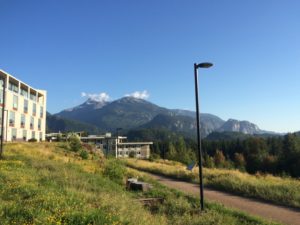
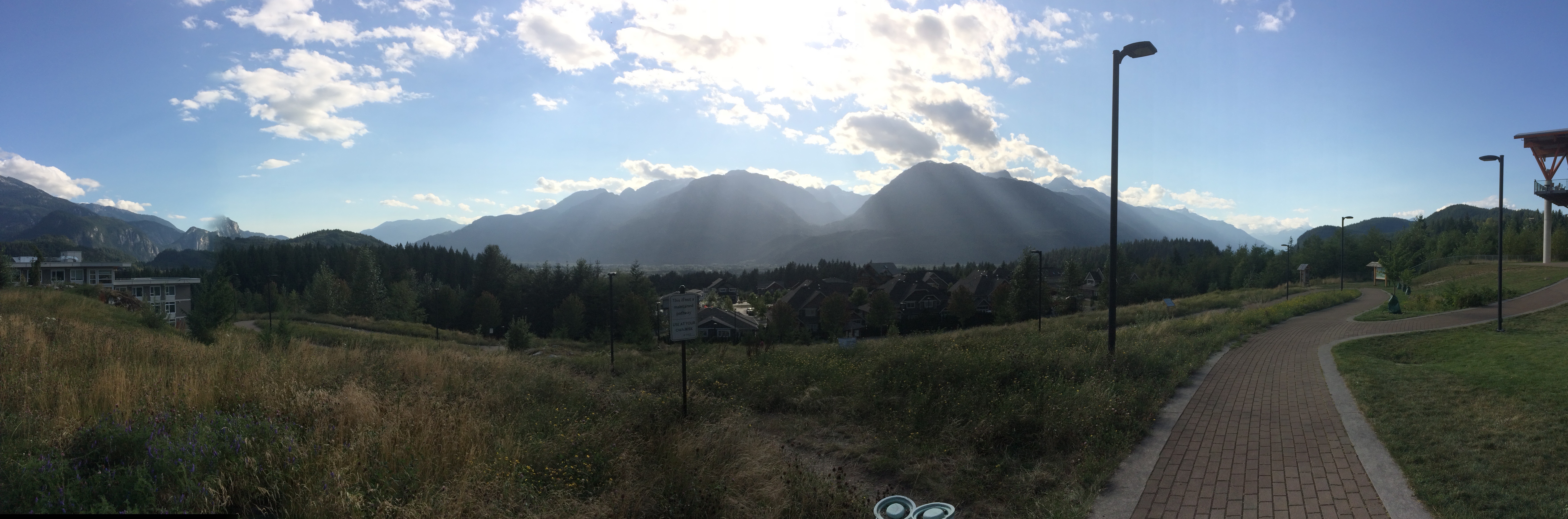
Beautiful Sky Pilot Mountain, south of Quest University.

The last two days of Exoclimes 2016 were as engaging as the first two — lots of great talks, discussion, and coffee break snacks.

The day 3 talks that really grabbed me were the first talks, focused on atmospheric mass loss from exoplanets since I’m currently working on that problem myself.

Ruth Murray-Clay gave a nice review talk about the variety of different mechanisms and regimes for atmospheric escape, while Eric Lopez suggested that, because escape should preferentially remove lighter elements from atmospheres, short-period exoplanets might retain water-rich envelopes, which could help us constrain their atmospheric compositions. Patricio Cubillos picked up on an idea previously explored by Owen and Wu and suggested that we could use mass-loss considerations to constrain the overall properties (density, etc.) of some short-period planets.

Other talks that stood out for me on day 3 included Eric Gaidos‘s talk about looking for geoengineering efforts by alien civilizations and Mateo Brogi‘s talk about measuring the spin rates of distant exoplanets, including GQ Lup b, a brown dwarf/high-mass exoplanet with a spin period of 3 days.

Day 4 of the conference whizzed by with a variety of talks regarding clouds and hazes in exoplanet atmospheres. Sarah Hörst taught us we should use the term ‘aerosol‘ instead of ‘clouds and/or hazes’ (since we’re not sure which of the two we’re seeing in exoplanet atmospheres).

Joanna Barstow and I rounded out the conference. She talked about her work analyzing exoplanet spectra and constraining aerosol (not clouds and/or haze) properties. Drawing upon the liturgical texts from the dawn of exoplanet science, I talked about my group’s work looking at Roche-lobe overflow of hot Jupiters (I’ve posted my talk below).


The first and second days of the Exoclimes conference were just excellent.

The indefatigable Andy Ingersoll opened the conference with a brilliant review talk comparing the state of exoplanet science to the development of solar system science over the centuries, and he suggested in exoplanets we are at the same point solar system astronomers were 50 years ago.

As the day progressed, we toured the universe, learning about the connection between a planet’s mass and composition, visiting Saturn’s moon Titan, and exploring the atmospheres of exoplanets, both via transit and by directly imaging the planets.

Dinner at Howe Sound Pub for a pint of their Super Jupiter ISA capped off the first day of the conference.

IMG_4657

The second day started with a focus on the connections between geology, life, and climate for Earth and how we might expand that understanding to exoplanets.

One talk that particularly stuck out for me was Robin Wordsworth’s talk about how the eruption of a large igneous province in Canada 720 million years ago (the Franklin LIP, as it’s called) may have catalyzed the Sturtian Glaciation, which provided a cautionary tale against making simple connections between the insolation a planet receives and its climate, the usual approach in exoplanetary astronomy.

After a visit to the Sea-to-Sky Gondala around lunch time and some spectacular views, the conference reconvened to discuss planets around low-mass stars. Since low-mass or M-dwarf stars are so small (less than half the mass of our Sun), finding and characterizing planets around them is a lot easier than for stars like our Sun. But M-dwarfs can be very different from Sun in many ways, and so it’s hard to know whether Earth-like planets around these stars would actually be Earth-like.

For instance, Antigona Segura discussed the effects of M-dwarf flares on the atmospheres of Earth-like planets and showed the flares can induce complex (and even potentially fatal) chemical changes in the atmospheres. Since M-dwarfs flare much more frequently than the Sun, it’s possible that life might be challenged on a planet orbiting an M-dwarf.

IMG_4684

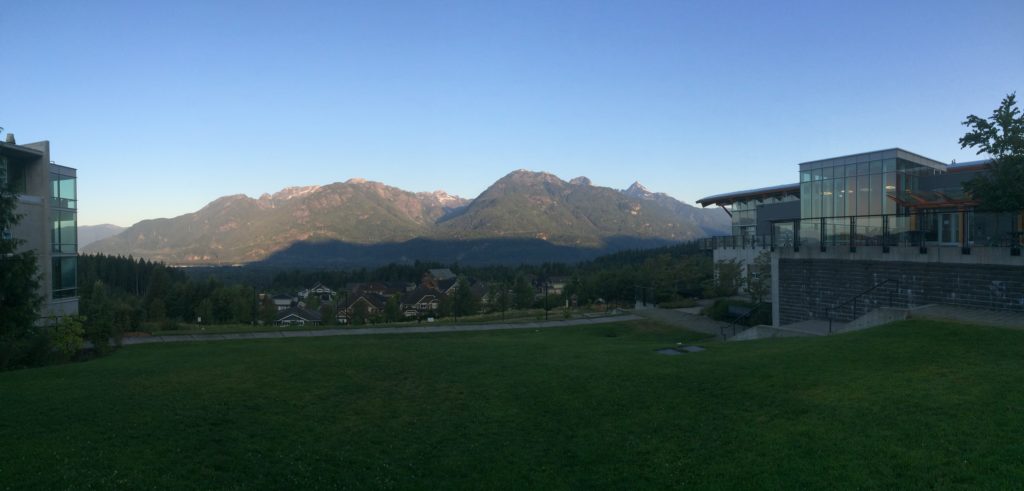
I just arrived at Quest University in beautiful Squamish, British Columbia (or Sḵwx̱wú7mesh as it’s originally pronounced — the ‘7’ represents a glottal stop) for the start of the Exoclimes Conference, a biennial astronomy conference focused on the diversity of planetary atmospheres. Lots of amazing talks scheduled this week from the world’s leading experts. I can’t wait.

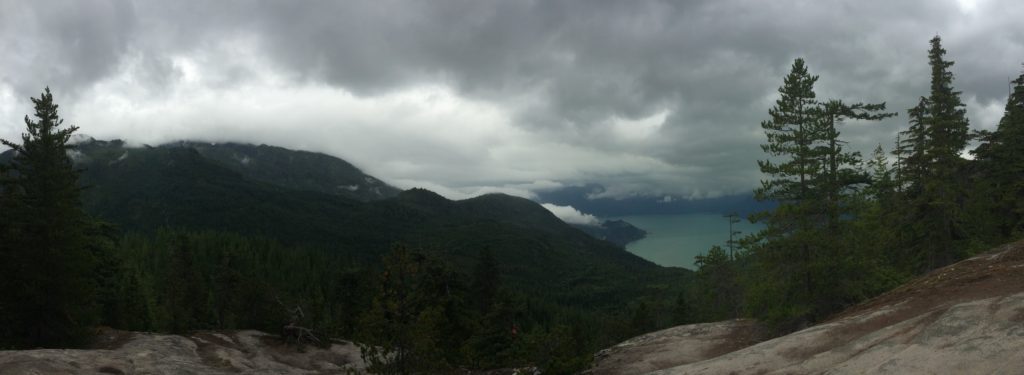
Couldn’t ask for a more inspiring locale.

IMG_4645

ISAS_logoOn Friday, we welcomed visitors from among the Idaho Science and Aerospace Scholars program. This is an Idaho Science Technology Engineering Math (STEM) Program for rising high school seniors and provides an opportunity to learn in-class and hands-on during the school year and summer academy. The students spent most of their week at Boise State but also had a fun trip to NASA Ames to explore the facilities there.

In the Physics Dept., we hosted a group of 12 students from among the ISAS crowd, all of whom specifically requested to learn about astronomy during their Boise State visit. The students came from all over Idaho, including local Boiseans.

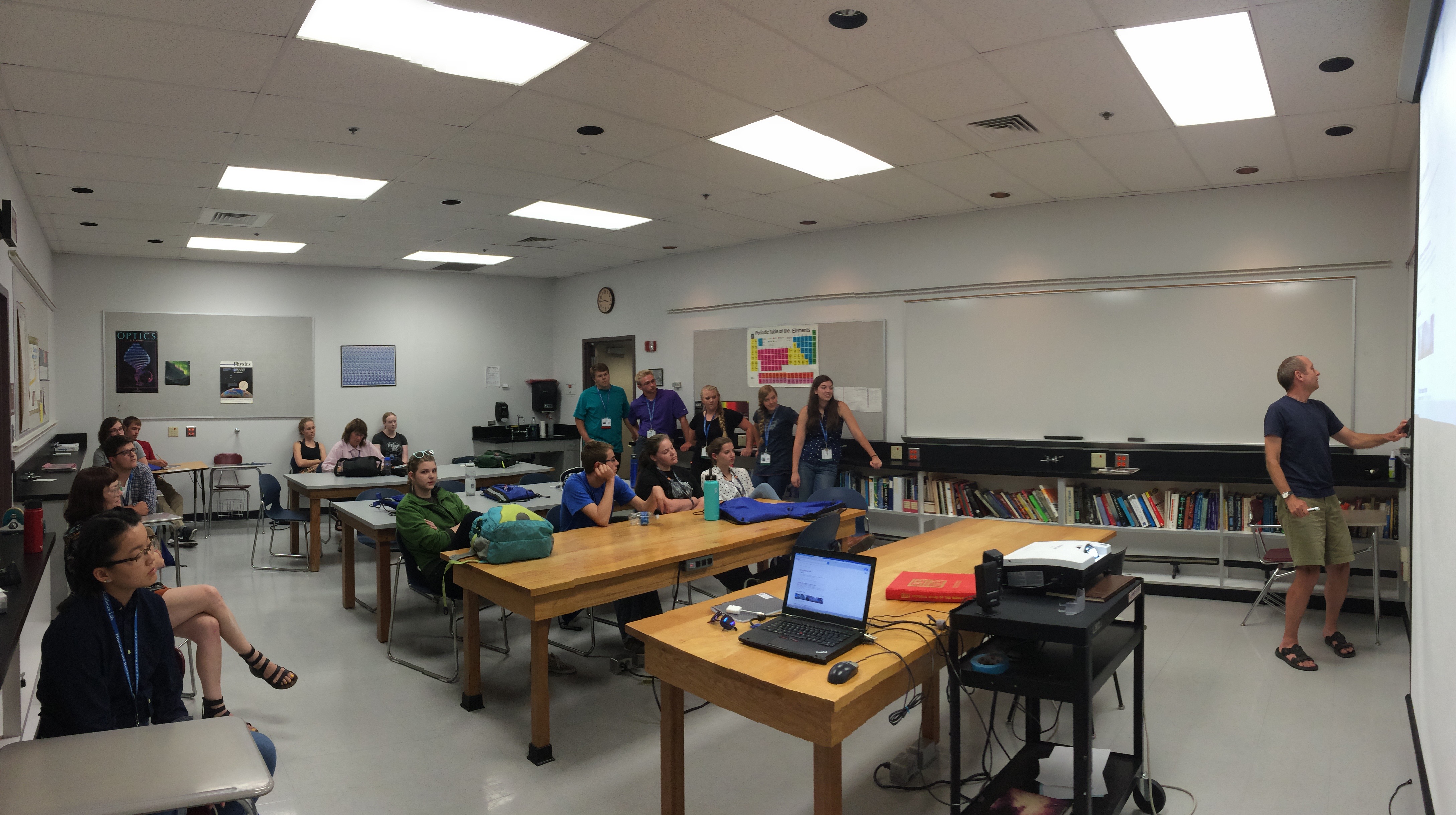
They spent the first hour of their visit learning about the physics research going on at Boise State and then exploring the night sky using a sky simulator like stellarium.

Never look at the Sun with the appropriate equipment!

Never look at the Sun with the appropriate equipment!

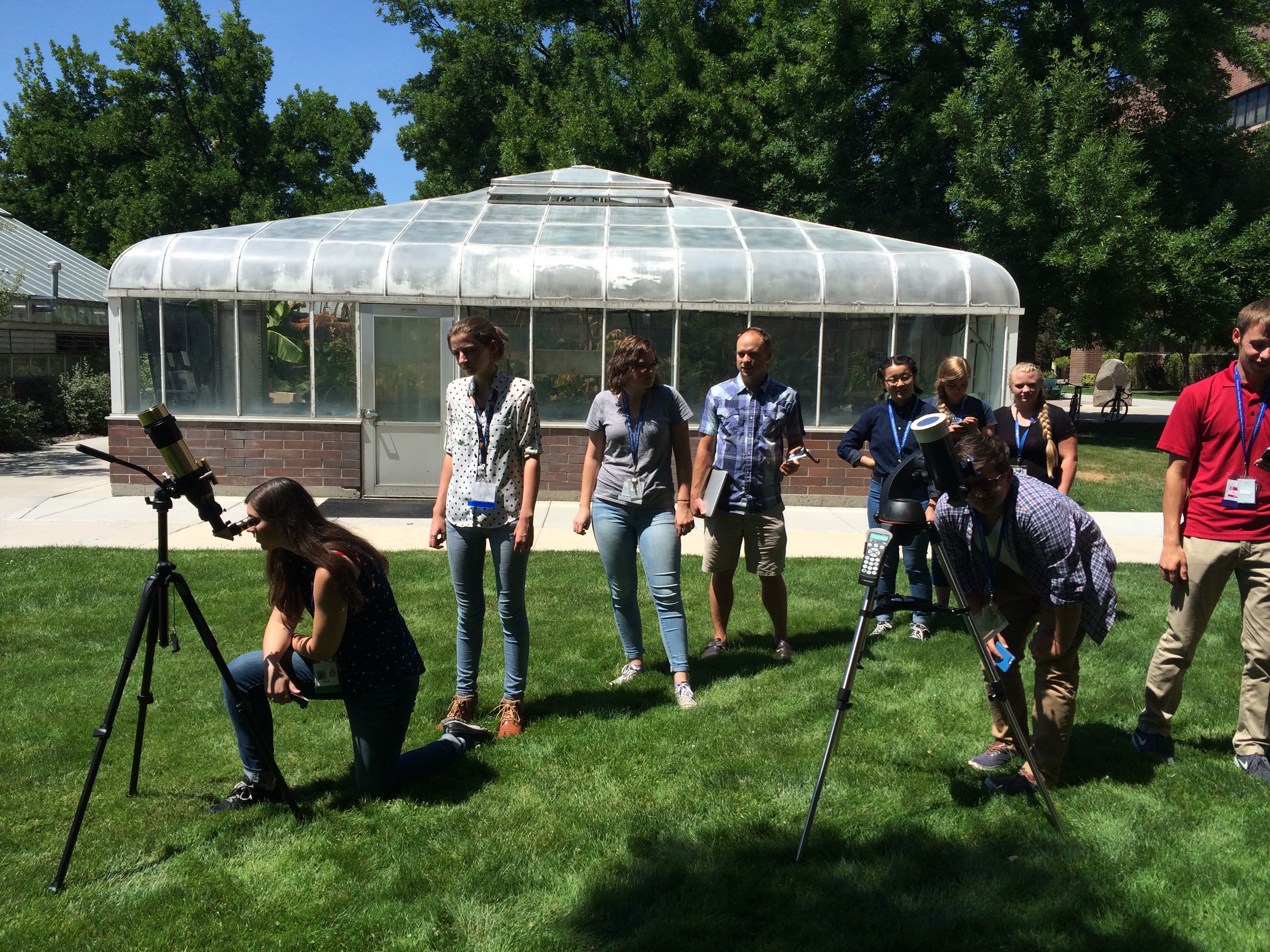
Then we went outside to look at the Sun using our solar telescopes. Fortunately, there was a beautiful solar filament strewn across the face of the Sun.

Dr. Josh Bandfield explains thermal conductivity and how we can use it to learn about Martian volcanoes.

Dr. Josh Bandfield explains thermal conductivity and how we can use it to learn about Martian volcanoes.

We retreated from the 100-degree temperatures to join my research group’s weekly meeting, where planetary scientist Josh Bandfield regaled us with stories of Martian volcanology and recurring slope lineae.

Although the students were pretty tired by the end, they seemed very enthusiastic, lobbing a wide variety of questions at Josh and engaging in a spirited conversation about water and life on Mars.

Thanks for visiting, ISAS!

IMG_4527

Welcome to Jupiter!

The Juno Mission arrived safely in orbit around Jupiter on Monday night. A group of more than 200 Boiseans watched NASA TV’s live-stream of the insertion at our Jupiter-viewing event on Boise State’s campus.

The event was tremendous, and I was very gratified with all the enthusiasm of our local astrophiles. Special thanks to the Boise Astronomical Society and to my student volunteers for helping out.

Several folks asked about donating to support these events. If you want to donate, visit the following link — http://bit.ly/DonateToBSUAstro.

Thanks!


Thinking,_Fast_and_SlowWell, this book has more than 2,000 reviews on Amazon, so I’m not sure what I’m going to add by writing another one, but here goes.

Thinking, Fast and Slow journeys through Daniel Kahneman‘s extensive work on the psychology of decision-making, its relation to economics, and the distorting effects of memory. The book is chockful of fascinating and, for me at least, reassuring insights into the human mind.

According to Kahneman’s work, when it comes to decisions, our mind consists of two systems. One is good at drawing on past experience to continuously (and involuntarily) make quick evaluations but has pretty limited abilities when it comes to statistical inference or basic math. The other system is much better at complex evaluations but is lazy and usually just follows the input of the first system.

The daily grind of thinking through complex problems for me feels like turning a rusty crank, so I was relieved to hear experimental psychology has revealed this to be a common struggle.

After discussing the two systems, Kahneman describes his work displacing one of the central tenets of economics, utility theory developed by none other than Daniel Bernoulli, which assumes that humans are logical and rational. Kahneman’s (and many others’) work showed, in fact, we are prone to all sorts of misunderestimations. By way of illustration, what if you had a 100% chance to win $500,000 or a 98% chance to win $520,000? Bernoulli says you would pick the latter option.

Finally, Kahneman covers his work on the disconnect between experiences and memories of experiences. Turns out that, when we recall a painful experience, the very last part of the experience can completely discolor the memory. One example discussed involved the pain experienced during colonoscopies (which took place during the 90s when these things still hurt a lot).

Patients who had shorter colonoscopies that ended with a peak in pain described the experience as much worse than those who had longer, equally painful colonscopies but which ended with a tapering of the pain. Objectively, the latter group had a worse experience, but the tapering of pain made their memories less bad.

This discrepancy has some interesting implications for what we mean by the word “happiness” — are we referring to satisfaction in the moment or contentment during reflection upon our memories? Kahneman has a neat TED talk on this topic.

Kahneman illustrates many of the results with personal and experimental anecdotes, from the UCLA class that rated a course more highly after listing all its faults to the 1952 conference of economists who failed a basic test of economic rationality.

One of the experiments appealed to me especially because it was something I could replicate. Apparently, your pupils dilate when you’re engaged in a challenging mental task — the more challenging, the more dilated. So I tried to see if that was true for me.

Below is a gif of me staring into my iphone. The top panel shows my pupil as I thought about eating ice cream, the bottom as I multiplied 13 by 37 in my head. The bottom pupil is slightly but discernibly larger, about 1% larger on average.

cQhIlkn - Imgur

The only criticism I have of the book — Kahneman repeats himself a lot. Most of the important results are illustrated several times and from one chapter to the next. Maybe, as a psychologist, Kahneman believed that driving a point home required repetition, but I think the book could have been just as interesting with about half the pages.

In any case, definitely worth the extended read to learn about the inner workings of your mind and maybe how to avoid common pitfalls in decision-making.


So why is the second choice the rational one? With a 98% chance of winning $520,000, on average, you would win $509,600. If you had 100 chances to try this bet, it’s obvious which one you should choose, but it’s hard to convince yourself not to go for the sure thing with only one chance. That’s human psychology for you.