Kepler mission

All posts tagged Kepler mission

At Friday’s journal club, we discussed on two papers. The first, Webber et al. (2015), investigated the effects of clouds on theĀ phase curves for hot Jupiters. Webber et al. found that planet’s phase curve may depend sensitively on whether clouds are distributed uniformly or heterogenously throughout the atmosphere. They also found that the amount of light reflected by an exoplanet depends on the composition of the clouds — clouds made of rocky minerals like MgSiO3 and MgSi2O4 are much brighter than Fe clouds.
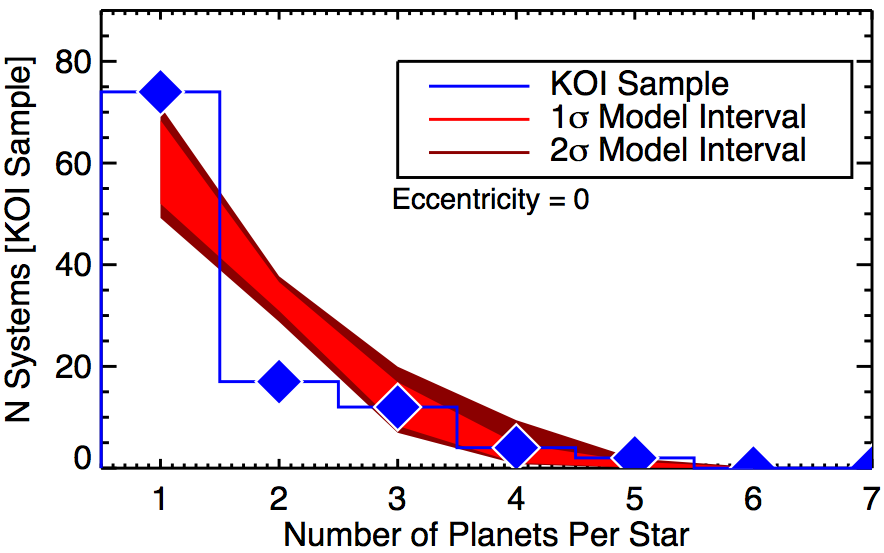
From Ballard & Johnson (2015), this figure compares the number of stars with a certain number of planets detected by Kepler (blue diamonds) to our expectations (in red) if single planet systems actually had more planets hidden from Kepler's view. The disagreement between the blue and red curves suggests that many of those apparently singleton planets really are only children and single and multi-planet systems are inherently different.

From Ballard & Johnson (2015), this figure compares the number of stars with a certain number of planets detected by Kepler (blue diamonds) to our expectations (in red) if single planet systems actually had more planets hidden from Kepler’s view. The disagreement between the blue and red curves suggests that many of those apparently singleton planets really are only children and single and multi-planet systems are inherently different.

The second paper, Ballard & Johnson (2014), investigated the frequency of exoplanets around M-dwarf stars observed by the Kepler mission. Because the Kepler mission found planets by looking for transits, there’s always a good chance that a system with only one detected planet actually has more that just don’t pass in front of their host star as seen from Earth. But we know exactly how to account for this geometric effect.

By accounting for it, Ballard and Johnson showed that Kelper actually found a lot more systems with only one planet than we would expect if there were just more planets in those systems hidden from Kepler‘s view. So there are two distinct kinds of planetary systems around M-dwarfs: those with only one planet (or possibly several planets with large mutual inclinations) and those with several.

Why the difference? Ballard and Johnson find tantalizing hints thatĀ  stars hosting only one detected planet are older on average. One simple explanation: given enough time, systems with many planets become unstable, and the lonely planets we see today originally had siblings that were gravitationally cast out of the system, to wander the void between the stars. Or the siblings were accreted by their parent stars, like Saturn eating his children. Along with many others, this study helps show that planetary systems can be much more violent places than astronomers originally thought.

Journal club attendees included Jennifer Briggs, Nathan Grigsby, Jared Hand, Tanier Jaramillo, Emily Jensen, Liz Kandziolka, and Jacob Sabin.
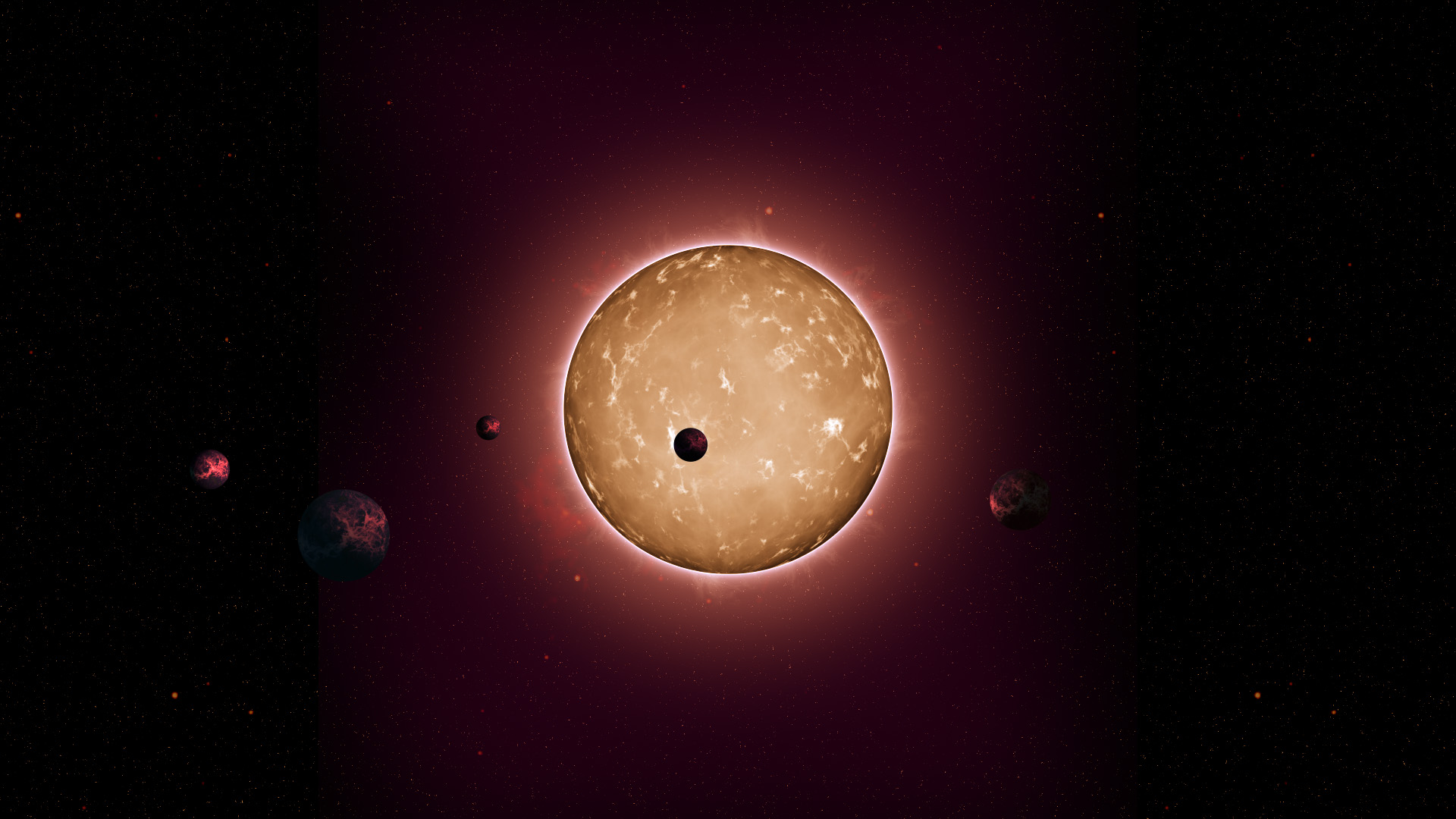
The tightly packed system, named Kepler-444, is home to five small planets in very compact orbits. The planets were detected from the dimming that occurs when they transit the disc of their parent star, as shown in this artist's conception. From http://www.nasa.gov/ames/kepler/astronomers-discover-ancient-system-with-five-small-planets/.

The tightly packed system, named Kepler-444, is home to five small planets in very compact orbits. The planets were detected from the dimming that occurs when they transit the disc of their parent star, as shown in this artist’s conception. From http://www.nasa.gov/ames/kepler/astronomers-discover-ancient-system-with-five-small-planets/.

In journal club on Friday, we discussed a fascinating paper from Campante and colleagues announcing discovery of one of the oldest planetary systems ever discovered — Kepler-444. The system comprises five planets, ranging from roughly Mercury- to Venus-sized with orbital periods from about 3 to 9 days.

Studying the frequencies of oscillations within the K-dwarf host star (an approach known as asteroseismology), Campante et al. estimate the host star, and therefore probably the planets, is about 11 billion years old, almost as old as the Milky Way galaxy itself.

To put that age into perspective, by the time our solar system formed, about 5 billion years ago, the Kepler-444 was already a billion years older than our solar system is now.

The existence of such an old system tells us that rocky planets began forming almost as soon as the Milky Way itself formed, which allows for the exciting possibility of very ancient life in the galaxy.

Present at journal club were Jennifer Briggs, Trent Garrett, Nathan Grisgby, Emily Jensen, Liz Kandziolka, Brenton Peck, and Jacob Sabin.

From https://emps.exeter.ac.uk/physics-astronomy/research/astrophysics/phd-opportunities/modelling-shock-waves/.

From https://emps.exeter.ac.uk/physics-astronomy/research/astrophysics/phd-opportunities/modelling-shock-waves/.

On Friday, everyone in our research group gave a little update on what they’ve been up to.

Liz and Jennifer talked about Parmentier et al.’s (2013) paper on the meteorology of hot Jupiters and how condensates are transported throughout these dynamic atmospheres.

Emily talked about working through the first few chapters of Murray & Dermott’s classic Solar System Dynamics. She will eventually study the orbital dynamics of systems of exoplanets very close to their host stars.

Brenton discussed his reading of Balme & Greeley (2006) on dust devils in preparation for working with me on terrestrial and Martian dust devils. A very exciting possibility, Brenton and the rest of the group said dust devils are common just south of Boise. Good chance we can do some in-situ monitoring locally.

Nathan spoke briefly about looking for more very short-period planets using data from the Kepler and K2 missions.

In attendance were Liz Kandziolka, Jennifer Briggs, Emily Jensen, Brenton Peck, Nathan Grigsby, Trent Garrett, and Tiffany Watkins.