close-in exoplanets

All posts tagged close-in exoplanets

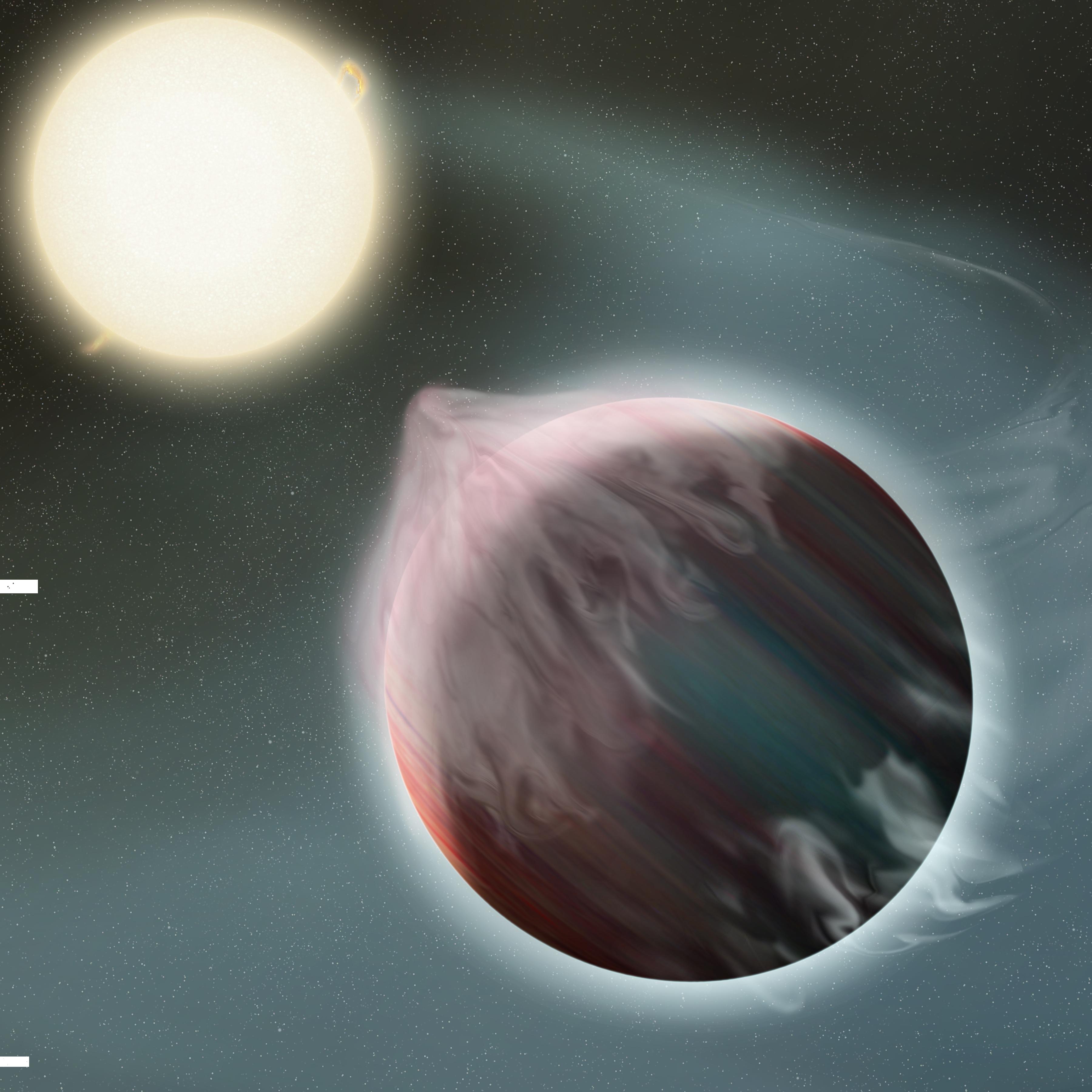
Artist’s conception of a hot Jupiter shedding mass.

Tidal interactions between short-period exoplanets and their host stars drive orbital decay and have likely led to engulfment of planets by their stars. Precise transit timing surveys, with baselines now spanning decades for some planets, are directly detecting orbital decay for a handful of planets, with corroboration for planetary engulfment coming from independent lines of evidence. The large number of possible targets (hundreds of planets) means it is not feasible to continually observe all planets that might exhibit detectable tidal decay. For this work, we explored the properties of an exoplanet system that can maximize the likelihood for observing tidally driven transit timing variations.

Research Publications

  • Jackson et al. (2023) “Metrics for Optimizing Searches for Tidally Decaying Exoplanets.” Astronomical Journal.
Artist’s conception of a hot Jupiter shedding mass.

Though worlds in our Solar System have been rocked by geological upheavals, mountain-shattering impacts, and climatic disasters throughout their histories, we think they have remained essentially intact. The planets we see today have been here since they first coalesced 4.5 billion years ago. But that long-lived stability may be the exception and not the rule. Indeed, astronomers now know many planets face destruction through what’s called tidal disruption, and recent searches have revealed direct evidence of the final moments for these doomed worlds.

Continue Reading

Evidence of Long-term Period Variations in the Exoplanet Transit Database (ETD)

https://iopscience.iop.org/article/10.3847/1538-3881/ac959a

An artist’s concept of the hot-Jupiter exoplanet WASP-12b. Image credit: NASA / ESA / G. Bacon, STScI / C. Haswell, Open University.
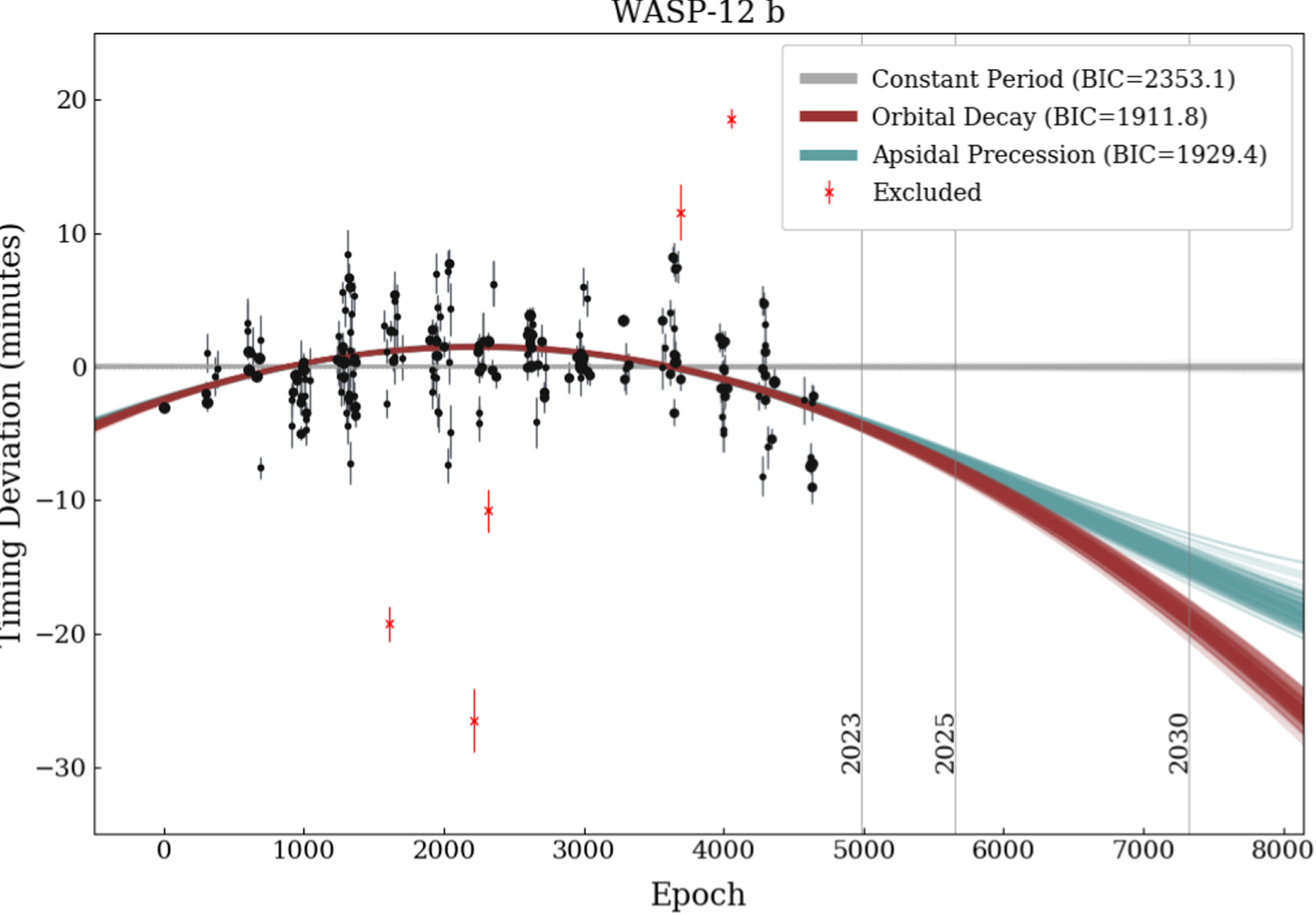
Transit timing for WASP-12 b from Hagey et al. (2022).

able 4. Model Comparison for Secondary Analysis—Data Variance for ETD Transit Times

TargetDecay Rate1σ Unc.BIClinearBICdecayΔBIC
 (ms yr−1)(ms yr−1)   
WASP-12 b−34.84.9223.7202.7−21.0
HAT-P-19 b−641780.678.2−2.4
TrES-1 b−16.03.773.368.3−5.0
WASP-4 b−6.72.462.662.70.1
TrES-2 b−22.08.0159.0160.31.3
TrES-5 b−2511118.3120.52.2
HAT-P-32 b−321295.596.71.2
WASP-10 b−10.17.6131.6135.53.9
WASP-43 b3.54.0126.5130.94.4
TrES-3 b0.011.9227.8233.15.3
Model comparison of the results from the reduced data of the top 10 systems after replacing the ETD transit center uncertainties with the standard deviation of the nominal timing residuals. A negative ΔBIC value favors the orbital decay model. From Hagey et al. (2022).

The Tony and Pulitzer Prize-winning musical “Rent” opens with a lie.

Contrary to popular opinion, there are NOT 525,600 minutes in a year. That’s because the Earth takes more than 365 days to circle the Sun and come back to the same place (although defining “the same place” is non-trivial). Modern calendar systems assume 365.2422 days in a year, which works out to 525,948.768 minutes — it doesn’t quite roll off the tongue the same way, but it does give you almost 349 more seasons of love.

But that’s just for Earth. If you lived on one of the most recently discovered exoplanets, you would have fewer than a thousand love seasons. That’s because this planet, the ultra-hot Jupiter TOI-2109 b, circles its star once every 16 hours. But the fate of TOI-2109 b-ian lovers is sealed not just by their short seasons but because their planet is doomed, a sad destiny foretold by a French physicist who saw his own world rent to pieces.

Continue Reading
Illustration of the hot-Jupiter exoplanet WASP-12b. From https://www.nasa.gov/mission_pages/hubble/science/planet-eater.html.

WASP-12 b is in trouble. A giant ball of mostly hydrogen, the planet circles its star once every 25 hours. The resulting intense stellar irradiation drives super-sonic storms of plasma around the world, and the atmosphere has so much thermal energy, in fact, that some of it is escaping into space. But it gets worse. WASP-12 b is steadily tumbling toward its host star, and astronomers expect that, within a few million years, the star will eat the planet.

WASP-12 b is one of a few hundred hot Jupiters, gas giants very close to their stars, and so far, it’s the only one we have confirmed in a death spiral. Many other hot Jupiters probably are probably also condemned, but how many more can we find perched on the edge of destruction? And, come to think of it, how did the planets find themselves in such precarious positions in the first place? To answer these questions, astronomers need to understand how many hot Jupiters there are out there and how many more are left to be found.

Continue Reading
Jacob Peter Gowy’s The Flight of Icarus. From https://en.wikipedia.org/wiki/Icarus.

Daedalus’ situation was desperate: to keep the secret of the labyrinth, King Minos had trapped its creator, Daedalus, and his son Icarus in the maze with the man-eating Minotaur. In a fit of inspiration, Daedalus crafted two pairs of wings of feathers and wax. As they flew out over the Aegean Sea, Daedalus admonished Icarus not to fly too close to the Sun or else the wax holding the feathers would melt.

Famously full of flawed physics, this fabulous fable foreshadows the forbidding future for a planet newly discovered using data from NASA’s TESS Mission. Dubbed a “warm Jupiter”, TOI-3362 b swings around its host star every 18 days. Like Jupiter, it is a gas giant planet (with a mass five times greater than Jupiter’s), but, unlike Jupiter, It sweeps past its host star every 18 days on a wildly elongated orbit that flash-heats the planet. And like Icarus, TOI-3362 b will one day plunge disastrously into the sea (although in this case, it’s not the warm Aegean but a sea of molten plasma).

Continue Reading