Asking questions at a scientific conference is one of the most exciting but intimidating aspects of conference attendance. Here, I give a few suggestions (write down your questions, introduce yourself, etc.) to ease the process.


Annual scientific conferences are one of the highlights of working in astronomy – you get to visit a new place, you get to meet with old friends, and you get to hear about scientific results so cutting-edge they can change from hour to hour. Optimizing the conference experience requires a fair amount of planning, but fortunately, there are a number of online guides explaining how to plan your conference, how to prepare an oral presentation, how to make a poster, etc.

At the end of most presentations, the audience is invited to ask questions, and these question-and-answer sessions can lead to some of the most exciting, interesting, and dramatic developments at a conference. These exchanges can also be very important forums for feedback and can give a budding scientist a chance to make connections to the broader community.

But asking a question in front of a big crowd can be a little daunting, and unfortunately, there doesn’t seem to be any advice online about how to do it. (UPDATE: After writing this blog post, I found this discussion that echoes some of my points.)

So I thought it would be helpful to collect a few thoughts on the topic. These ideas are by no means exhaustive and may not be widely agreed upon, so if anyone has suggestions, please don’t hesitate to let me know.

Here we go:

1. Don’t feel bad for feeling nervous – One of my colleagues once told me she felt so nervous walking up to the mic to ask questions that she thought her voice would crack. That made me feel a lot better about my own intestinal lepidoptera. Most people get anxious when speaking in front of hundreds of the smartest people in the world, so don’t stress about feeling that way.

If you anticipate wanting to ask a question, though, you can sit close to the mic at the beginning of the presentation to shorten the walk.

2. Write down your question – I tend to take short notes during presentations, usually about things to ask the speaker after the presentation or even in an e-mail after the conference. But it’s very helpful to already know what you want to say before getting to the mic, so not a bad idea to write it down.

3. Introduce yourself – Several times after one of my presentations, someone has asked an interesting question or made a good point that I wanted to follow up on afterward. However, after asking their question, the person melted back into the crowd to remain anonymous forever. So it’s very helpful if you give your name and affiliation before asking your question. Keep in mind that the speaker may be staring into bright lights and not able to see the audience.

I also think it’s just common courtesy to introduce yourself, and if, as a community, we encourage questioners not to remain anonymous, we will reduce the temptation to attack the speaker.

4. Keep it short, and don’t get hung up on a minor point – A good anecdote from this website shows what I mean here: “I … gave my talk and the Q&A followed, then a questioner began a diatribe that lasted at least 20 minutes: in fact, it was a mini-lecture. At first I thought I heard a question begin to emerge, but it disappeared – after that the ‘lecture’ was in full flow. … Finally the chair [of the session] rose to stop him by thanking him and saying it was halfway through lunch, to much relief.”

If you have a lot to say or would like to address a very narrow, technical point in the presentation, it’s probably best to wait until after the session to talk to the speaker. Remember that the presenter is not the only person to whom you are speaking. I think it’s best to focus on questions of general interest, not just to the one or two people who specialize in, for instance, tidal dissipation parameters. Of course, this is a scientific conference where the audience is full of specialists, so there’s a balance to strike here.

Also, at most conferences, there are only a few minutes for questions, so keeping your question short leaves time for others.

5. Don’t ambush the speaker – Once, early in my grad career, a very preeminent astronomer introduced himself at breakfast and expressed a big concern about some recent work I’d done. It was a very good point, and, at the time, I said I didn’t have an answer but would get back to him. After I gave my talk later that afternoon, this astronomer raised the same question, publicly suggesting to hundreds of others that my results were probably wrong. Of course, I still didn’t have an answer for him. (As it turned out, he was wrong, and we responded to those concerns in a few subsequent papers.)

The point of the story is not to complain but to say that it’s not helpful to attack a speaker publicly since it can be hard for someone to come up with a thoughtful response on the spot. I think it’s much more effective (and more polite) to raise such concerns privately (at least at first), perhaps one-on-one or via e-mail. Then, if the presenter refuses to respond or obfuscates, maybe it makes sense to raise your concerns in a public forum so the community is aware of the problem.

6. When in doubt, save it for the post-session – In the end, you almost always have a chance to talk with the speaker later. So if you’re hesitant to ask during the question session, approach the speaker afterward.

It’s true that there are some jerks in the scientific community, but the vast majority of scientists I’ve met are considerate and thoughtful. And even most jerks love it when someone has taken enough interest in their work to ask questions.

If you’re uncomfortable approaching someone you don’t know, reach out to your colleagues at the conference to see if anyone knows the speaker. And then, of course, e-mailing the question is always possible. Another good reason to write it down.
A quick visit last night to a city council meeting in Payette, just about an hour northeast of Boise. I gave a short presentation about the eclipse (below) and helped answer questions for the council and city residents, along with reps from Idaho’s Board of Tourism and Emergency Management.

One particular concern for Payette is traffic on the day of the eclipse. Lots of folks are expected to fly into Boise and the surrounding area for the eclipse and then drive up to the path of totality, which will take many of them along Hwy 95 and through Payette. City fire and police reps are trying hard to plan for any eventuality and seemed well aware of the unprecedented event headed their way.

Unfortunately, I was only in town for a few hours, so not any time to poke around. Maybe next time.


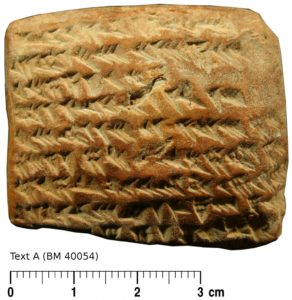
Ancient Babylonian astronomy textbook.

Today, in the first summer meeting of our research group, we discussed a recent paper from Prof. Guillermo Gonzalez of Ball State that explored observations from Babylonian clay tablets to estimate changes to the spin rate of the Earth.

Even though it seems like there’s never enough time in the day, it turns out that the Earth’s rotation rate has been slowing over thousands (and even billions) of years. Numerous effects, including tidal interactions with the Moon, reshaping of Earth via earthquakes, and the melting of glaciers, all contribute to slow down or speed up Earth’s rotation.

One good way to measure the change in the length of the day is to measure the positions of stars, planets, and the Moon in the sky and compare their positions with where you’d expect them to be based on the time. And going back to about 1600, astronomers have used telescopes to accurately measure the timing of celestial configurations to good enough precision that changes in the length of the day can be seen – for instance, the day was about 22 minutes longer when Galileo first pointed his telescope to the heavens.

But the change in length of the day is pretty small – the Moon’s tides slow the Earth about 2.3 milliseconds per day each century – and the change isn’t necessarily constant over time. Fortunately, even thousands of years of ago, humans were keeping track of the positions of objects in the sky, even though they didn’t know what the objects were.

In Gonzalez’s recent paper, he analyzes reports from ancient Babylonian astronomers of lunar occultations and appulses (i.e., close approaches). These reports extend back to 400 BC, giving an observational baseline of nearly 2500 years, and are replete with lovely and ancient descriptions:

“Year 7. Month IV, the 22nd, 64 degrees before sunrise, Saturn came out from the northern horn of the Moon.”

Gonzalez’s results mostly agree with previous work, although he finds that the Earth’s rotation has slowed a bit more slowly than other estimates suggest since the time of Babylon.

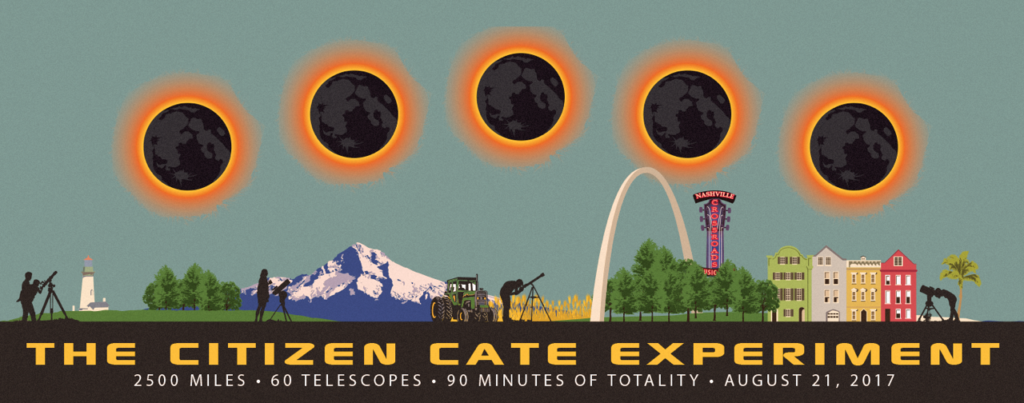
Over the Memorial Day weekend, we hosted a workshop for volunteers with the Citizen CATE Project, an ambitious citizen-science project to make a 90-min long movie of totality during the solar eclipse on August 21.

For the August eclipse, it only takes about 2-min for the Moon’s shadow to pass over anyone point on the surface of the Earth – after all, it’s traveling about 1,000 miles per hour.

But the Citizen CATE project aims to extend the duration of totality by outfitting sites all along the eclipse track with telescopes, cameras, Arduinos, etc.

That way, as the Moon’s shadow passes from west to east across the US, from one site to the next, the images can be cut together to produce a totality that lasts much longer than that at any one site. The resulting movie will quickly be uploaded to the internet and made available to eclipse-lovers the world over.

Such citizen science projects go back at least to 1715, when the preeminent Edmund Halley, of cometary fame, predicted the apparition of a solar eclipse to a precision of four minutes. He enlisted the aid of his fellow citizens to record the eclipse duration at more than a dozen locations throughout the British Isles. Compiling these data, he was able to significantly improve the Moon’s ephemeris and make much more accurate future predictions.

And so on Sunday, May 28, the Physics Dept at Boise State invited groups from sites across Idaho to campus for a training workshop hosted by Citizen CATE. The day was hot and sunny – perfect for sunburns and sungazing – and I’ve posted photos from our work below.

Jolts and Juice on the main drag in Ontario.

Last week, I spent a few days in Ontario, Oregon, our neighbor just across the border.

I was invited to visit by Sam Castonguay, a geologist at Treasure Valley Community College (TVCC) as part of my American Astronomical Society Shapely Lectureship. I was allowed to interrupt an advanced calculus class to talk with the students about the upcoming eclipse and astronomy in general. Lots of great questions and enthusiasm for science amongst the TVCC folks.

In the evening of May 31, I gave a presentation to about 70 members of the broader Ontario community about the eclipse. I was really impressed by how engaged and receptive everyone was, and I was able to address concerns folks had about this historical event. People were also very excited to receive eclipse shades.

The next day, I visited with science students at Ontario High School. Even though the semester was nearly over, the students were very attentive and asked a wide range of questions.

And finally, on Saturday, June 2, I attended Ontario’s Global Village Fest at the invite of the local Chamber of Commerce. Good audience, and the clouds that moved into that morning were thick enough to keep the temperatures bearable but thin enough that we were able to set up a to-scale demonstration of the eclipse.

Although all the events left a very positive impression of Ontario, one thing really stuck out during my visit to TVCC. The school recently received a donation of mastadon and mammoth fossils dug out of a nearby quarry. Between my visit to the calculus class and the evening presentation, Castonguay showed me these amazing bones, pictured at left. One of the best things I’ve found about this part of the country is that there are a fair number of fossil deposits throughout. TVCC is in the process of setting up a display for their fossils, and so if you’re in Ontario anytime soon, be sure to visit their collection.

This visit and many others are made possible by support from the Idaho STEM Action Center and donations to the Pony Up Campaign from lots of generous donors, including Michal Martinez, Kathryn Scott, Debra Sklenar, John Freemuth, Keith Sander, Stuart Weiser, Tamsin Clapp, Dorothy A Snowball, Russell Wolff, Luanne Tangedal, Laurie Barrera, Mary Rausch, Steven Drake, Theresa Weiland, Earnest Harper, Brian Cronin, Robert Applequist, Darrell Palmer, Gay Pool, Garretta Reynolds, Lisa Marie Howell, and many anonymous donors.

Thanks to these folks and many others, we raised more than twice what we’d originally asked for, giving us $10k to do public astronomy outreach – an unbelievable outpouring of support from our Boise State community.

I’ve posted my presentations to the community and to the high school below.

UPDATE (2017 Jun 7): Some press coverage in the local paper – http://www.argusobserver.com/news/eclipse-explained/article_805c98f6-46eb-11e7-b41e-6b1b70b6b1d7.html.


Ontario Community Presentation


Ontario High School Presentation

Wonderful event last Friday. Prof. Katie Devine talked about star formation and radio astronomy, engaging the crowd of a few dozen with anecdotes and rapid-fire wit. After the presentation, we enjoyed the beautiful evening weather and found the Sun, the Moon, and Jupiter in our telescopes.

I’ve posted her presentation below.


What do “bubbles” and “yellowballs” have to do with star formation? Identified in mid-infrared Galactic plane surveys, these objects are both named for their appearance in infrared wavelengths.
Join the Boise State Physics Department and College of Idaho Prof. Katie Devine on Friday, June 2 at 7:30p to learn about the role they may play in triggering new star formation, and the work being done to explore this role.

The lecture will take place in the Multi-Purpose Classroom Building, room 101. After the lecture (assuming clear weather), we’ll move to the top of the Brady Garage to do some stargazing.

Contact Prof. Brian Jackson (bjackson@boisestate.edu) with questions.

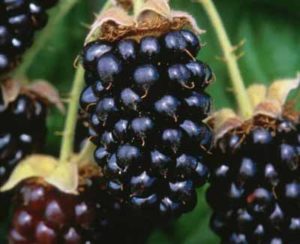
Marionberries, a product of Washington state and not of Washington DC.

Had a nice visit last night with the folks in lovely Garden Valley about an hour’s drive north of Boise at the confluence of the Middle Fork and Payette Rivers. In response to an invitation from the Chamber of Commerce, I gave a short presentation about the solar eclipse at the Crouch Community Hall. The presentation I gave is posted below.

Folks were really engaged and interested, and I was impressed by how thoughtful and forward-thinking everyone was when it came to logistics and planning for the eclipse. The Idaho Board of Tourism expects lots of people to come to Idaho, many of whom will visit or at least pass through Garden Valley, so being prepared for August 21 is key, especially for municipalities with limited resources.

After the talk, my hosts invited me to dinner at the Two Rivers Grill, where we enjoyed a pretty amazing cobbler made from marionberries, a berry I’ve only encountered after moving to the Pacific Northwest. At dinner, my hosts explained that the marionberry was developed by Oregon State University via crossbreeding between a smaller, flavorful Chehalem blackberry and a larger, better-producing Olallie blackberry in the mid-1950s.

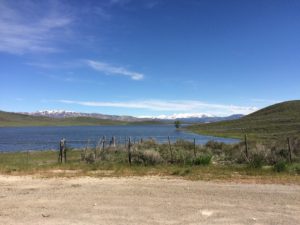
Little Camas reservoir south of Arco

As part of our statewide eclipse tour, this week I visited the town of Arco, perched on the margin of one of the youngest extinct lava flows in the world, the Craters of the Moon National Monument and Preserve. The blocky a’a flows in Craters resembles the surface of the Moon so closely that Apollo astronauts trained there in the 1960s. Arco itself has a very interesting history as the first town in the world light entirely by nuclear power.

During my visit, I spoke with hundreds of elementary, middle, and high school students. Then in the evening, I gave a presentation to the wider Arco community. Those presentations are available below.

In addition to the conversations with the citizens of Arco (Arconoids?), I enjoyed the fried pickles at Pickle’s Place. And the drive between Boise and Arco was filled with sparkling lakes, snow-scarfed mountains, and a podcast from Radiolab. Just as Highway 20 spilled into the valley of Castle Rocks, the sunglint from the Little Camas reservoir crashed in through my windshield. It was very Idaho.

Because Arco is in the path of totality for the August eclipse, they are hosting an event for their visitors, and you can find out more about that event here – http://arcosrockincountryoutdoors.com/.


Presentation to Arco Elementary School

Presentation to Butte County High School

Presentation to Arco Community