It has been proposed that FRBs are some kind of alien signal. In fact, Lingam & Loeb at Harvard earlier this year suggested FRBs might be beams of light used by aliens to accelerate alien ships into space. Probably not, but a very cool suggestion.
One of the neatest responses to this recent detection was the conversion of the radio signals into audio by redditor u/Arzu1982, which I’ve linked to below. Not sure that the audio provides any insight into the origin of the FRBs, but they are neat to listen to.
To find the elusive exocomets, a group led by Prof. Saul Rappaport at MIT conducted an exhaustive search of more than 200,000 lightcurves collected by Kepler over its 3.5 year nominal mission.
By meticulously sifting these lightcurves by hand, Rappaport’s group were able to spot strangely and non-periodic signals, the kinds of signals that computers, with their rigid predictability, have trouble finding.
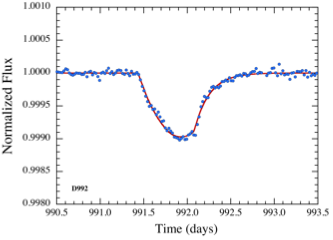
The shadow of an exocomet.
The figure at left shows the shadows of exocomets orbiting a very bright star, a little bigger than the Sun, as they pass between the star and the Earth. The cometary signal is asymmetric and doesn’t occur on a regular schedule, totally unlike an exoplanetary transit.
Rappaport’s group reports seeing six of these strange signals coming from the Kepler target star. Probably most of the signal is coming from a cloud of dust ejected by the exocomet. Such dust ejections are common for comets in our solar system, giving rise to one of the two lustrous tails usually seen for comets (the other tail is made of a stream of ionized plasma).
The shadow signals appear six times, separated by tens to hundreds of days. Assuming the two dips separated by about 200 days are due to one comet (they don’t have to be), the comet would have to contain about as much mass as Halley’s comet and probably more.
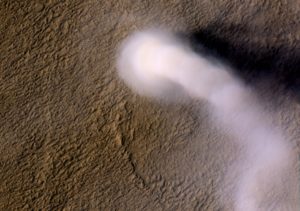
From https://www.nasa.gov/mission_pages/MRO/multimedia/pia15545.html.
Dust devils occur ubiquitously on Mars, where they have been observed from space and from landed spacecraft. Martian dust devils may present a hazard to exploration of the planet, but they have also lengthened the lifetime of the Mars rovers.
Join the Physics Department on Friday, Sep 1 at 7:30p in the Multi-Purpose Classroom Building, room 101 to hear about research on terrestrial analog dust devils conducted by Boise State’s own Prof. Brian Jackson. He will discuss a recent pilot study using an instrumented quadcopter to sample active dust devils and will present encounter footage collected onboard the drone.