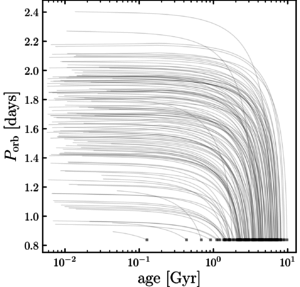
The distribution of orbital eccentricities e of extrasolar planets with semimajor axes a > 0.2 AU is very uniform, and values for e are relatively large, averaging 0.3 and broadly distributed up to near 1. For a < 0.2 AU, eccentricities are much smaller (most e < 0.2), a characteristic widely attributed to damping by tides after the planets formed and the protoplanetary gas disk dissipated. Most previous estimates of the tidal damping considered the tides raised on the planets, but ignored the tides raised on the stars. Perhaps most important, in many studies the strongly coupled evolution between e and a was ignored. In Jackson+ (2008a), my colleagues and I modeled the coupled tidal evolution of e and a for many extrasolar planets and confirmed that even close-in planets probably began with broadly distributed e-values, like those for planets far from their host stars and unaffected by tides. The accompanying evolution of a-values showed most close-in planets had significantly larger a at the start of tidal migration, and the current small values of a were only reached gradually due to tides over the ages of the planets.
Related Scientific Publications:
- Jackson+ (2008a). “Tidal Evolution of Close-in Extrasolar Planets.” ApJ 678, 1396.
- Jackson+ (2008). “Tidal evolution of close-in extra-solar planets.” Proceed. IAU 249, 187.