Illustration of tidal interactions. From ftp://ftp.osupytheas.fr/pub/symposiumCOROT/posters/Francoise-Remus-Poster.pdf.

Illustration of tidal interactions. From ftp://ftp.osupytheas.fr/pub/symposiumCOROT/posters/Francoise-Remus-Poster.pdf.

I attended a talk at the US Naval Observatory on Friday given by newly minted Dr. Françoise Remus of the Paris Observatory. Remus discussed tidal interactions between the Jovian or giant planets and their satellites.

Tides are well known here on Earth, where the Moon raises tides in the oceans on a regular basis, as seen in the Chesapeake Bay. The moons of Jupiter and Saturn also raise tides on those planets, in the planets’ atmospheres and deep interiors.

The tides raised on these planets interact gravitationally with the satellites and influence the moons’ orbits, as for the Earth’s Moon — tides on the Earth push the Moon away from the Earth a few centimeters every year.

On Earth, drag in the oceans provides tidal dissipation that drives the Moon’s orbital evolution. Tides raised on Jupiter and Saturn apparently also experience dissipation, but since those planets don’t have shallow oceans, it’s not clear what generates the dissipation.

For her graduate work, Remus created complex models to explain tidal dissipation within Jupiter and Saturn and showed that the planets’ rocky and icy cores, deep within their interiors, play a key and previously under-appreciated role. Her work has broad implications, from helping us understand these planets’ mysterious interiors to explaining the origins of the planets’ complex satellite systems.

Good talk today from one of our own, Dr. Jackie Faherty, a Hubble fellow here at Carnegie.

Artist’s impression of the disc of dust and gas around a brown dwarf. From http://en.wikipedia.org/wiki/File:Artist%E2%80%99s_impression_of_the_disc_of_dust_and_gas_around_a_brown_dwarf.jpg.

Artist’s impression of the disc of dust and gas around a brown dwarf. From http://en.wikipedia.org/wiki/File:Artist%E2%80%99s_impression_of_the_disc_of_dust_and_gas_around_a_brown_dwarf.jpg.

Faherty talked about brown dwarfs (BD), a relatively new class of astronomical object that straddles the border between planets and stars. Brown dwarfs typically have masses between 13 and 75 times that mass of Jupiter and are made mostly of hydrogen gas, with lots of complex and interesting molecules mixed into their atmospheres.

Faherty studies the motion and distances of BDs using an age-old technique called parallax determination. It is very important to accurately estimate the distance for a BD because combining that estimate with measurements of a BD’s brightness and temperature gives a sense of the BD’s age — critical for understanding how BDs evolve over time.

BDs exhibit a bewildering variety of compositions and evolutionary behavior — some have variable clouds and weather — and the field is moving very rapidly. For example, astronomer Ian Crossfield just this year produced the first image of a BD’s atmosphere. And, in her talk, Faherty highlighted important similarities and differences between BDs and gas giant planets and showed how they may help unravel the mysteries of planet formation.

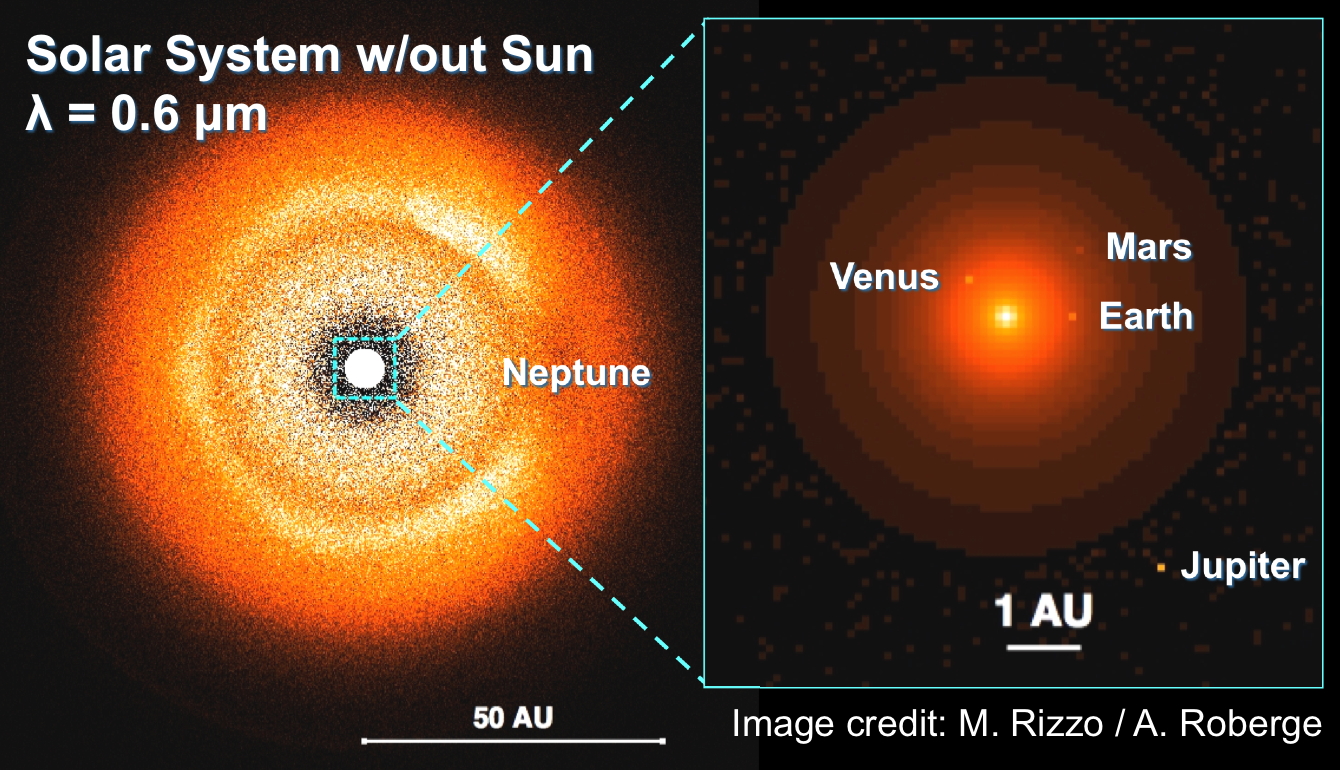
A slice from a high-fidelity model of the Solar System, viewed face-on from the outside. Image credit: M. Rizzo / A. Roberge from http://asd.gsfc.nasa.gov/projects/haystacks/haystacks.html.

A slice from a high-fidelity model of the Solar System, viewed face-on from the outside. Image credit: M. Rizzo / A. Roberge from http://asd.gsfc.nasa.gov/projects/haystacks/haystacks.html.

Great talk today from Ashlee Wilkins, a grad student at University of Maryland Astronomy working at NASA Goddard, about imaging dust disks and planets around other stars.

Many stars, including the Sun, are surrounded by dust grains in disks, usually produced by collisions between asteroids and other larger bodies orbiting the stars. The orbits of these dust grains can then be shaped by gravitational interactions with planets in the system. Because the disks are much easier to observe than planets in these systems, they can provide clues to the presence of the otherwise unseen planets.

Wilkins and her collaborators are working to make very sophisticated models of such disks to learn what the disks would look like so that we can design telescopes to directly image planets in such systems. The image at left shows what our solar system might look like to astronomers on a distant planet, as produced by such a model.  Wilkins is also helping to build the instruments that could directly image an Earth-like planet in a distant solar system.


Good talk today from Karen Collins, a graduate student in U of Louisville’s Physics program.

Artist's illustration of KELT-6b, a Saturn-like alien planet announced in June 2013. From http://www.space.com/21431-saturn-like-alien-planet.html.

Artist’s illustration of KELT-6b, a Saturn-like alien planet announced in June 2013. From http://www.space.com/21431-saturn-like-alien-planet.html.

She spoke about her work in ground-based observations of exoplanet transits, which are impressively simple but amazingly powerful for revealing new planets and telling us about already known planets.

Collins helped discover and confirm the Saturn-sized planet KELT-6 b (pictured at right), in a roughly 8 day orbit around a metal-poor F-type star.

This is a particularly interesting discovery because gas giant planets seem to prefer forming around metal-RICH stars, where there was more material to form planets. But KELT-6 b seems to buck that trend, and this result may point to something unusual about the planet’s formation and history.

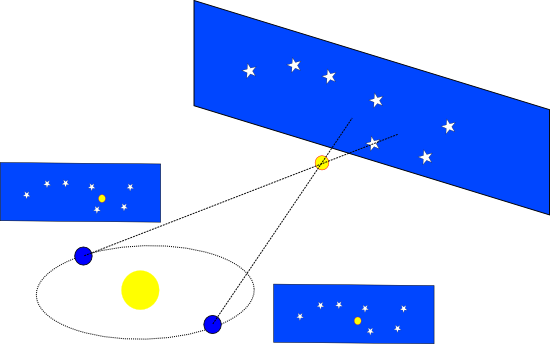
Observing stellar parallax. From http://en.wikipedia.org/wiki/File:ParallaxeV2.png.

Observing stellar parallax. From http://en.wikipedia.org/wiki/File:ParallaxeV2.png.

Dr. Jennifer Bartlett of the US Naval Observatory visited today to talk about her work measuring parallaxes for the stars closest to us in space.

Dr. Bartlett spoke about her collaboration’s, RECONS, discovery of several low-mass binary star systems. Since the least massive stars are also the dimmest, these systems are some of the most interesting but difficult to study.

However, these stars can also be the easiest to found extrasolar planets around since the perturbations astronomers look for to find planets are enhanced for these stars, due to their low masses and sizes. But we can only really study these systems if they are close to us.

So, for several reasons, measuring the parallaxes to infer the distances to the nearest stars in the galaxy is an exciting topic.

Great talk from Ronni Grapenthin of UC Berkeley’s Seismology Lab. Dr. Grapenthin discussed how he uses high-precision and high data-rate GPS measurements to link the motions of the Earth’s crust to geophysical processes, including earthquakes and volcanic eruptions.

One of the neatest things he showed was a video of GPS displacements during the huge Tōhoku earthquake in Japan three years ago (above). The left panel shows lateral displacement (the largest arrows reflect only a few meters of displacement, not hundreds of kilometers, as it may seem), while the right panel shows vertical displacement. The waves associated with the earthquake and an aftershock are shown pretty dramatically, as they propagate through the Earth’s surface away from the earthquake source.

In the near-term, Grapenthin is helping to develop an early warning system for earthquakes in California using these kind of GPS data, which could help save many lives.

Light emitted by the star HD105 and the debris disk orbiting it. From Donaldson+ (2012) -- http://adsabs.harvard.edu/abs/2012ApJ...753..147D.

Light emitted by the star HD105 and the debris disk orbiting it. From Donaldson+ (2012) — http://adsabs.harvard.edu/abs/2012ApJ…753..147D.

Great talk today from Jessica Donaldson of University of Maryland Astronomy about observing circumstellar debris disks.

These disks represent the fragments from collisions between rocky bodies, themselves orbiting the star and some of which go into forming planets around those stars. Light from the stars heats the dust, and so it emits infrared (IR) radiation that astronomers can distinguish from light emitted from the star (see figure at left).

By studying this IR emission, astronomers attempt to understand how far the dust is from its host star and whether it is in the places where astronomers expect planets to form. The emission can also tell us about the composition of the dust.

Donaldson described her work refining techniques to tease that information out of datasets collected by the Spitzer and Herschel spacecrafts. Her work has suggested, for example, that the dust observed around some stars has a composition similar to that observed in dusty comets orbiting the Sun.

Dr. Andrea Banzatti of the Space Telescope Science Institute visited today and talked about observing infrared (IR) light emitted by water vapor in protoplanetary disks.

Artist illustration of a protoplanetary disk. From http://www.keckobservatory.org/index.php/gallery/detail/milky_way/32.

Artist illustration of a protoplanetary disk. From http://www.keckobservatory.org/index.php/gallery/detail/milky_way/32.

Planets like the Earth are born in these protoplanetary disks, the gas and dust leftover after a star forms, and by analyzing IR light, Banzatti can estimate how much water there is in a disk and how hot it is.

Water is a key ingredient in planet formation, especially for gas giants like Jupiter, and of course, a key requirement for life. So by learning about how much water is in disks, Banzatti is helping us understanding the earliest stages in planet formation and the origins of life.

Banzatti developed a new technique to study the temperature and abundance of water in disks, and his results suggest that ice grains actually migrate around the disk, in ways that have been expected but not observed.

A light-optical microscope image of a zircon, 250 micrometers long.

A light-optical microscope image of a zircon, 250 micrometers long.

Very interesting seminar today from Prof. Blair Schoene of Princeton University’s Dept. of Geosciences. Prof. Schoene discussed his work on geochronology, estimating the ages of rocks.

The Earth is very old, and figuring out the ages of rocks can be tricky. Luckily, the Earth provides some help, notably in the form of small crystals called zircons (one shown at left). Zircons are hardy little crystals that contain trace amounts of uranium (U) and lead (Pb). When zircons crystallize, they can incorporate some U into the crystal, but Pb is chemically excluded.

However, U radioactively decays into Pb at a well-known rate, and so if you find Pb in an old zircon, you know that it used to be U and formed by decay. By counting up the amount of Pb, you can estimate the zircon’s age.

Prof. Schoene and his research group use this fact to estimate the ages of rocks on the Earth’s surface. This work can tell us, for example, whether the chemistry of lavas erupted onto the surface have changed over time.

In fact, work by Schoene’s group has found preliminary indications that there may have been a big shift in the chemistry of lava flows right about the time that oxygen appeared in abundance in the Earth’s atmosphere, 2.5 billion years ago during the Great Oxygenation Event (GOE). The GOE is suspected to have devastated Earth’s biosphere — oxygen was toxic to most life at that time — and now it seems that eruptions from the Earth’s interior were affected, too.

3D view of the inner part of a collapsing gas cloud, forming a star, where a bundle of twisted magnetic field lines is surrounded at the “waist” by a dense ring. The star is shown as a red dot located near the inner edge of the ring.

3D view of the inner part of a collapsing gas cloud, forming a star, where a bundle of twisted magnetic field lines is surrounded at the “waist” by a dense ring. The star is shown as a red dot located near the inner edge of the ring.

Good talk today from Bo Zhao of UVA Astronomy about the effects of magnetic fields on the formation of binary stars.

Binary stars are very common, and about half of all stars have such a celestial companion. Moreover, several exoplanets have now been found in binary star systems. So the formation of these stars touches on many astronomical topics.

Bo described how magnetic fields can control the orbital evolution of binary stars and influence the accretion of mass by the stars. For example, magnetic fields can sculpt the shape of accretion disks around the stars into complex shapes, filaments and strands (as shown at left).

Since these accretion disks mass onto the young stars, understanding their shapes, dynamical evolution, and the effects of magnetic fields on both these are important for understanding the population of binary stars we can see.