Uncategorized

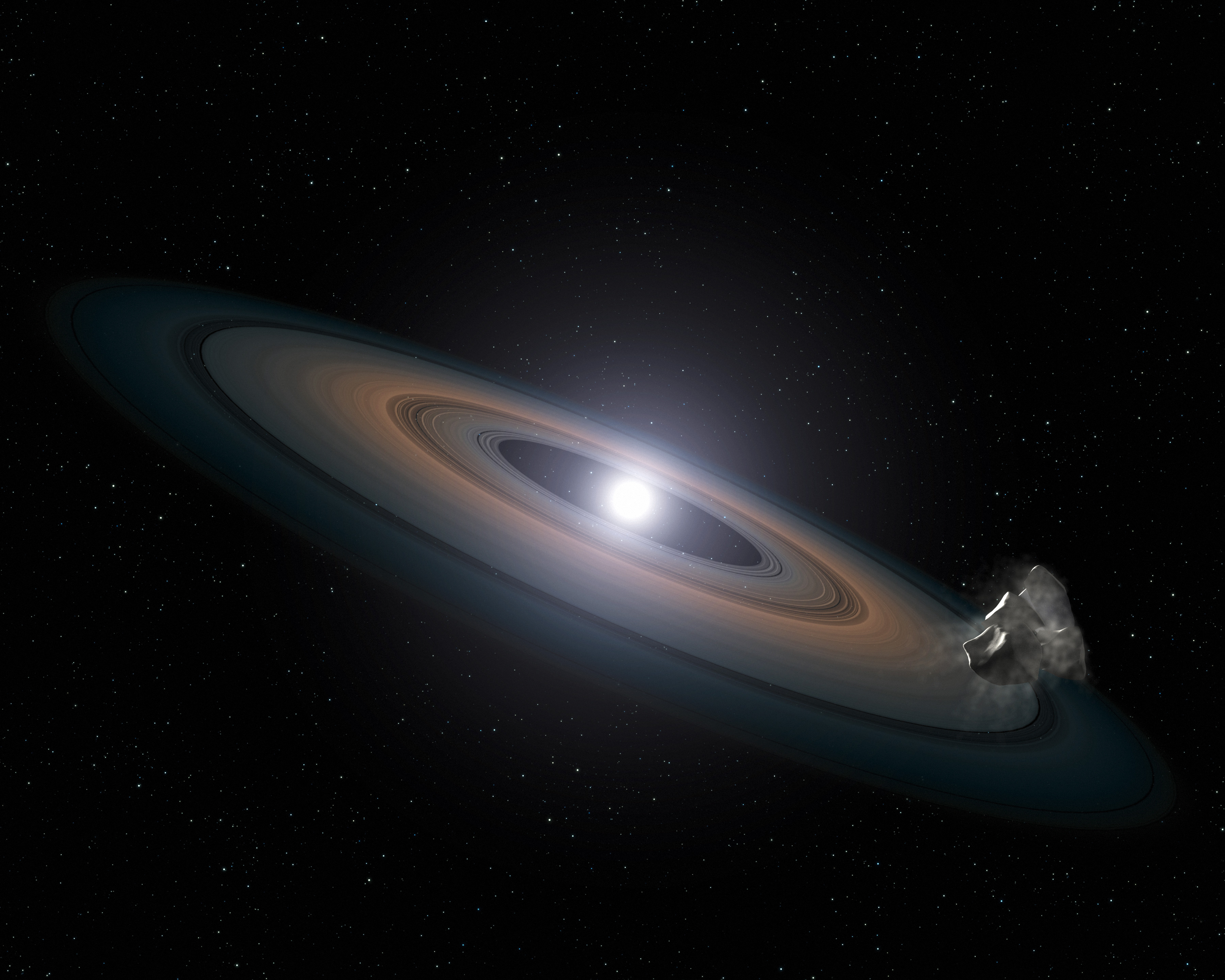
This illustration is an artist's impression of the thin, rocky debris disc  discovered around the two Hyades white dwarfs. Rocky asteroids are  thought to have been perturbed by planets within the system and diverted  inwards towards the star, where they broke up, circled into a debris  ring, and were then dragged onto the star itself. From http://en.wikipedia.org/wiki/File:Artist%E2%80%99s_impression_of_debris_around_a_white_dwarf_star.jpg.

This illustration is an artist’s impression of the thin, rocky debris disc discovered around the two Hyades white dwarfs. From http://en.wikipedia.org/wiki/File:Artist%E2%80%99s_impression_of_debris_around_a_white_dwarf_star.jpg.

Fun talk today from Dr. John Debes from the Space Telescope Science Institute (STScI) about white dwarfs eating planetesimals.

White dwarfs are the ghostly embers of former stars — they originate when a star (that is small enough not to become a black hole instead) dies and leaves behind a dense core of carbon and oxygen, enshrouded in a thin hydrogen atmosphere. That white dwarf core then slowly cools and darkens over billions of years, basically doing nothing else.

However, many white dwarfs show telltale signs in their atmospheric spectra of rocky materials. Debes, along with others, has suggested that material arises from asteroids that are perturbed by distant planets around the white dwarf. Those orbits take the asteroids so close to the white dwarf host that they are ripped apart by the star’s gravity, producing a cloud of dust and gas that then accretes onto the star.

Astronomers can very accurately measure the composition of that dust, which can actually tell us something about the compositions of asteroids in distant planetary systems. So astronomers can learn about what makes up the planets in distant systems by studying the remains in these planetary graveyards.
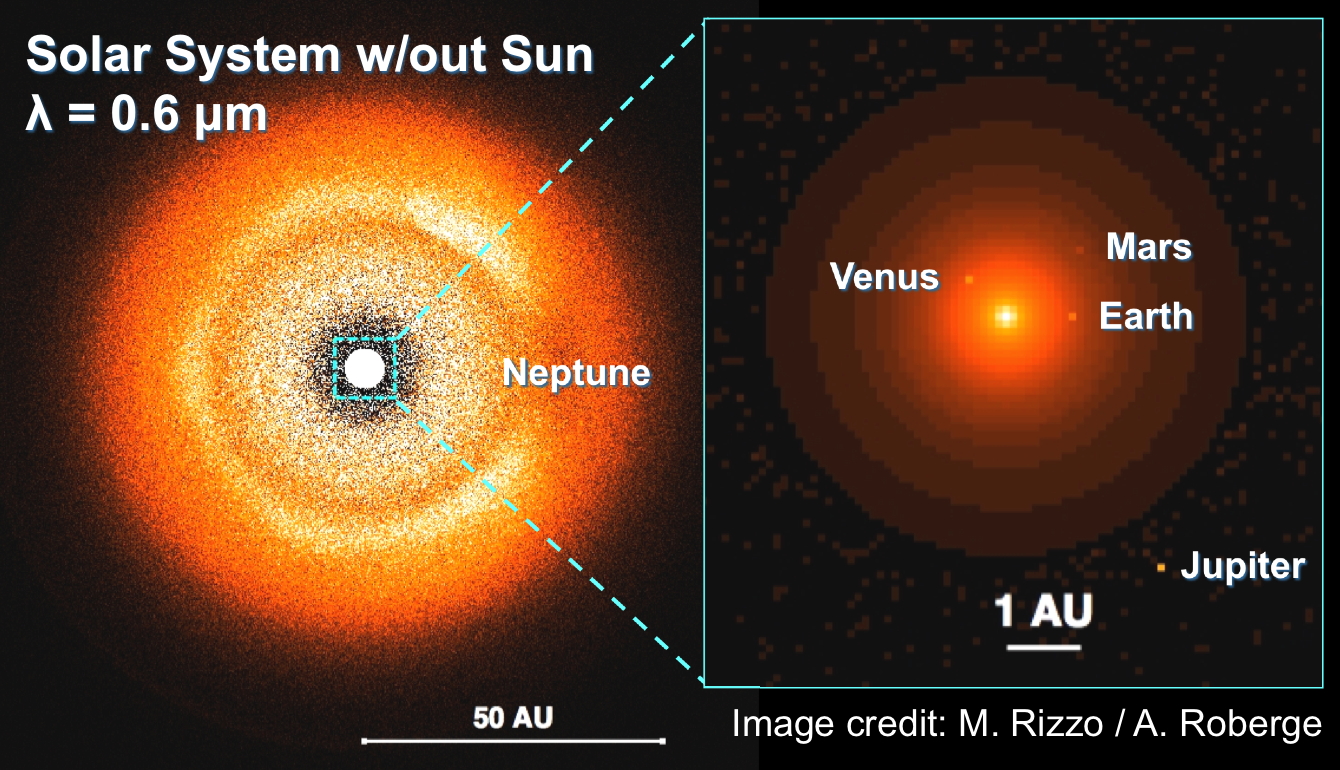
A slice from a high-fidelity model of the Solar System, viewed face-on from the outside. Image credit: M. Rizzo / A. Roberge from http://asd.gsfc.nasa.gov/projects/haystacks/haystacks.html.

A slice from a high-fidelity model of the Solar System, viewed face-on from the outside. Image credit: M. Rizzo / A. Roberge from http://asd.gsfc.nasa.gov/projects/haystacks/haystacks.html.

Great talk today from Ashlee Wilkins, a grad student at University of Maryland Astronomy working at NASA Goddard, about imaging dust disks and planets around other stars.

Many stars, including the Sun, are surrounded by dust grains in disks, usually produced by collisions between asteroids and other larger bodies orbiting the stars. The orbits of these dust grains can then be shaped by gravitational interactions with planets in the system. Because the disks are much easier to observe than planets in these systems, they can provide clues to the presence of the otherwise unseen planets.

Wilkins and her collaborators are working to make very sophisticated models of such disks to learn what the disks would look like so that we can design telescopes to directly image planets in such systems. The image at left shows what our solar system might look like to astronomers on a distant planet, as produced by such a model.  Wilkins is also helping to build the instruments that could directly image an Earth-like planet in a distant solar system.


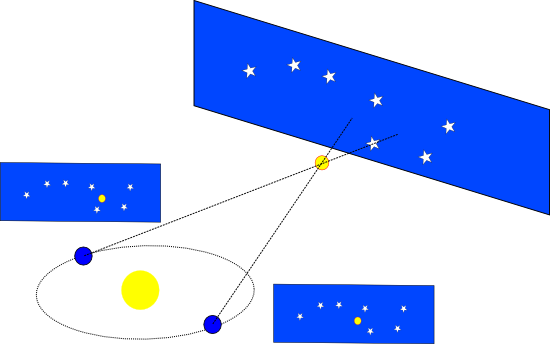
Observing stellar parallax. From http://en.wikipedia.org/wiki/File:ParallaxeV2.png.

Observing stellar parallax. From http://en.wikipedia.org/wiki/File:ParallaxeV2.png.

Dr. Jennifer Bartlett of the US Naval Observatory visited today to talk about her work measuring parallaxes for the stars closest to us in space.

Dr. Bartlett spoke about her collaboration’s, RECONS, discovery of several low-mass binary star systems. Since the least massive stars are also the dimmest, these systems are some of the most interesting but difficult to study.

However, these stars can also be the easiest to found extrasolar planets around since the perturbations astronomers look for to find planets are enhanced for these stars, due to their low masses and sizes. But we can only really study these systems if they are close to us.

So, for several reasons, measuring the parallaxes to infer the distances to the nearest stars in the galaxy is an exciting topic.

Sanchis-Ojeda2013_Fig3

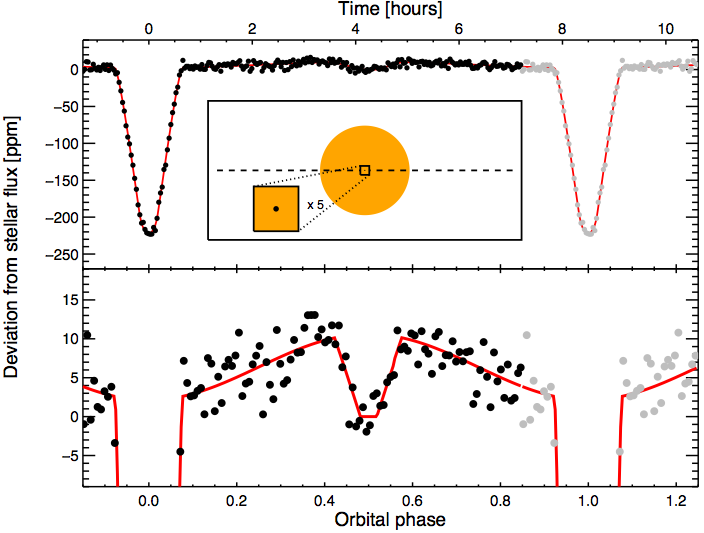
Figure 3 from Sanchis-Ojeda+ (2013) showing observations of the Kepler-78 b’s shadow as it passes in front of its host star.

I sat in on University of Maryland Astronomy’s colloquium, today given by Roberto Sanchis-Ojeda of the Kavli Institute at MIT. He discussed his recent paper announcing the discovery of Kepler-78 b, an Earth-sized planet with on orbital period of only 8.5-hours.  In such a short orbital period, this planet is only 0.01 AU distant from its host star, almost 100 times closer to its star than the Earth and 40 times closer than Mercury are to our Sun.

Unfortunately, since the planet is so small, we don’t have a direct estimate of its mass, but so close to its sun, the planet’s day side is baking at a temperature probably greater than 1,500 K (2,200 degrees F), above the melting point of rock — The planet’s day side is probably covered by a lake of molten rock.

Kepler-78 b is one of a few very hot rocky planets discovered so far and the shortest-period transiting planet confirmed. CoRoT-7 b was the first one (discovered by the CoRoT mission), and Kepler-10 b was the first rocky planet discovered by the Kepler mission. The origins of these very hot rocky planets are unclear — they probably didn’t FORM so close to their host stars (although some have suggested rocky planets MAY form very close to their host stars). In any case, they represent yet another entirely unexpected but exquisitely interesting discovery in extrasolar astronomy.