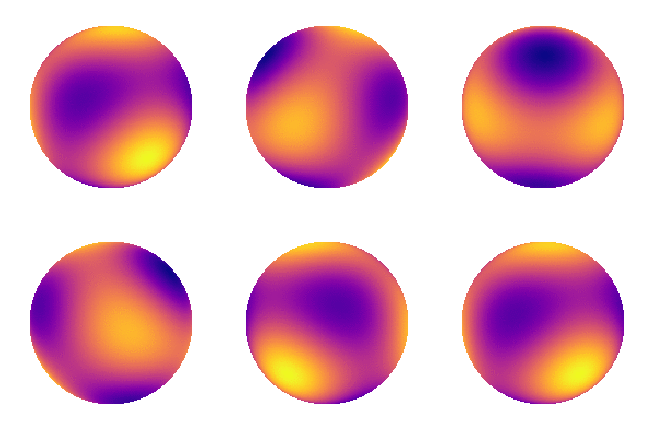
Planetary phase curves (light reflected and emitted by the planet as it orbits its star) can provide insight into atmospheric processes, and the Kepler Mission’s observational baseline spanning hundreds of days for some planets makes its dataset especially well suited to search for phase curve variability, diagnostic of meteorology as advective processes sweep thermal structures and aerosols into and out of view. This project involves analysis of archival Kepler data to understand the weather on these distant worlds.
- Jackson et al. (2018) – “Searching for Eclipse Variability for Kepler-76 b in the Kepler Dataset” – DPS Presentation
- Jackson et al. (2019) – “A Search Variability in the Atmosphere of the Hot Jupiter Kepler-76 b” – LPSC Presentation
- Jackson et al. (2019) – “Variability in the Atmosphere of the Hot Jupiter Kepler-76b” – ApJ article