tidal disruption

All posts tagged tidal disruption

The distribution of the orbits of close-in exoplanets shows evidence for ongoing removal and destruction by tides. Tides raised on a planet’s host star cause the planet’s orbit to decay, even after the orbital eccentricity has dropped to zero. Comparison of the observed orbital distribution and predictions of tidal theory shows good qualitative agreement, suggesting tidal destruction of close-in exoplanets is common. The process can explain the observed cutoff in small orbital semimajor axis values, the clustering of orbital periods near three days, and the relative youth of transiting planets. Contrary to previous considerations, a mechanism to stop the inward migration of close-in planets at their current orbits is not necessarily required. Planets nearing tidal destruction may be found with extremely small semimajor axes, possibly already stripped of any gaseous envelope. The recently discovered CoroT-7 b may be an example of such a planet and will probably be destroyed by tides within the next few Gyrs. Also, where one or more planets have already been accreted, a star may exhibit an unusual composition and/or spin rate.

Related Press:

Related Scientific Publications:

  • Jackson+ (2009). “Observational Evidence for Tidal Destruction of Exoplanets.” ApJ 698, 1357.
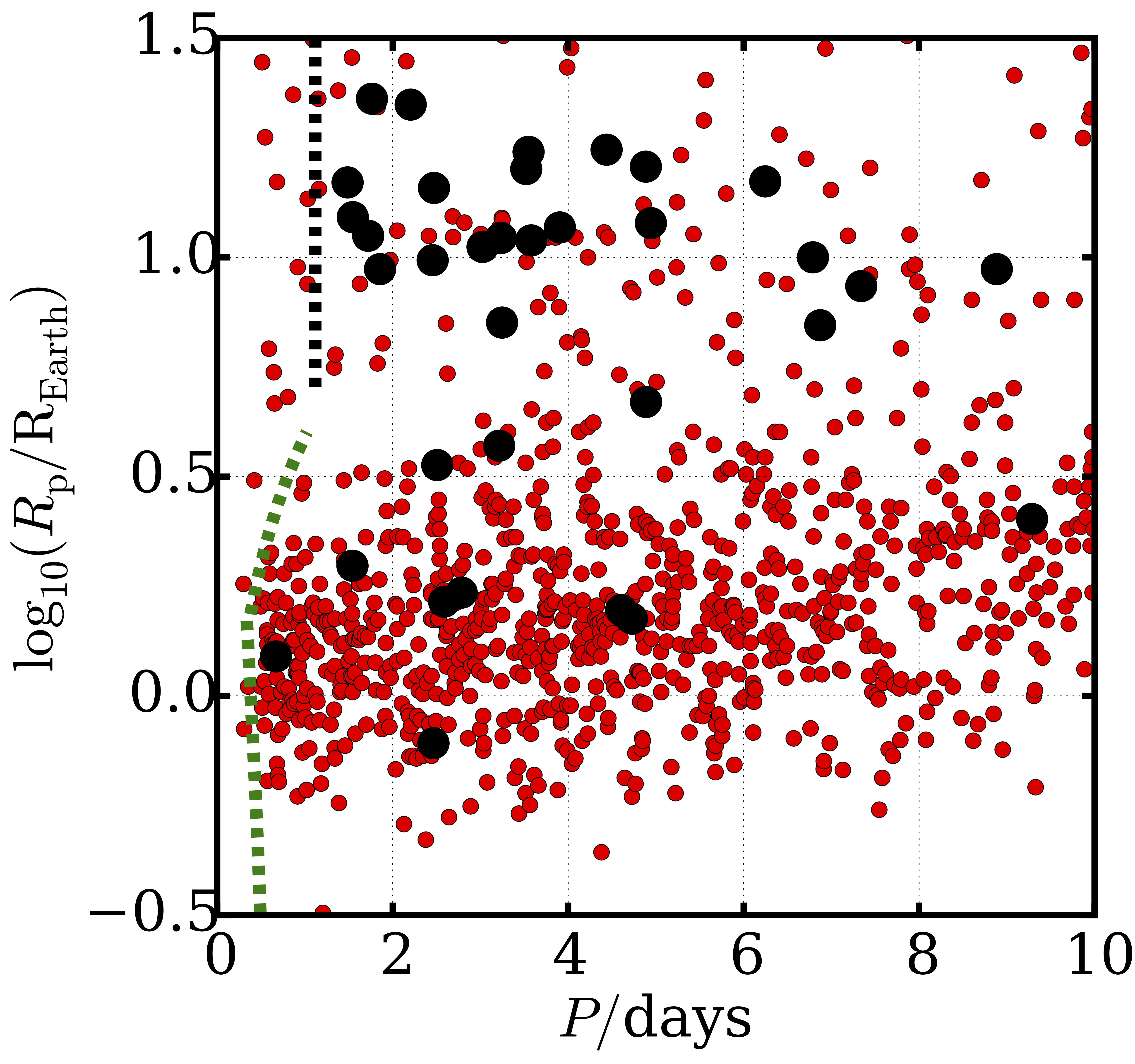
Planetary radii and orbital periods for many short-period planets (black circles) and planetary candidates (red circles) discovered by the Kepler mission. The dashed curves shows how close different planets can get to their host stars before they would be tidally disrupted. Taken from Jackson et al. (2016).

Some close-in gaseous exoplanets are nearly in Roche-lobe contact, and previous studies show tidal decay can drive hot Jupiters into contact during the main sequence of their host stars. Improving upon a previous model, we present a revised model for mass transfer in a semi-detached binary system that incorporates an extended atmosphere around the donor and allows for an arbitrary mass ratio. We apply this new formalism to hypothetical, confirmed, and candidate planetary systems to estimate mass loss rates and compare with models of evaporative mass loss. Overflow may be significant for hot Neptunes out to periods of ~2 days, while for hot Jupiters, it may only be important inward of 0.5 days. We find that CoRoT-24 b may be losing mass at a rate of more than an Earth mass in a Gyr. The hot Jupiter WASP-12 b may lose an Earth mass in a Myr, while the putative planet orbiting a T-Tauri star PTFO8-8695 might shed its atmosphere in a few Myrs. We point out that the orbital expansion that can accompany mass transfer may be less effective than previously considered because the gas accreted by the host star removes some of the system’s angular momentum from the orbit, but simple scaling arguments suggest that the Roche-lobe overflow might remain stable. Consequently, the recently discovered small planets in ultra-short-periods (< 1 day) may not be the remnants of hot Jupiters/Neptunes. The new model presented here has been incorporated into Modules for Experiments in Stellar Astrophysics (MESA).