Mars
All posts tagged Mars
https://agupubs.onlinelibrary.wiley.com/doi/10.1029/2022JE007605


Even though sound cannot propagate through the vacuum of space, that doesn’t mean we don’t know what space sounds like. Audio recordings have provided a wealth of information for space scientists almost since the beginning of the space era. Because of their simple and robust operation, microphones have been included on many past and recent space missions, on which they have recorded wind sounds and dust sounds. They will even accompany NASA’s return mission to Saturn’s moon Titan in the 2030s. Audio recordings allow us to reach far across space but also back and forth through time, and probably the last, soulful vestiges of human civilization will persist in the form of audio long after we’re gone.
Continue ReadingEstimating Aerodynamic Properties of Planetary Surfaces Using Drone Attitude
This presentation is based on a paper published here – Jackson, B. (2022) RNAAS.
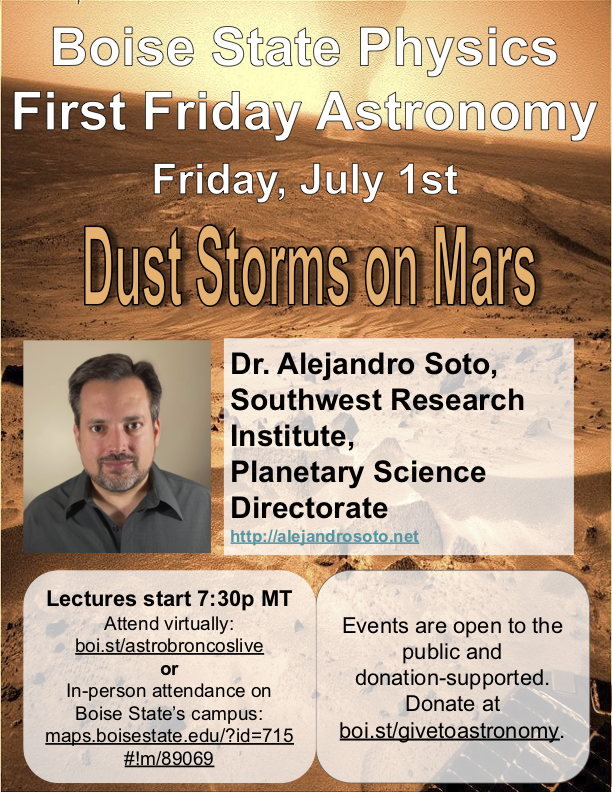
Join Boise State Physics on Friday, July 1st at 7:30p MT for our First Friday Astronomy event to hear Dr. Alejandro Soto of SwRI discuss the science of “Dust Storms on Mars”.
The presentation will be live-streamed and recorded at boi.st/astrobroncoslive.
Brian Jackson’s Press Conference Presentation
Contact Info
- Scientist: Prof. Brian Jackson – bjackson@boisestate.edu – @decaelus – Don’t call my office.
- Boise State Press Officer: Brianne Phillips – briannephillips@boisestate.edu
Summary
An key source of dust, dust devils help drive weather and climate on Mars. With a sophisticated suite of meteorological instruments, the Mars 2020 Perseverance rover can detect when a dust devil passes nearby — the instruments can see the pressure and dust perturbations from the dust devils. (Wind data were not available by the time of our work, so we didn’t include any — oh, well, next time.)
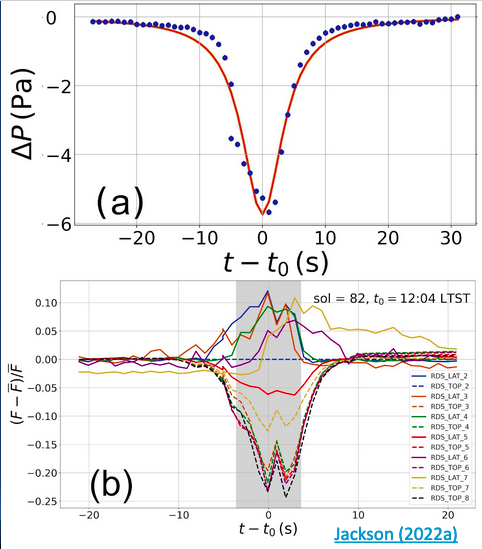
In a two new studies, my research group used data from Mars 2020 to look for passing dust devils and spotted almost 1000 encounters over the missions first 178 days. We confirmed previous weather predictions that Mars 2020 would see more than other recent missions, including InSight and Curiosity. We also found out that there were lots of whirlwinds that passed by Mars 2020 that actually didn’t raise any dust — only about a quarter of whirlwinds showed any signs of dust-lifting.
These kinds of studies are important for understanding the martian dust cycle and the contribution from dust devils. Scientists know Mars’ dust cycle strongly affects climate, and increases in atmospheric dust increase the rate of water loss into space. Martian dust may even be toxic, so dust devils could pose a big hazard for humans on Mars.
Research Publications
- Jackson, B. (2022) “Estimating the Heights of Martian Vortices from Mars 2020 MEDA Data.” Planetary Science Journal.
- Jackson, B. (2022) “Vortices and Dust Devils as Observed by the Mars Environmental Dynamics Analyzer Instruments on Board the Mars 2020 Perseverance Rover.” Planetary Science Journal.