close-in exoplanets

All posts tagged close-in exoplanets

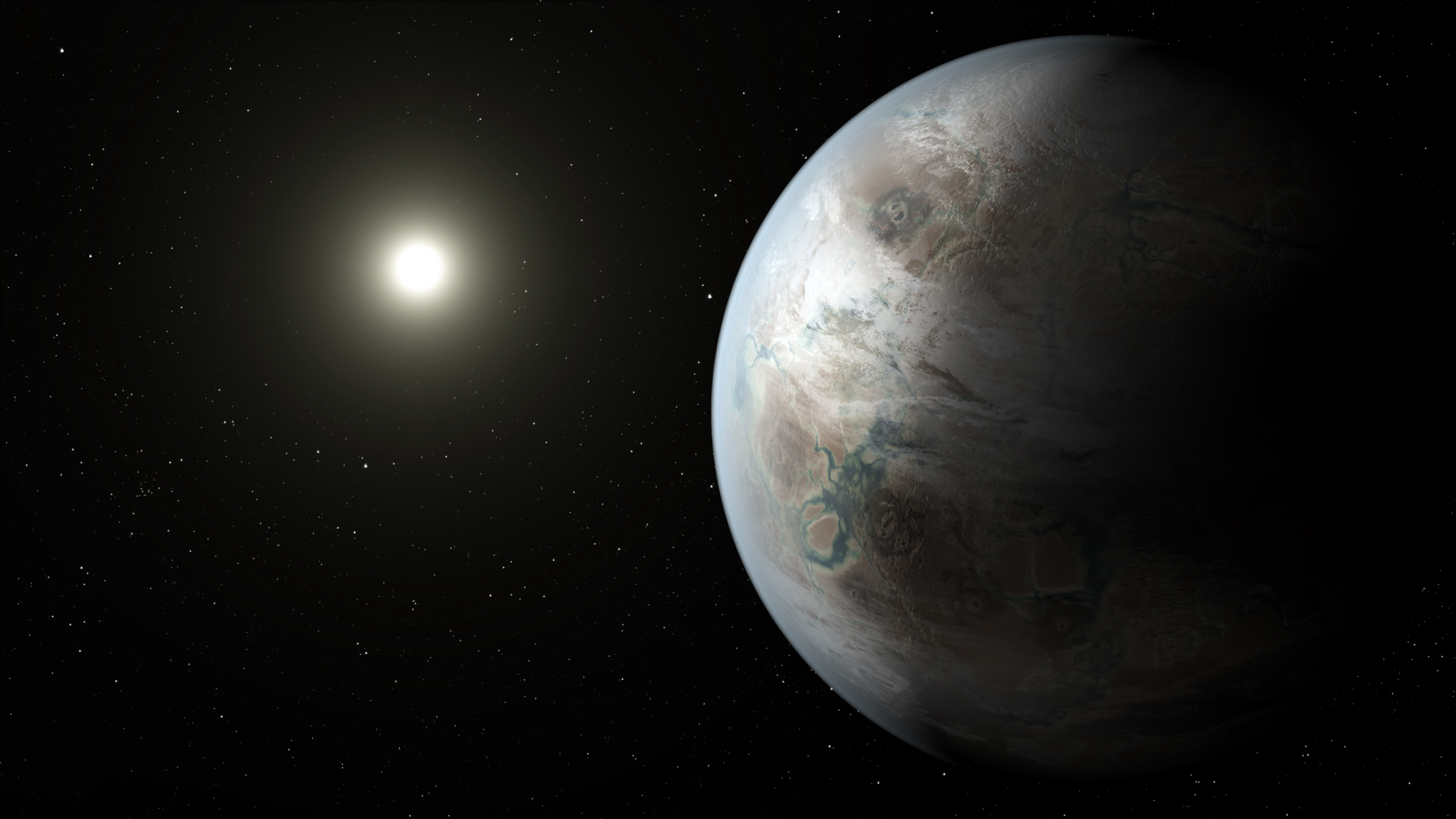
Artist's conception of Kepler-452 b. From https://en.wikipedia.org/wiki/Kepler-452b#/media/File:Kepler-452b_artist_concept.jpg.

Artist’s conception of Kepler-452 b. From https://en.wikipedia.org/wiki/Kepler-452b#/media/File:Kepler-452b_artist_concept.jpg.

Exciting discovery reported last week of a planet a little bigger than Earth orbiting a star very like our Sun.

The planet, Kepler-452 b, was discovered by the Kepler mission and has a radius 60% larger than the Earth’s. It receives about 10% more light from its star than we do here on the Earth, and it’s probably about 2 billion years older. Together, these qualities mean it may be the most Earth-like exoplanet found to date (although there are lots of other similar planets).

Unfortunately, the host star is so distant, 1,400 lightyears from Earth*, that the usual method for directly estimating the planet’s mass, radial velocity observations, is not feasible. Instead, the planet’s discoverers constrain the planet’s mass by considering a range of compositions, calculating the radius expected for each of those compositions, and comparing it to the observed radius. Based on this analysis, they estimate at least a 49% probability that the planet is rocky, like the Earth.

Based on the amount of light it receives from its host star, there’s a good chance Kepler-452 b is habitable. This means, given a long-list of assumptions about the planet and its atmosphere, liquid water would be stable on its surface. Thus, Kepler-452 b joins a short but rapidly growing list of planets that might host life.

With our success finding potentially habitable planets, it’s probably only a matter of time (maybe just a few more years) before we find a planet that’s not just habitable but inhabited. Children in school right now might be the first generation to grow up in a universe where they know we’re not alone.

Today’s journal club attendees included Jennifer Briggs, Hari Gopalakrishnan, and Jacob Sabin.

*This website is the only reference I can find that gives the distance to Kepler-452 b from Earth. The paper itself doesn’t say 1,400 light years. The exoplanet.eu catalog gives a stellar magnitude V = 13.7 (also not given in the discovery paper). Converting that V magnitude to a flux and then using the stellar parameters given in the paper, I estimate a distance of 2,400 light years.
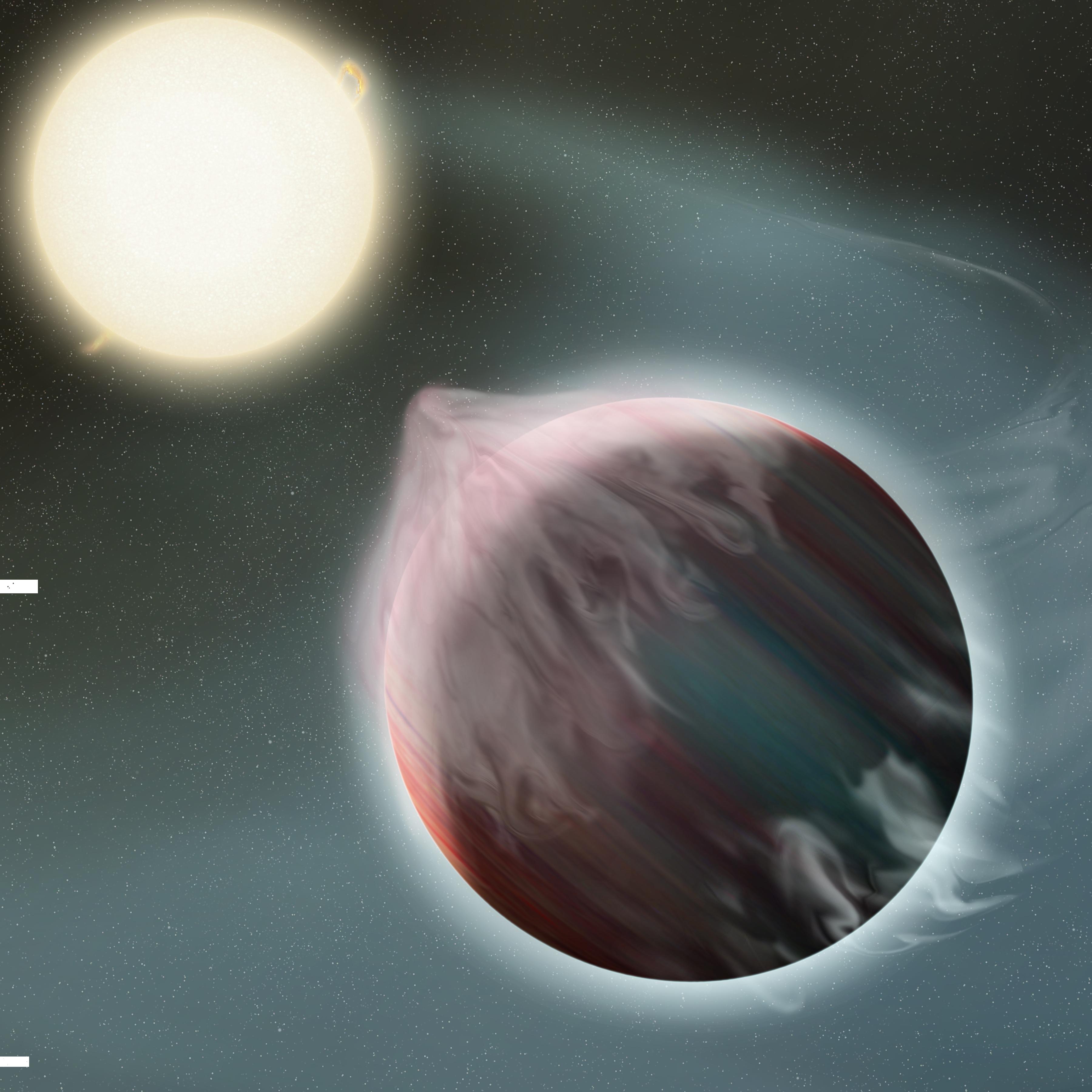
Artist's conception of a hot Jupiter shedding mass.

Artist’s conception of a hot Jupiter shedding mass.

At journal club today, we discussed a recent paper by Valsecchi et al. (2015) that looks at mass loss from hot Jupiters. These planets are so close to their host stars that the stars can blast away and rip the planets’ atmospheres apart.

By employing the sophisticated star/planet evolution model MESA, Valsecchi and colleagues found that the planets can shed most of their atmospheres, leaving behind a small sub-Neptune planet in a short period orbit. However, gravitational interactions between the planet and escaping gas actually push the planet away from the star as the planet is shedding mass, potentially out to orbital periods of a few days.

The upshot of this is that, based on these calculations, the recently discovered population of small ultra-short period planets probably did NOT originate from atmospheric stripping of more massive planets. So it’s not totally clear how these little planets originated, although Kevin Schlaufman suggested one still viable possibility.

Today’s attendees included Jennifer Briggs, Emily Jensen, Charlie Matthews, Jacob Sabin, and Tyler Wade.

From https://emps.exeter.ac.uk/physics-astronomy/research/astrophysics/phd-opportunities/modelling-shock-waves/.

From https://emps.exeter.ac.uk/physics-astronomy/research/astrophysics/phd-opportunities/modelling-shock-waves/.

On Friday, everyone in our research group gave a little update on what they’ve been up to.

Liz and Jennifer talked about Parmentier et al.’s (2013) paper on the meteorology of hot Jupiters and how condensates are transported throughout these dynamic atmospheres.

Emily talked about working through the first few chapters of Murray & Dermott’s classic Solar System Dynamics. She will eventually study the orbital dynamics of systems of exoplanets very close to their host stars.

Brenton discussed his reading of Balme & Greeley (2006) on dust devils in preparation for working with me on terrestrial and Martian dust devils. A very exciting possibility, Brenton and the rest of the group said dust devils are common just south of Boise. Good chance we can do some in-situ monitoring locally.

Nathan spoke briefly about looking for more very short-period planets using data from the Kepler and K2 missions.

In attendance were Liz Kandziolka, Jennifer Briggs, Emily Jensen, Brenton Peck, Nathan Grigsby, Trent Garrett, and Tiffany Watkins.