A very active and engaging morning session on detecting exoplanets via the transit method on AAS 229 Day 1. Lots of good talks (although all of the talks were by male astronomers) and probing but polite questions (again, mostly by male astronomers – interesting study on these trends here). A few talks stuck out in my mind.

Aaron Rizzuto from UT Austin looked for transiting planets in stellar clusters spanning a range of ages using data from the K2 Mission and found there seem to be fewer hot Jupiters in clusters 10 million years old than there are in older (hundreds of millions of years old) clusters. He suggested that this may mean it takes 100s of millions of years for the migration that makes hot Jupiters to take place. That would probably rule out one standard model for making hot Jupiters, namely gas disk migration, since that probably takes place within a few 10s of millions of years.

Dave Kipping of Columbia University discussed his search for transits of Proxima b, the recently discovered, Earth-sized planet just four light years from Earth. Unfortunately, the host star, Proxima, is a highly variable star due to almost constant flaring. As a result, it would be very difficult to see the planet’s transit – as Kipping said, it requires wading through “a sea of variability”. However, Kipping and his group struggled valiantly to recover the transit using data from the Canadian MOST satellite, and it looks like the planet just does not transit. So we probably won’t know the planet’s radius (at least not for a long time). Bummer.

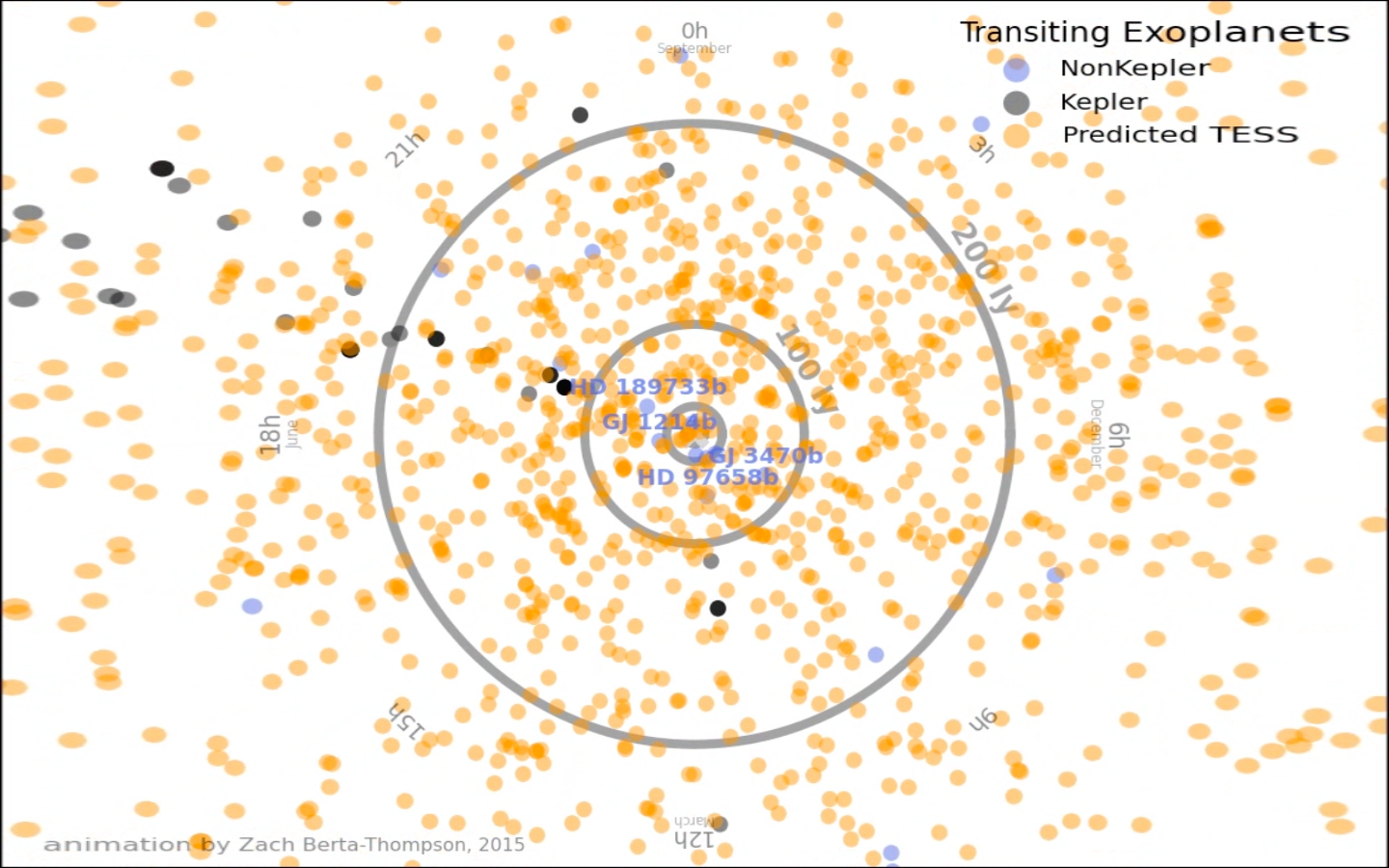
The last talk of the session was from George Ricker, the PI of the TESS mission, the follow-up mission to Kepler, about TESS’s status and prospects. Apparently, the mission will observe more than 2 million stars! Orbiting many of those stars will be nearby habitable planets, and Ricker showed an amazing simulation of where those stars might be found (courtesy of Zach Berta-Thompson of UC Boulder), a still from which is shown below.

I’m at the beautiful Gaylord Convention Center in Grapevine TX, attending the 229th meeting of the American Astronomical Society.
Today’s the first day, and it will be chockfull of presentations, posters, and press releases.

Given my research focus on exoplanets, I’ll mostly be attending talks on that topic, but I’m going to duck out at one point to hear about the solar eclipse, coming up in August this year.

Fortunately for me this year, my presentation was scheduled on the first day of the meeting, in the first session of contributed talks. That means I’ll be able to focus on the rest of the meeting without being preoccupied by preparing for my own presentation. I’ve posted my slides below.

Stay tuned this week for more.

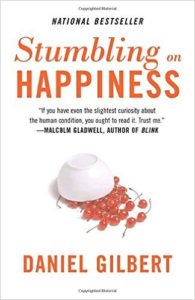
Another book bites the dust during my holiday read-athon, Daniel Gilbert‘s Stumbling on Happiness.

_Stumbling on Happiness_ is an entertaining glimpse into the revolution in applied psychology that has taken place in the last few decades. Gilbert’s frequent use of example and references to specific psychology studies made the book accessible and engaging.

For instance, Gilbert illustrates the anchoring effect by discussing an experiment in which participants were asked how many African countries are represented in the UN. One group was asked whether the number was larger or small than 10, while another was asked whether it was larger or smaller than 60. The former group tended to chose a number larger than but close to 10, while the latter chose one less than but close to 60 (the actual number is 54 apparently). This and many other experiments, Gilbert explains, show that people make estimates by referencing their current situation and correcting from there. This has the effect of skewing their estimates, whether of UN member nations or their future happiness.

The examples were helpful, but often the level of detail or large number of examples given made it difficult to follow the original point. When Gilbert explains how we often incorrectly imagine our feelings will persist indefinitely into the future, he says, “Teenagers get tattoos because they confident that DEATH ROCKS will always be an appealing motto, new mothers abandon promising law careers because they are confident that being home with their children will always be a rewarding job, and smokers who have just finished a cigarette are confident for at least five minutes that they can easily quit and that their resolve will not diminish with the nicotine in their bloodstreams.” I struggled to retain the narrative thread as I waded through that hamdinger of sentence, and many others.

_Stumbling_ is also VERY similar in topic and structure to Daniel Kahneman‘s Thinking, Fast and Slow (which was published 6 years later). However, the latter book was organized around Kahneman’s own professional trajectory, which made a nice logical progression (at least for me) from topic to topic, whereas I couldn’t always follow the sequence from chapter to chapter in _Stumbling_. On the other hand, _Thinking_ is a little drier and more technical, which might turn some people off.

So if you’re looking for introduction to recent developments in applied psychology and the science of happiness, _Stumbling on Happiness_ is a very good choice; just be prepared for a lot of colorful (if lengthy) anecdotes.

Growing Up With Manos

The Master, looming over Torgo.

Another book down during my holiday reading marathon: I just finished Growing Up With Manos: The Hands of Fate by Jackey Neyman Jones.

If you’re not familiar with the movie “Manos: The Hands of Fate“, it’s supposed to be the worst movie ever made, and if it’s not actually, it’s definitely high on the list.

One of my favorite shows, Mystery Science Theater 3000, did a legendary show, introducing the movie to the world back in the 90s, after the movie sank into obscurity. After the MST3K episode, the movie developed a cult following, spawning sequels, musicals, and puppet shows.

Written by the child star of the movie, Jackey Neyman Jones, _Growing Up with Manos_ explains the origins, production, and fall-out of “Manos: The Hands of Fate”. Jones’s account gives some interesting and surprising insights into many bizarre and puzzling aspects of the movie. For instance, the very long driving scene at the movie’s beginning was originally intended by the movie’s creator, Hal Warren, to play behind the credits, but after cutting the scene together, he decided it wasn’t quite long enough to contain the credits. So they were stuffed in haphazardly at the end.

Jones’s story about her complicated but affectionate relationship with her father, who played the star role of the Master, sweetens the otherwise unsettling story of the film’s production: the film’s creator essentially conducted a confidence scheme to rope the stars and crew into helping with production on the promise of fame and fortune (and 200% stock in the production company).

Although the book is an easy read (I read it in a few hours), it could have used a little more editing — several details of the story were told multiple times in essentially the same words. And if you aren’t already very familiar with the film, it would be a hard book to enjoy.

But for the legions of Manos fans, _Growing Up With Manos_ should sit on your shelf, right next to your MST3K boxset.

https://www.youtube.com/watch?v=Pbzkn4Wce-A

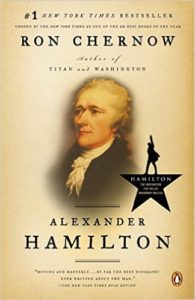
I’m trying very hard this holiday break to wade through my enormous pile of unread books. As a first, tiny success, I just finished reading Ron Chernow’s biography of Alexander Hamilton.

I thoroughly enjoyed the book on an intellectual and personal level, but, surprisingly, it also relieved some of my anxieties about today’s political tumult in the US. Every worrying element of the modern political landscape seems to have had some historical parallel in Hamilton’s time.

An endless stream of fake news stories stressing you out? In 1796, just after George Washington’s farewell address, the Aurora newspaper accused him of having conspired with the British during the American Revolution (p. 507).

Worried about US officials making backroom deals with foreign governments? Thomas Jefferson met secretly with France’s ambassador to sabotage President Adams’s negotiations to avert war with France during its own bloody revolution while Jefferson was vice-president (p. 547).

Troubled by signs of suppression of the press? While it controlled the government, Hamilton’s Federalist party passed the Sedition Act in 1798, which criminalized making false statements that were critical of the federal government.

Alongside the vivid portrait Chernow paints of Hamilton and his life in the newly founded nation, these stories make this biography as relevant and alive as news posted yesterday on facebook. And as just in Hamilton’s time, the political turmoil and truculent partisanship seem to threaten the foundations of our government. Unlike Hamilton, though, we have 200-plus years of democratic traditions to reflect on as we face our current political crises.

Chernow’s rightly acclaimed biography is emotionally engaging, replete with detailed anecdotes from Hamilton’s life, and reassuring, showing that American politics has always been raucous and exasperating.

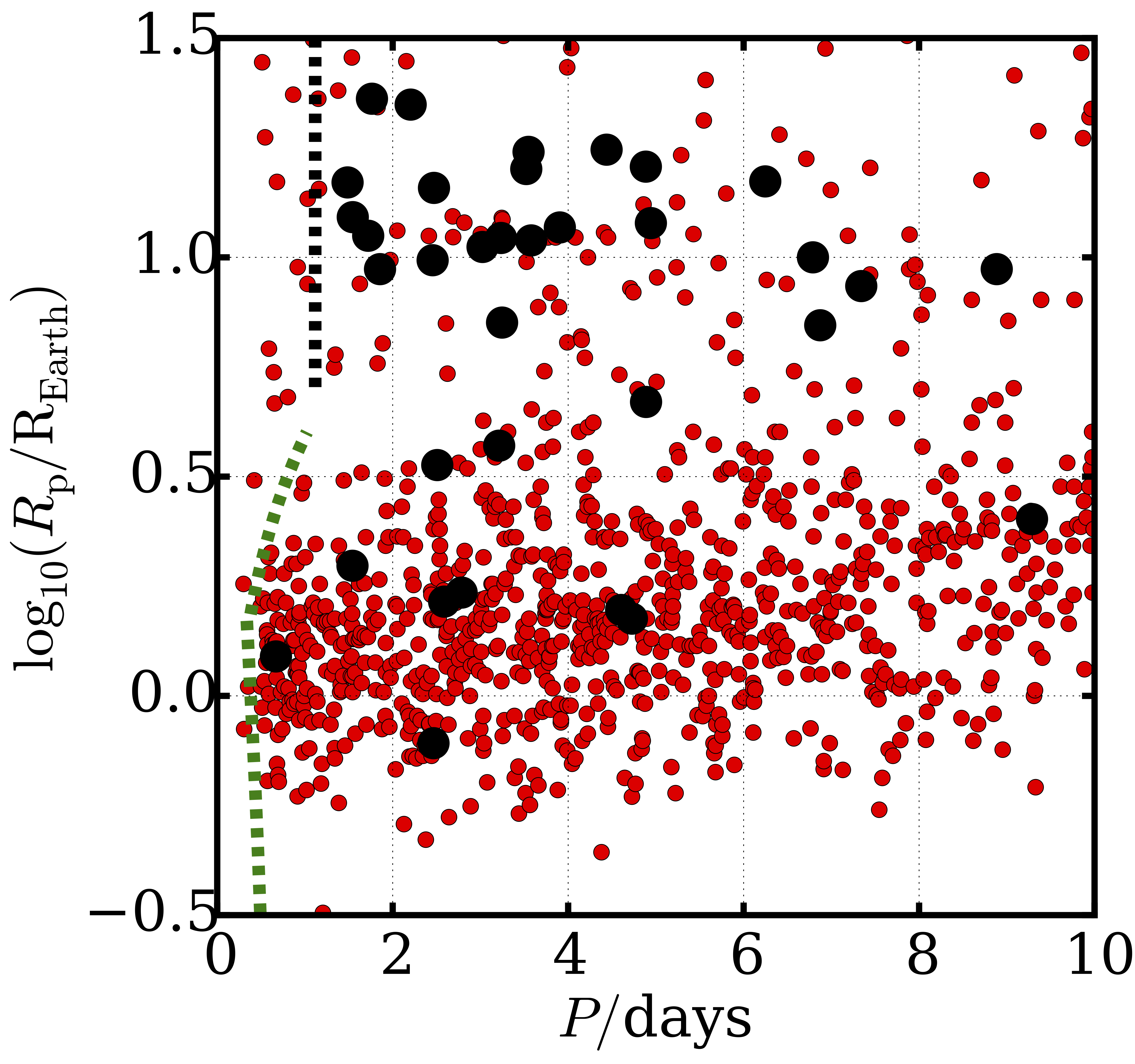
Planetary radii and orbital periods for planets (black circles) and planetary candidates (red circles) discovered by the Kepler mission. The dashed curves shows how close different planets can get to their host stars before they would be tidally disrupted. Taken from Jackson et al. (2016).

Exciting news – just today, my research group had another paper accepted for publication, so we’ve added one more tiny brick to the edifice of human knowledge.

This paper explored tidal disruption of gaseous exoplanets. Over the last few decades, astronomers have discovered thousands of planets outside of our solar system, so-called “exoplanets”.

Most of the planets do not resemble planets in our solar system, and owing to biases in the way we find the planets, many of them are big, gas balls like Jupiter but orbiting much closer to their host stars than planets in our solar system – these planets are called “hot Jupiters“. The figure at left shows how close some of these planets are to their host stars.

Many of these hot Jupiters are doomed to spiral in toward their host stars, and when they get too close, the star’s gravity can rip them apart in a process called “tidal disruption“.

In our recent paper, we studied that process to try to understand how close a planet can get before it’s ripped apart and what might happen as it’s being ripped apart. The upshot of our study is that planets might get ripped apart a little farther from their stars than is often assumed BUT that ripping-apart process might proceed fairly slowly, over billions of years.

UPDATE: Fantastic crowd tonight, with lots of good questions and comments. Thanks, all, for coming.

I’ve posted my presentation below.


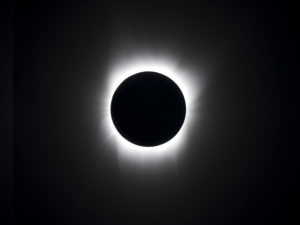
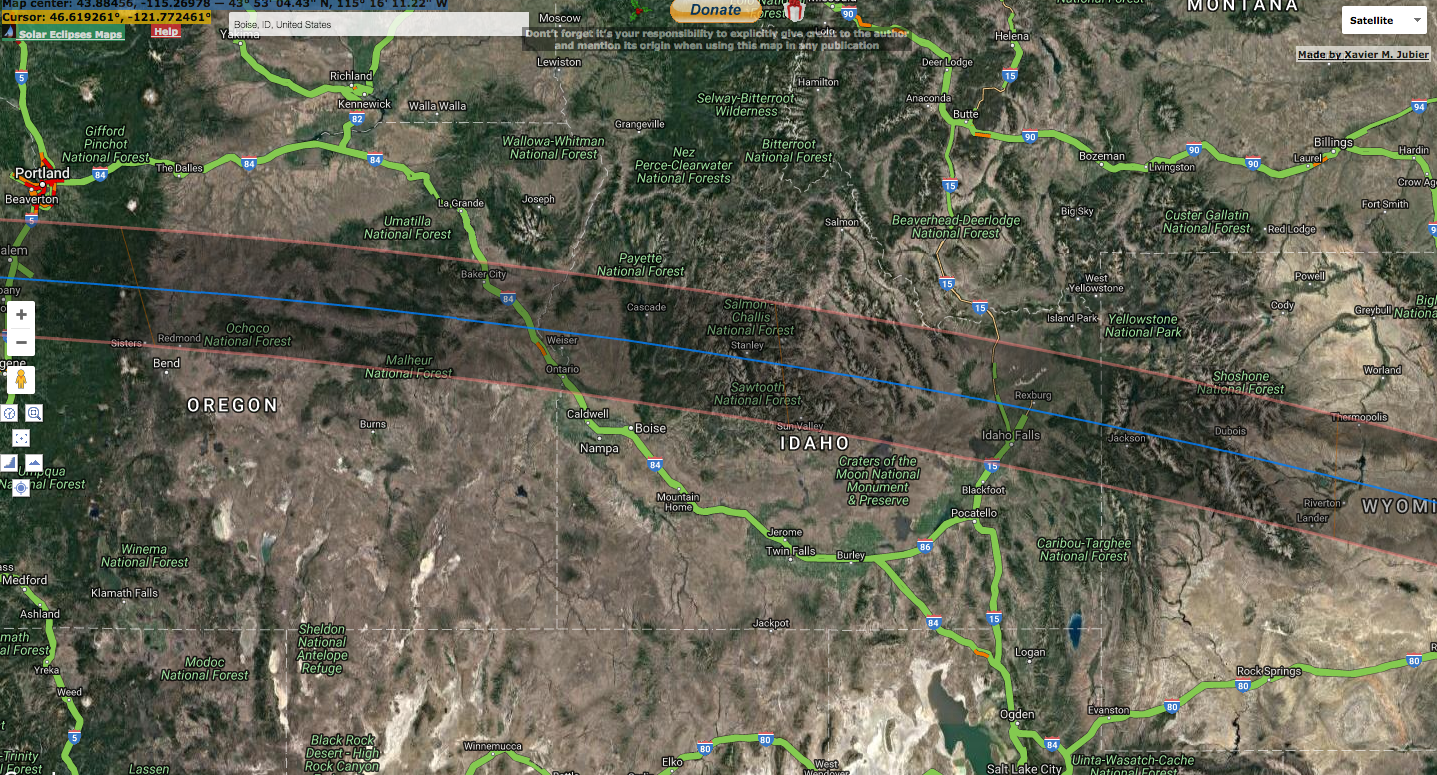
On August 21st, 2017, a total solar eclipse will be visible across the continental United States, the first such eclipse in 38 years! With the path of totality passing directly across our state, Idaho will be a destination for eclipse-chasers from around the world.

On Friday, December 2nd 7:30p to 10p, join the Boise State Physics Department for a stargazing party, with a special lecture about the eclipse from Boise State’s own Dr. Brian Jackson.

The event will be start in the Multi-Purpose Classroom Building in room 101 at 7:30p and then move to the top of the Brady Garage at 8:30p, where telescopes will be set up for star-gazing (weather-permitting).

E-mail Dr. Jackson (bjackson@boisestate.edu) for more info.

UPDATE: Here’s the interactive eclipse map – http://xjubier.free.fr/en/site_pages/solar_eclipses/TSE_2017_GoogleMapFull.html. Please remember to donate to help support that effort.

NASA’s Solar Eclipse page is here – https://eclipse.gsfc.nasa.gov/solar.html.

From http://xjubier.free.fr/en/site_pages/solar_eclipses/TSE_2017_GoogleMapFull.html.

From http://xjubier.free.fr/en/site_pages/solar_eclipses/TSE_2017_GoogleMapFull.html.

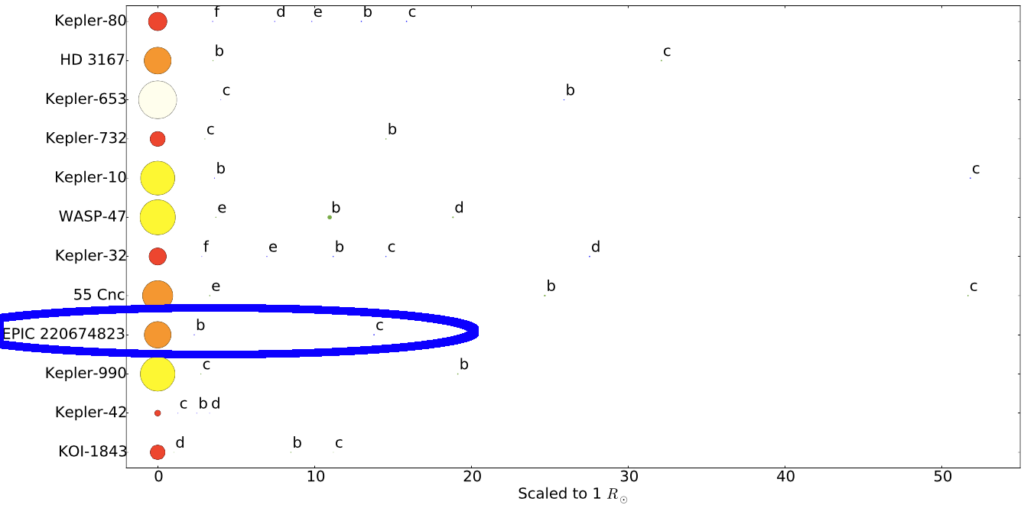
Twelve multi-planet systems where the innermost member is very close to the host star, that is, has an orbital period less than 1 day. From Adams et al. (2016).

Twelve multi-planet systems where the innermost member is very close to the host star, that is, has an orbital period less than 1 day. From Adams et al. (2016).

Big research news today: our research group SuPerPiG, led by the inimitable Dr. Elisabeth Adams, announced the discovery of two new planets, EPIC 220674823 b and c.

Using data from the K2 Mission, we found these planets by looking for the shadows of the planets as they passed in front of their host stars, a planet-hunting technique known as the transit method.

These new planets are very different from planets in our solar system in several surprising ways.

First, they’re both bigger than Earth but smaller than Neptune – planet b is 50% larger, and planet c is 2.5 times larger. They inhabit a strange nether-region of planets where they’re known as super-Earths or sub-Neptunes, planets somewhere between Earth and Neptune. The reason there’s no specific name for such planets is because astronomers don’t understand this new class of planet at all.

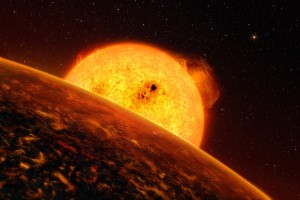
An artist's conception of CoRoT-7 b, another ultra-short-period planet.

An artist’s conception of CoRoT-7 b, another ultra-short-period planet.

Second, both planets are MUCH closer to their Sun than the planets in our solar system. In fact, planet b is so close to its sun that it takes less time to orbit (14 hours) than all the playtime it took the Cubs to go from 3 games down to tying up the World Series. By comparison, planet c circles at the glacial pace of once every 13 days.

Another thing that’s interesting about our planets: they’re yet another system of with an ultra-short-period planet (USP) in which there is more than one planet, i.e. a multi-planet system. In fact, as we argue in our paper,  most of the known systems with ultra-short-period planets are probably multi-planet systems and that fact might help explain the origin of these chthonic planets.

screen-shot-2016-10-25-at-2-00-27-pmOn Friday, November 4th, join the Boise State Physics Department for a public astronomy presentation about exoplanets from special guest Dr. Elisabeth Adams.

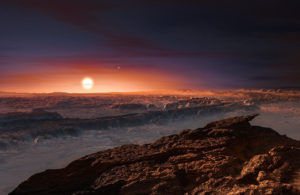
Between planets that orbit so close to their stars that their year is measured in hours to the recently discovered planet around the closest star to Earth (Proxima Centauri b), exoplanets have never been closer. We will discuss what it would be like to visit an ultra-short-period planet, as well as a not-entirely-crazy plan to send probes to Proxima Centauri b.

The lecture will be held on Boise State’s campus in the Multi-Purpose Classroom Building, room 101 at 7:30p. Weather permitting, we will then star-gaze on top of the Brady Garage at 8:30p until 11p.