It was a nice chance to talk about our Pony Up Campaign to support public outreach for the upcoming solar eclipse. We’re just finishing week two of the campaign, and it’s received a lot of local interest. Thanks to all our donors, especially Beverly Takeuchi and our anonymous donors.
These planets have been something of a puzzle since the first was discovered back in 1995. Like Jupiter, they are mostly made out of hydrogen and helium gas, but unlike Jupiter, they orbit very close to their host star, which probably means they didn’t form where we see them today.
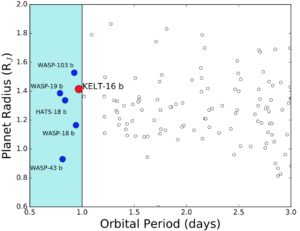
Even among hot Jupiters, though, KELT-16 b is an outlier. It’s one of a handful of hot Jupiters with orbital periods less than 1 day (as compared to Jupiter’s orbital period of 12 years), so whatever processes led to its origin are cranked up to 11 for KELT-16 b and its ultra-short period siblings.
The mystery of its origins aside, its short period means KELT-16 b is probably a good candidate for follow-up observations of its atmosphere, particularly by the James Webb Space Telescope. But tidal interactions with its host star means it may get eaten by its host star in less than a million years, so we need to get those observing proposals submitted soon.
Dear Astrophiles, we’re officially one week into our Pony Up campaign to raise money to support outreach for the solar eclipse in August this year. Things are going great – we’re 20% of the way to our goal of $5k.
Thanks to our many donors and especially to Pam Robbins, Mark & Sharon Johnson, flying m coffeegarage, Scott Watkins, Paul Collins, Cindy Hall, Barbara & Clay Morgan, and several anonymous donors.
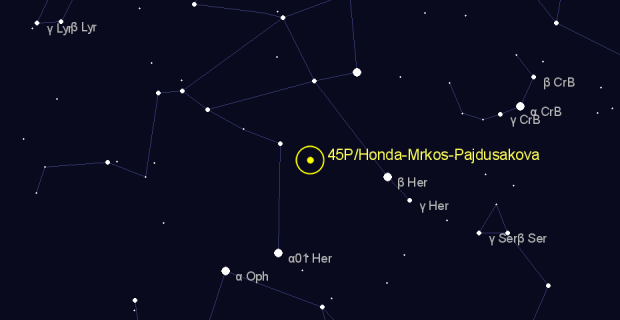
To celebrate our progress so far, I’ve arranged for Comet 45P/Honda-Mrkos-Pajdusakova to pass by the Earth this weekend. You can see Comet 45P in the constellation Hercules high in the early morning, eastern sky. It will look like fuzzy bluish-green ball with a fan-shaped tail. The green color comes from glowing carbon gas.
Proxima Centauri is the closest star to the Earth (only 4 lightyears away), and last year, an Earth-sized planet was found around it, opening to door to the very real possibility of a mission to an exoplanet.
After the planet’s discovery, the Breakthrough Starshot project proposed using solar sails and lasers to accelerate a tiny spacecraft to the system. Weighing only a few grams, the spacecraft could be accelerated to 20% the speed of light, giving a travel time to the system of about 20 years. Of course, the drawback to such a short trip is that the spacecraft would quickly zip past the planet, so the mission would have only seconds to collect data.
Building on that idea, Heller and Hippke pointed out that, as long as you didn’t mind waiting a little longer to get there (about 100 years), you could send the spacecraft at a low enough velocity that the solar sail could be used to slow the spacecraft on the other end. That would give you years to collect data, instead of seconds.
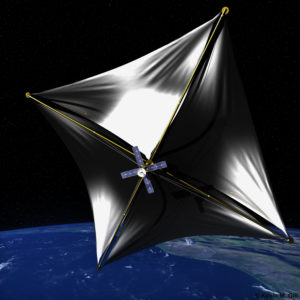
Key to their solution is the idea that you could slowly turn the solar sail, similar to tacking in the wind, to optimally slow and steer your 10-gram spacecraft. The animation below shows the basic idea.
With such a small spacecraft, there wouldn’t be a lot of room for moving parts to turn and orient the solar sail. To solve this problem, Heller and Hippke suggest the sail could be made of nanocrystals-in-glass whose reflective properties could be tuned to torque the spacecraft using the stellar photons themselves.
Of course, there are still zillions of technical problems to solve for such a mission (not to mention the difficulties of obtaining centuries-long NASA funding), but this study adds one more piece to the growing possibility of interstellar exploration.
Another exciting day for STEM at Boise State – today is the Engineering & Science Festival. I’ve heard thousands of people have signed up to attend, so we’re expecting huge crowds.
Today is Aerospace Day at Boise State, a celebration of all things aerospace, aeronautics, and aviation.
I was invited to give a talk about the upcoming solar eclipse, and during my talk, I’m going to kick off our Crowd-Funding campaign for public outreach focused on the eclipse. I’ve posted my talk below.
Due to popular demand, we have re-opened the Pony Up Campaign! If you still need eclipse shades, please donate to help our outreach program.
2017 Idaho Eclipse
On the morning of August 21, 2017, a total solar eclipse will be visible across the continental United States. The Moon’s shadow will also pass through Idaho, and visitors from all around the world will flock to our state.
To prepare for this once-in-a-lifetime event, Boise State is asking for your support to help us work with communities around the state.
The Challenge
This will be the first eclipse visible across the United State since 1979 and the last one visible from Idaho for more than 150 years. For two hours, the Moon’s disk will cross the disk of the Sun, completely blotting it out for about two minutes during the height of the eclipse.
The eclipse will be visible to the naked eye, but before and after the total eclipse, viewing the Sun directly can potentially damage the eye. And thousands upon thousands of visitors are expected to come to Idaho, posing significant logistical challenges for small municipalities.
The Plan
Boise State is partnering with local libraries, astronomy clubs, and science museums to organize outreach events all over the state throughout 2017.
With these partners, Boise State will host public presentations about the eclipse and provide eclipse shades for safe viewing. One of Boise State’s own, Prof. Brian Jackson, will help organize and lead these efforts.
Here’s where you come in: donations to this campaign will cover the costs of travel, materials, and other expenses related to these events. They will also enable Boise State to support our partners in their own outreach efforts.
To reward your generosity, we are offering a variety of gifts, from VIP access to a public astronomy event to a private stargazing party with Prof. Jackson. And perks stack, so if you donate at a certain level, you also get the perks from lower levels, too.
So help Boise State University reach out across Idaho to make the 2017 solar eclipse an eclipse to remember.
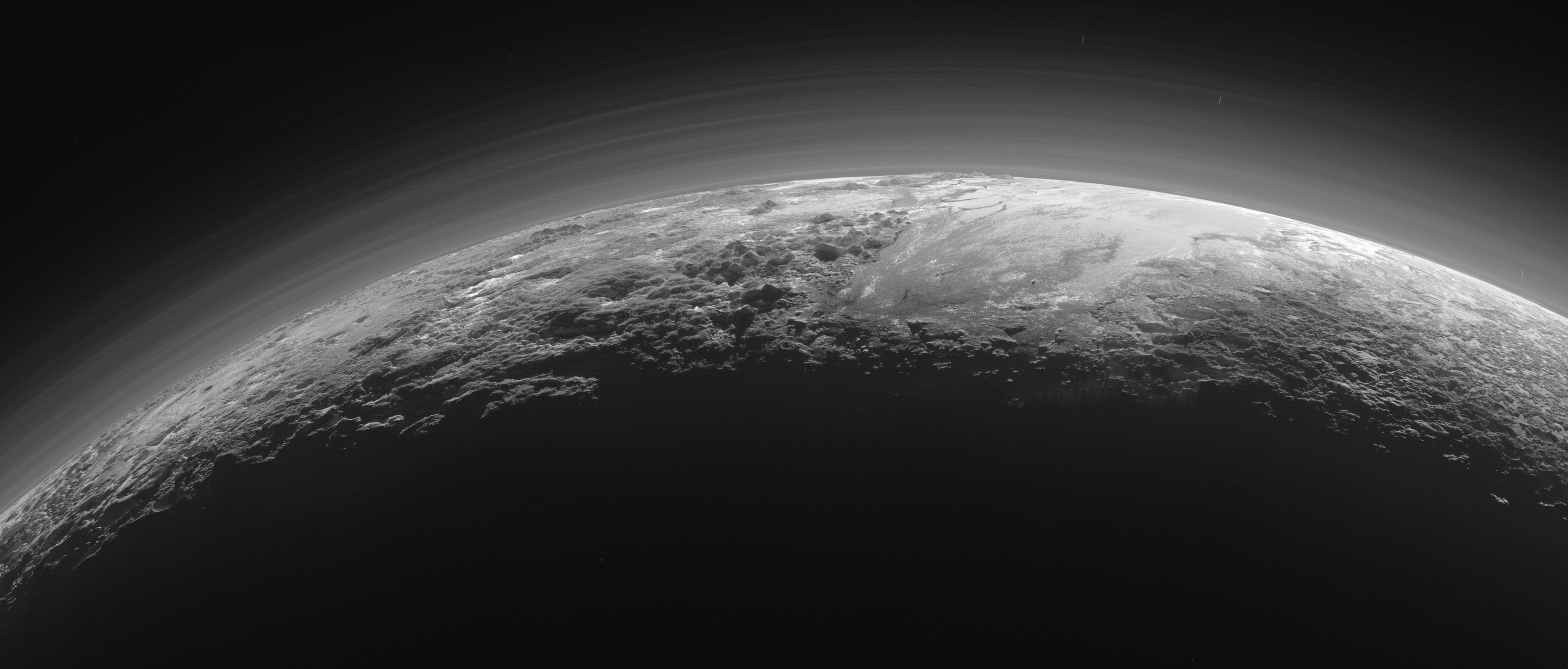
Come learn about the New Horizons mission, the team, and the 20+ years it took to get this mission to Pluto. Take a closer look at Pluto, Charon, and the other 4 moons as we dive into the Kuiper Belt, and the extended mission to visit another Kuiper Belt Object.
The event takes place on Friday, Feb 3 and will start in the Multipurpose Classroom Building in room 101 at 7:30p and then move to the top of the Brady Garage at 8:30p, where telescopes will be set up for stargazing (weather permitting).
The weather forecast for this week is not promising, so we’ll cancel the stargazing portion. The lecture will still happen, though.