UPDATE (2017 Aug 2) – I’ve had more than person ask whether they’ll be able to see the solar corona, the tenuous and very hot outermost layer of the Sun’s atmosphere, during the partial eclipse in Boise. I believe the answer is no.

This website indicates that the corona is a million times dimmer than the Sun’s photosphere. During the darkest part of the partial eclipse in Boise, the photosphere, the part of the Sun we usually see, will be 200,000 times dimmer than usual (see below).

So my guess is, from Boise, not enough of the photosphere will be occulted to reveal the corona.

Millions of people will travel from around the world to observe the total solar eclipse on August 21 in the path of totality, a band extending across the US in which the Moon will completely occult the Sun. Everyone NOT inside that path will observe a partial solar eclipse, and the closer you are to the path of totality, the darker your partial eclipse.

During our statewide tour talking about the eclipse, I have been asked again and again “Is it worthwhile trying to get to the path of totality?” The honest truth is that there are some aspects of the eclipse that you will miss out on if you don’t get to the path of totality.

BUT getting to the path of totality can be difficult – in Idaho, there are reports that all hotels and campsites are booked up, and driving to the path on the day of the eclipse will probably involve sitting in traffic for many hours. So travelers should be prepared with food and water.

So what will you see if you CAN’T get to the path? You can still enjoy a nice eclipse, but you MUST use eye protection during the ENTIRE eclipse. Staring at a partial eclipse at any level can permanently damage your eyes.
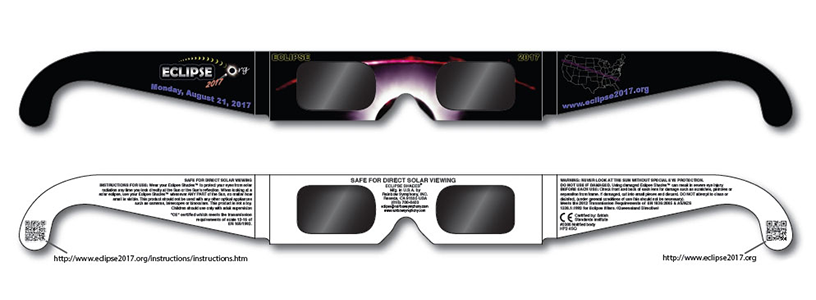
Eclipse shades, the best way to safely observe the solar eclipse.

What will you see during a partial eclipse? That depends on where you observe from. For example, Boise is just south of totality and will see a partial eclipse with 99.555% obscuration (check out this amazing map to see eclipse conditions anywhere in the world). That means the Moon will block all but 0.00445% of the Sun’s disk, making the Sun more than 200,000 times darker than usual.

So what will that look like? The visualization below shows an approximation as seen through eclipse shades. As one-two-hundredth its normal brightness, the Sun will appear a little dimmer than the sky at twilight* and about ten times as bright as the Sun normally appears from Pluto.
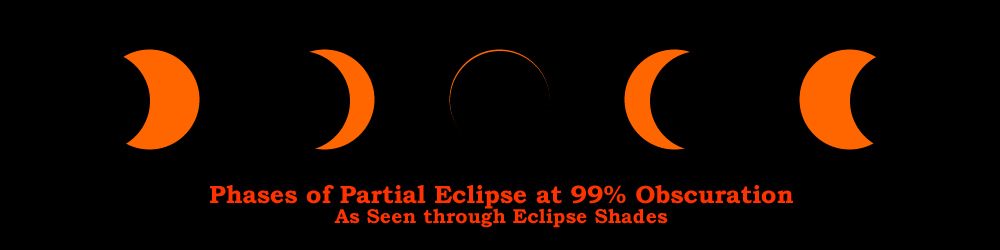
What a 99% partial eclipse looks like through eclipse shades. From http://americaneclipseusa.com/seeing-the-eclipse-from-home/.

At this level, though, you probably won’t be able to see the solar corona, and other eclipse effects will be substantially more muted. But for those who can’t take off of work or skip school – August 21 is a Monday, after all – the partial eclipse viewed from near the path of totality will still be a once-in-a-lifetime event.


*At 0.00445%, the usual solar flux (1300 W/m^2) will be reduced to about 0.06 W/m^2. This paper indicates that when the Sun is at a zenith angle of 105 degrees (i.e. a while after the Sun has set), the sky brightness is about 0.1 W/m^2.
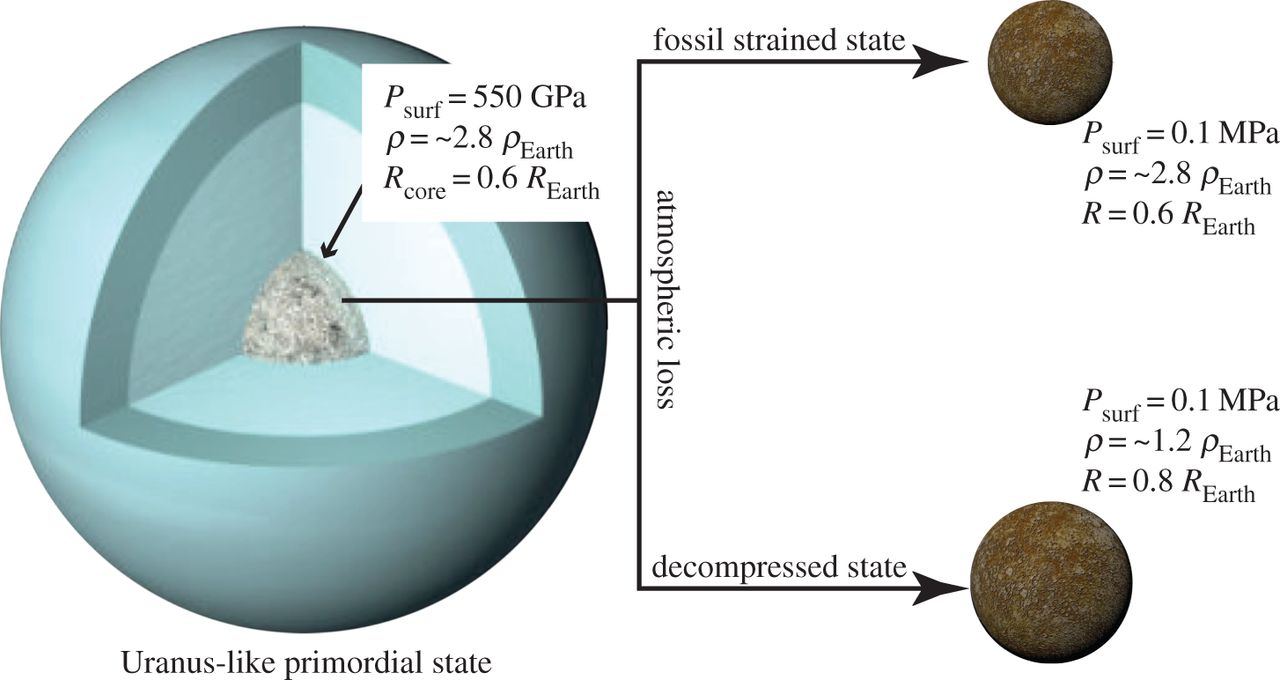
Figure from Mocquet et al. (2014) show how a gaseous planet might evolve into a dense, rocky core.

Another blast from the past, Mocquet et al. (2014) was the topic of our journal club this week, a paper that seeks to answer the question “What would Jupiter look like if you took away its atmosphere?”.

Given the enormous number of gas-rich exoplanets very close to their host stars discovered in recent years, many astronomers (including myself) have wondered whether such planets could have their atmospheres completely removed.

We certainly see some very hot planets where intense sunlight is blasting away their atmospheres, and in other cases, the star’s gravity can rip off the atmosphere. And so it’s not crazy to think some gaseous planets might completely lose their atmospheres.

Would anything be left over? Astronomers think that gas giants like Jupiter are like big cherries, with a squishy outer layer of gas wrapped around a dense pit of rock. Indeed, the Juno mission currently in orbit around Jupiter is designed to measure the size of Jupiter’s core by measuring its gravitational field very precisely.

And so the cores of gas giants are under enormous pressure – for instance, the core of Jupiter is being squeezed by 45,000 times the pressure at the bottom of the Mariana Trench on Earth.

In their study, Mocquet and colleagues explore what happens to a rocky core under such large pressures. Not surprisingly, they find that such a core would have an enormous density, perhaps three times larger than the Earth’s.

But what is surprisingly is that their results suggest the core might retain a very large density even if you removed the overlying atmosphere. It’s as if you squeezed down a nerf ball and then let it go – instead of springing back immediately, the nerf ball would take a few billion years to decompress. This means that we might be able to identify the cores of former gas giants by looking for planets roughly the size of Earth but with anomalously high densities.

And in fact, such planets have been found – the planet Kepler-57 b has a mass more than 100 times Earth’s but squeezed into a volume only ten times larger, giving a density of almost 44 grams per cubic centimeter – twice the density of the densest element on Earth, osmium.

So in their search for fossils, gas giant paleontologists should keep in mind that the bones of extinct gas giants may have distinctively large densities, almost as dense as adamantium.

Along with my student Karan Davis, I enjoyed a visit last night to the town of Cambridge, about a two hours north of Boise, to talk to folks there about the August 21st solar eclipse.

We were invited by Nina Hawkins, one of the librarians at the public library there in town, and we met her before the presentation at the newly refurbished Country Coffee Cabin in Midvale.

A BLT and fingersteak basket later, Nina led us up the nine-mile winding road to Cambridge, where we were greeted by a few dozen Cantabrigians at the library. For about an hour, Karan and I described the upcoming event and answered questions from the public. As always, I was impressed by how engaged and interested everyone was, especially late on a Thursday evening.

After passing out eclipse shades to the attendees, we packed up our road show and drove back down to Boise, just as the Sun set in the cloud-strewn pink sky, a preview of the twilight effect we will experience during the eclipse in August.

The presentation I gave in Cambridge is posted below.


Sunset over Idaho Falls.

Just returned from my trip to Idaho Falls, speaking to hundreds of locals about the upcoming eclipse.

I was invited to give two presentations at the Idaho Falls Public Library, a library so beautiful and spacious it has an atrium with a fountain.

On Tuesday evening, I gave a presentation to the broader Idaho Falls community. A few minutes before the presentation, there were only about a dozen attendees, which made me a little nervous, but by the appointed hour, the space had filled beyond capacity, with nearly one hundred folks – an unexpected large but very welcome crowd.

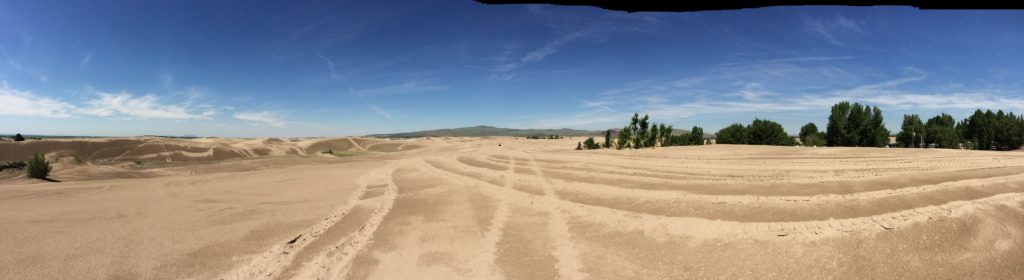
Before my next presentation on Wednesday afternoon, I took a side trip up to the St. Anthony dune field. Since the dune field is likely to be a prime spot for eclipse-viewing, I was curious to see what preparations they were making.

The dune field near St. Anthony.

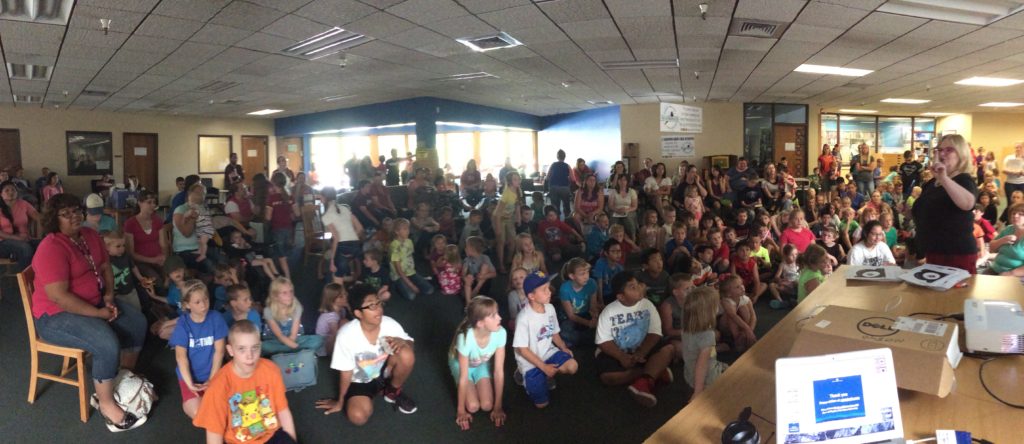
Back to Idaho Falls for an afternoon presentation geared to the youngest eclipse enthusiasts. Here again, we had an unexpectedly large crowd, with easily 200 kids and parents cheerfully crammed into the presentation space.

Wednesday’s crowd.

After helping the kids make souvenir planispheres, I packed up my roadshow for the long drive back to Boise. The megaflood-carved landscape of the Snake River Plain combined with a Planet Money podcast about a flatware-crafting commune to make the time pass quickly.

The presentations I gave in Idaho Falls are posted below.


Idaho Falls Community Presentation

Idaho Falls Children’s Presentation

UPDATE: The stargazing event today went swimmingly – several dozen visitors came down to talk about the solar eclipse and look at the Sun. We even had crew from KTVB film some interviews. Some photos from our event below.


Join the Boise State Physics Department and learn more about the Aug 21 solar eclipse. We will host a conversation about observing the eclipse and distribute eclipse shades.

The event will take place on Sunday, June 18 from 12p till 2p in the plaza just north of the Multipurpose Classroom Building on Boise State’s campus.

Questions can be sent to Prof. Brian Jackson via e-mail – bjackson@boisestate.edu.

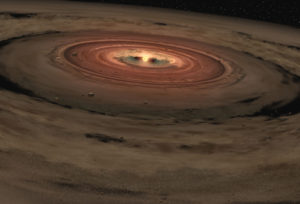
Artist’s conception of a protoplanetary disk from which planets form.

During today’s research group meeting, we discussed a paper from a few years ago from Lars Buchhave and colleagues that investigated the relationship between the composition of a planet-hosting star and the properties of its planets.

The discoveries of thousands of exoplanetary systems in the last few decades has revealed the bewildering variety of planets formed in our galaxy, and the richness of this planetary zoo probably reflects the wide range of conditions in which these planets formed.

Going back to the philosopher Kant, planets have been thought to form in disks of gas and dust leftover after their host star forms, and we now have a plethora of observational and theoretical evidence supporting this idea.

This idea means that the star and planets form mostly from the same source of material. However, while stars form directly out of the disk, the formation process for planets is a little pickier about what goes into the planets.

For example, the Sun is made almost entirely out of hydrogen and helium, elements that constitute most of the baryonic matter in the universe, while the Earth is made mostly of rocky elements, which are pretty rare in the universe. The gas giant Jupiter is kind of a mix – it’s mostly hydrogen and helium like the Sun, but it has more of the heavier elements than the Sun, all of which astronomers refer to as metals.

In their paper, Bucchave and colleagues report estimates of the ‘metallicities‘ or the amount of metals in lots of planet-hosting stars and try to figure if the type of planets around a star depends somehow on stellar metallicity.

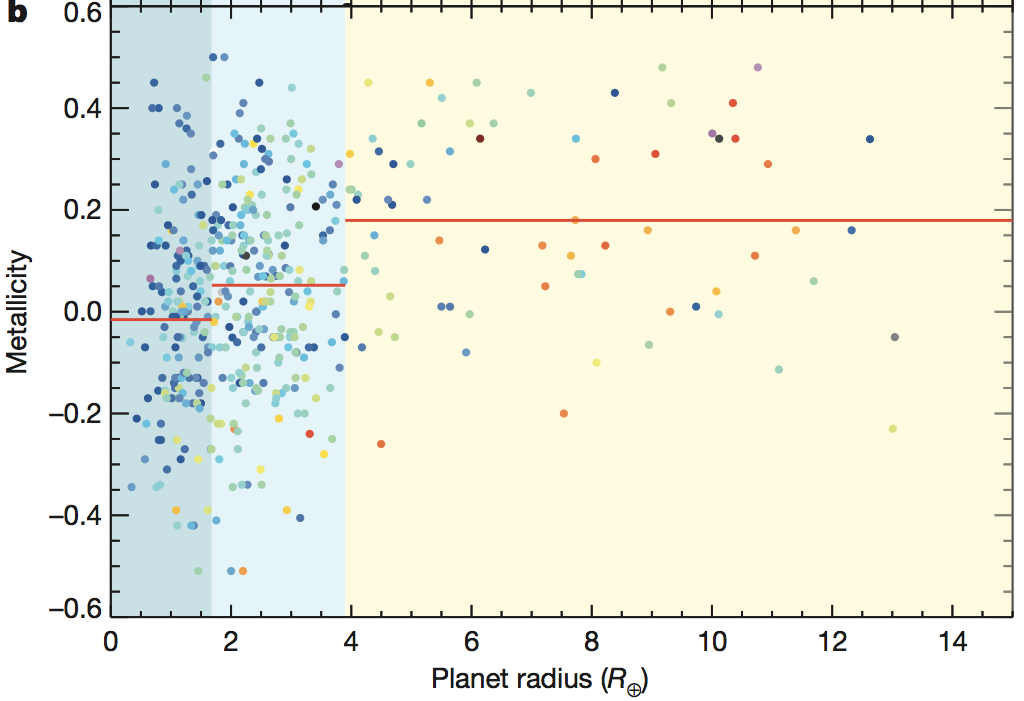
Figure 1 from Bucchave et al. (2014) shows the metallicities of stars vs. the radii (in Earth radii) of their planets. The horizontal red lines show the average metallicity for stars in that group.

Interestingly, the metallicities suggests there are three kinds of planetary systems – shown as dark blue, light blue, and yellow in the figure above. Big gaseous planets like Jupiter, with radii many times Earth’s, seem to form preferentially around stars with lots of metals, while small planets like the Earth aren’t as picky – they’ll form around stars with any metallicity. And planets with radii in between, about 2 to 4 times the Earth’s radius, they’re like Goldilocks and prefer stars with a little more metals but not too much.

What does all this mean? Astronomers think the protoplanetary disk (and therefore the star) might be required to have lots of planet-forming materials (that is, metals) in order to make big planets like Jupiter. On the other hand, forming small planets like the Earth apparently doesn’t take much because even stars with a tenth the Sun’s metals host them. Which all sort of makes sense.

But these results don’t answer everything. Why, for example, aren’t the stars with really big metallicities (the blue dots near the top left of the figure) always able to form big, Jupiter-like planets? This cluster of three blue dots are all members of the KOI-3083 planet system, whose star is Sun-sized but has almost three times more metals, but all the planets are smaller than Earth.

Could there be big planets in that system we haven’t found yet? Or maybe the planet formation process involves so much randomness (stochasticity) that a big metallicity only steers the system in the direction of big planets; it doesn’t force them in that direction. Like gently shepherding a toddler through a toy store – more often than not, you’ll end up with toys in your cart.