For a massive (Jupiter-sized) planet orbiting very close to its host star, the planet’s gravity can distort the shape of the star, similar to the tides raised in the Earth’s oceans by the Moon’s gravity. As these stellar tidal waves flow on the star in response to the planet’s gravity, the star can appear to brighten and dim slightly. The tides are VERY small (about 100 meters tall), and so the amount of brightening and dimming is very small, tens of parts per million, and looking for this astronomical signal is like looking for a firefly against the glare of football stadium lights. The figure below illustrates the effect.
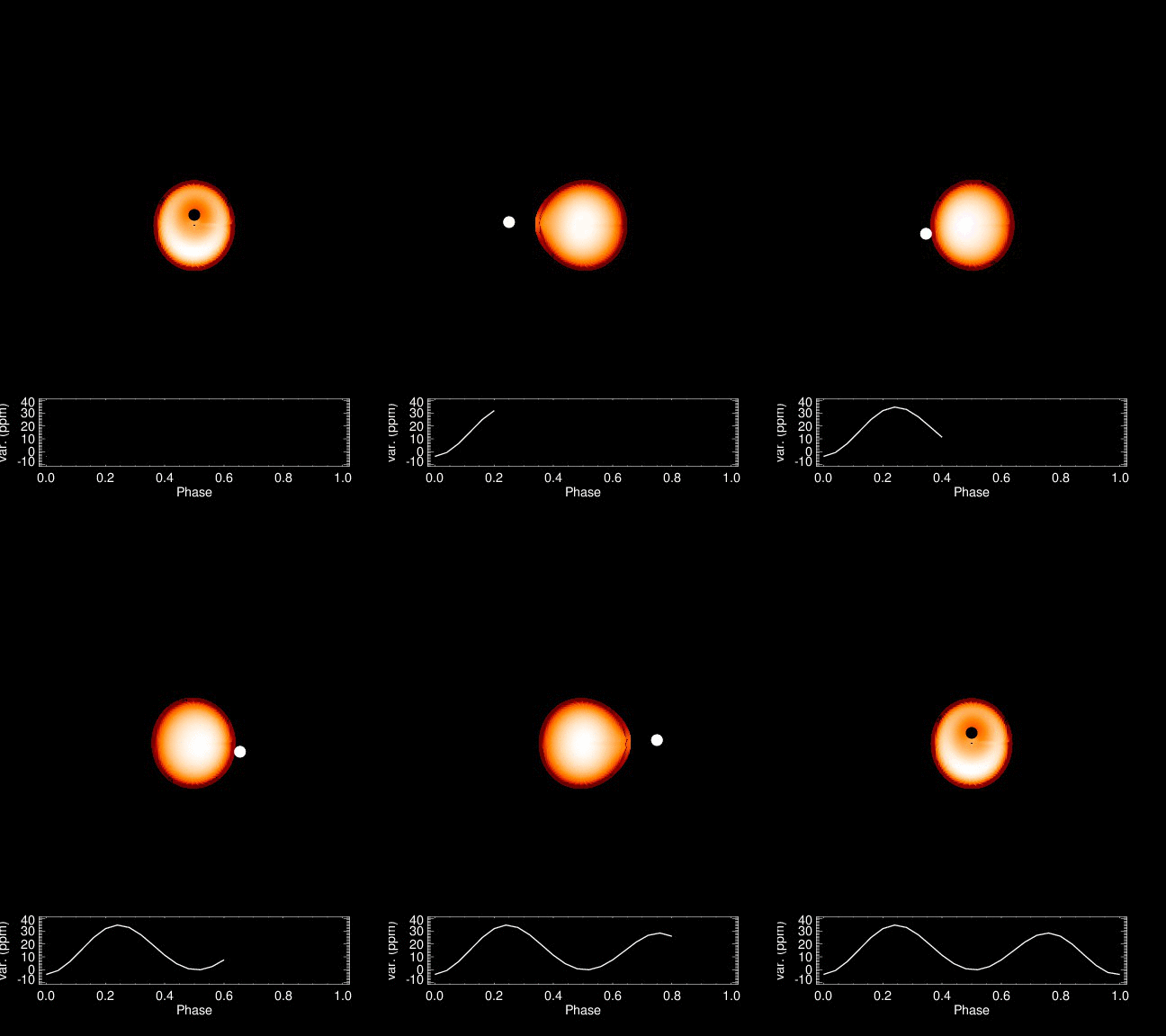
My colleagues and I created a new model for Ellipsoidal Variations Induced by a Low-Mass Companion, the EVIL-MC model, and in Jackson+ (2012), we used the EVIL-MC model to analyze observations from the Kepler mission of the HAT-P-7 system, an F-type star orbited by a roughly Jupiter-mass gas giant companion in a 2-day orbital period. Our analysis allowed us to estimate the planet’s mass and the (blackbody) temperature of the planet’s dayside, at about 2680 K. We also found a large difference between the day- and nightside planetary flux, with little nightside emission, which is qualitatively consistent with little day-to-night atmospheric circulation and in-line with other observations of very hot gas giants very close to their host stars.
Related Scientific Publications:
- Jackson+ (2012). “The EVIL-MC Model for Ellipsoidal Variations of Planet-hosting Stars and Applications to the HAT-P-7 System.” ApJ 751, 112.
- Jackson & Carlberg (2012). “Ellipsoidal Variation Analysis of Kepler Observations Using the EVIL-MC Model.” DPS Meeting.