exoplanets

All posts tagged exoplanets

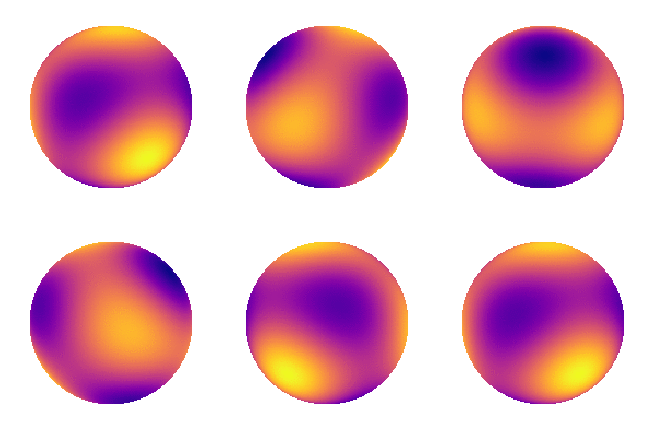
Simulated clouds rotating in and out of view on a hot Jupiter.

Planetary phase curves (light reflected and emitted by the planet as it orbits its star) can provide insight into atmospheric processes, and the Kepler Mission’s observational baseline spanning hundreds of days for some planets makes its dataset especially well suited to search for phase curve variability, diagnostic of meteorology as advective processes sweep thermal structures and aerosols into and out of view. This project involves analysis of archival Kepler data to understand the weather on these distant worlds.

  • Jackson et al. (2018) – “Searching for Eclipse Variability for Kepler-76 b in the Kepler Dataset” – DPS Presentation
  • Jackson et al. (2019) – “A Search Variability in the Atmosphere of the Hot Jupiter Kepler-76 b” – LPSC Presentation
  • Jackson et al. (2019) – “Variability in the Atmosphere of the Hot Jupiter Kepler-76b” – ApJ article
On August 21st 2017 a total solar eclipse crossed the USA from coast to coast. The Citizen CATE Experiment used a fleet of telescopes to observe the solar corona during this spectacular event. From https://www.youtube.com/watch?v=aIII0aOZ4UA.

Among different fields of science, astronomy has a unique history of citizen science projects. In the last few decades, the advent of user-friendly software and web infrastructure, as well as off-the-shelf research-grade instrumentation, has led to a golden age of citizen science astronomy. Opportunities for amateurs to contribute meaningfully to astronomical research have never been more plentiful.

Continue Reading

From https://webbtelescope.org/resource-gallery/articles. (This is a slightly updated reprint of an article originally run Nov 2021.)

An artist’s concept of the Webb Space Telescope. From https://solarsystem.nasa.gov/missions/james-webb-space-telescope/in-depth/.

NASA’s James Webb Space Telescope (JWST), scheduled to launch on December 18, will primarily use its spectrographs – specialized instruments that capture and spread out light like a rainbow – to study exoplanets. By analyzing this data, known as spectra, researchers will be able to measure exoplanets’ compositions and chemistries. Spectra will help refine what we know about any exoplanet Webb observes, including massive gas giants, mid-sized ice giants, and smaller rocky exoplanets (some of which could be similar to Earth). In a few cases, JWST will deliver images of exoplanets to reveal more about them.

Continue Reading
TRAPPIST-1 Discovery

https://www.nasa.gov/press-release/nasa-telescope-reveals-largest-batch-of-earth-size-habitable-zone-planets-around

https://www.popularmechanics.com/space/deep-space/g40958720/exoplanets-in-the-milky-way/

https://exoplanets.nasa.gov/alien-worlds/exoplanet-travel-bureau/

https://exoplanets.nasa.gov/alien-worlds/strange-new-worlds/