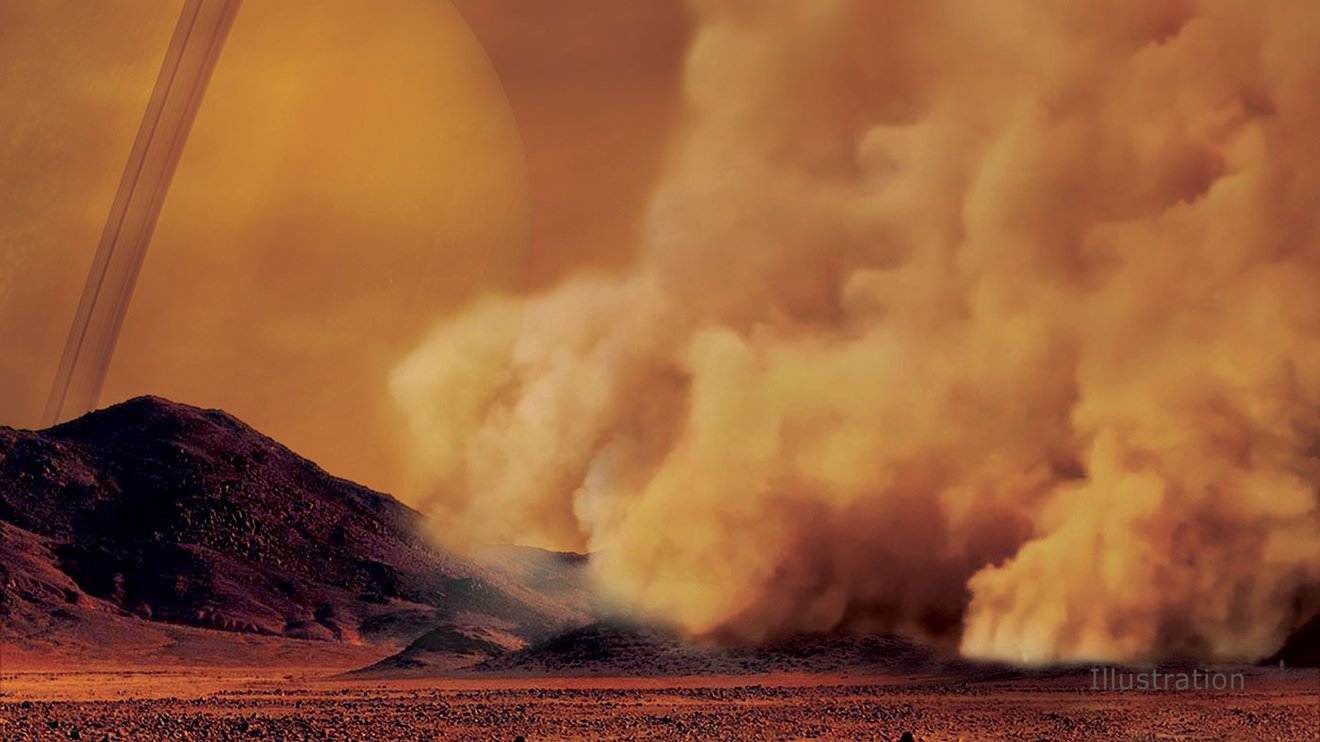
Saturn’s moon Titan may host active dust devils, small dust‐laden plumes, which could significantly contribute to transport of dust in that moon’s atmosphere. Although the exact nature of dust on Titan is unclear, previous observations confirm that there is actively blowing dust on that world. If dust devils are active on Titan’s surface, NASA’s upcoming Dragonfly mission is likely to encounter them, but dust devils on Titan are unlikely to pose a hazard to the mission.

Research Publications

  • Jackson et al. (2020). “Dust Devils on Titan.” JGR: Planets.
  • Jackson et al. (2020). “Dust Devils Throughout the Solar System.” Lunar and Planetary Sciences Conferences 2020.

    Press Coverage
  • “Dust devils may roam hydrocarbon dunes on Saturn’s moon Titan.” AGU Geospace.
  • “Saturn’s massive moon Titan may generate swarms of dust-fueled twisters.” Syfy Wire.
  • “Titan twisters? ‘Dust devils’ may be swirling on Saturn’s largest moon.” Space.com.
  • “The Best Moon in the Solar System May Be More Like Earth Than We Thought.” Popular Mechanics.
The InSight Mission‘s instrument suite.

The InSight mission has operated on the surface of Mars for nearly two Earth years, returning detections of the first marsquakes. The lander also deployed a meteorological instrument package and cameras to monitor local surface activity. These instruments have detected small-scale vortices, some of which may be dust devils. Howver, although our analysis shows that InSight encountered more than 900 vortices and collected more than 1000 images of the Martian surface, no active dust devils were imaged. Surveying the available imagery, we placed upper limits on what fraction of vortices carry dust (i.e., how many are bona fide dust devils) and estimate threshold wind speeds for dust lifting. Comparing vortex encounters and parameters with advective wind speeds, we find evidence that high wind speeds at InSight may have suppressed the formation of dust devils, explaining the lack of imaged dust devils.

Research Publications

Dust devil slithering along the martian surface, as seen by he Curiosity rover. From https://en.wikipedia.org/wiki/Dust_devil_tracks.

An important and perhaps dominant source of dust in the martian atmosphere, dust devils play a key role in Mars’ climate. Datasets from previous landed missions have revealed dust devil activity, constrained their structures, and elucidated their dust-lifting capacities. However, each landing site and observational season exhibits unique meteorological properties that shape dust devil activity and help illuminate their dependence on ambient conditions.

Data from the Mars Environmental Dynamics Analyzer (MEDA) instrument suite onboard the Mars 2020 Perseverance rover shows signals of passing vortices and dust devils. Over the mission’s first 180 sols, the rover encountered almost 1000 vortices, perhaps one quarter of which showed signs of dust-lofting. Combining our measurements of their meteorological signals with simple thermodynamic models, we estimates how tall the vortices were, and some reached as high as 2 km into the dusty martian sky.

These kinds of estimates are key for understanding how dust devils help to maintain the perpetual background of atmospheric dust on Mars, which drives martian climate and water loss to space.

Research Publications

  • Jackson, B. (2022) “Estimating the Heights of Martian Vortices from Mars 2020 MEDA Data.” in review with Planetary Science Journal.
  • Jackson, B. (2022) “Vortices and Dust Devils as Observed by the Mars Environmental Dynamics Analyzer Instruments on Board the Mars 2020 Perseverance Rover.” Planetary Science Journal.

Press

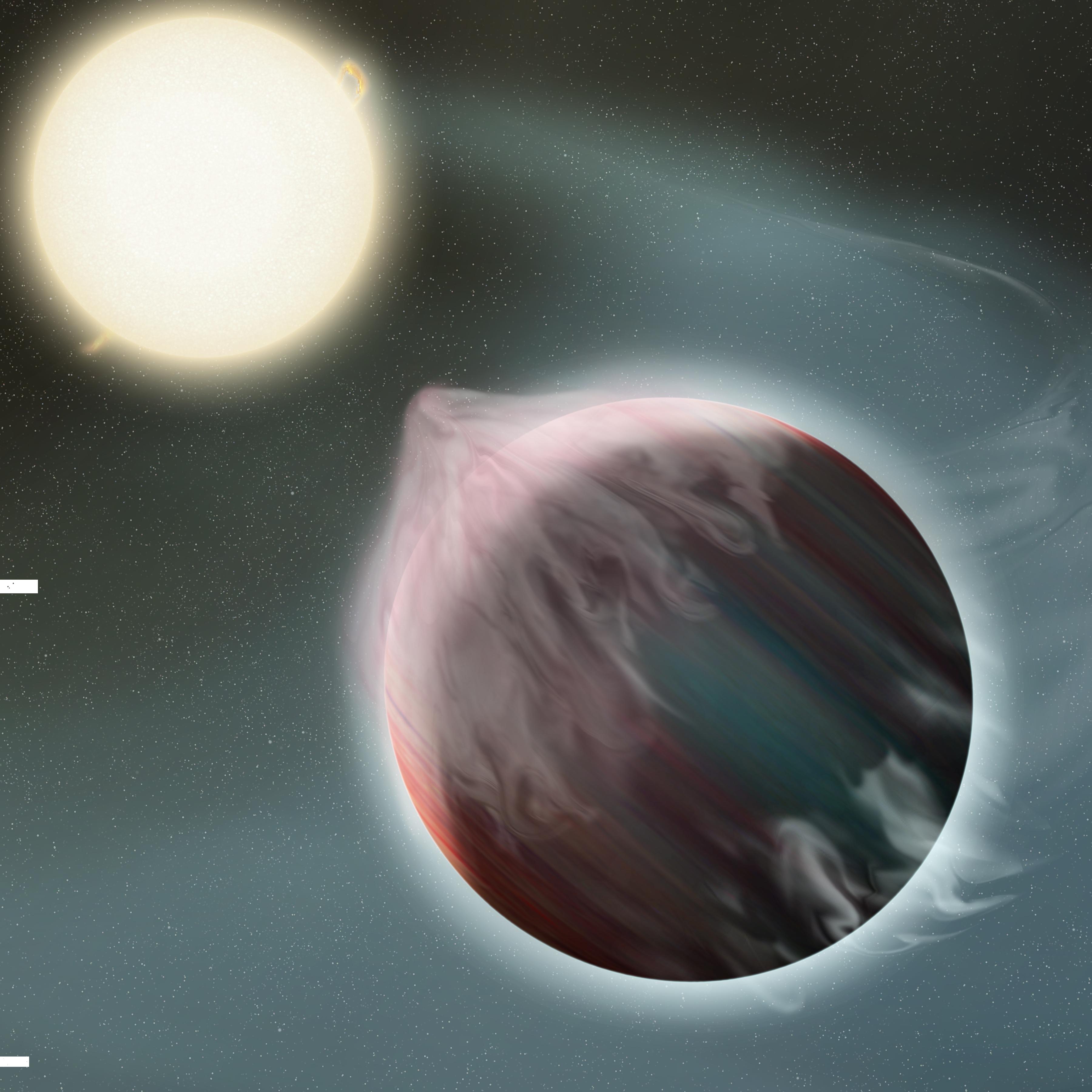
Artist’s conception of a hot Jupiter shedding mass.

Tidal interactions between short-period exoplanets and their host stars drive orbital decay and have likely led to engulfment of planets by their stars. Precise transit timing surveys, with baselines now spanning decades for some planets, are directly detecting orbital decay for a handful of planets, with corroboration for planetary engulfment coming from independent lines of evidence. The large number of possible targets (hundreds of planets) means it is not feasible to continually observe all planets that might exhibit detectable tidal decay. For this work, we explored the properties of an exoplanet system that can maximize the likelihood for observing tidally driven transit timing variations.

Research Publications

  • Jackson et al. (2023) “Metrics for Optimizing Searches for Tidally Decaying Exoplanets.” Astronomical Journal.
The first flight of the Ingenuity helicopter on Mars.

We used attitude data from the Mars Ingenuity helicopter to estimate wind speeds and directions at altitudes between 3 and 24 m, the first time winds at such altitudes have been probed on Mars. We compared our estimates to wind data from the meteorology package MEDA on board the Mars 2020 Perseverance rover and to predictions from meteorological models. Wind directions inferred from Ingenuity data agreed with the directions measured by MEDA, when the latter were available, but deviated from model-predicted directions by as much as 180° in some cases. The inferred wind speeds are often much higher than expected. The work here provides a foundation for exploration of planetary boundary layers using drones and suggests important future avenues for research and development

Research Publications

Press