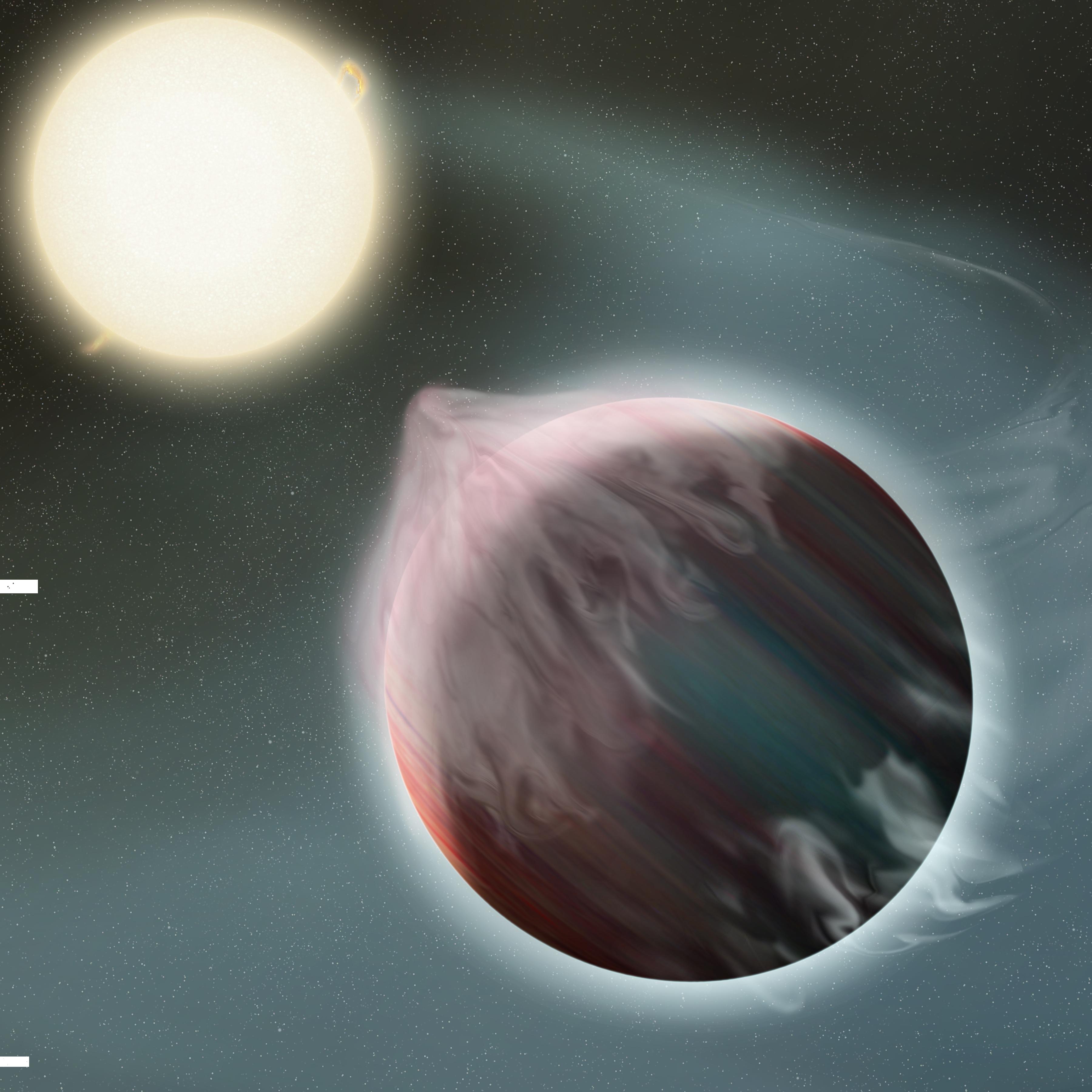
Artist’s conception of a hot Jupiter shedding mass.
Tidal interactions between short-period exoplanets and their host stars drive orbital decay and have likely led to engulfment of planets by their stars. Precise transit timing surveys, with baselines now spanning decades for some planets, are directly detecting orbital decay for a handful of planets, with corroboration for planetary engulfment coming from independent lines of evidence. The large number of possible targets (hundreds of planets) means it is not feasible to continually observe all planets that might exhibit detectable tidal decay. For this work, we explored the properties of an exoplanet system that can maximize the likelihood for observing tidally driven transit timing variations.
Research Publications
Jackson et al. (2023) “Metrics for Optimizing Searches for Tidally Decaying Exoplanets.” Astronomical Journal.
The first flight of the Ingenuity helicopter on Mars.
We used attitude data from the Mars Ingenuity helicopter to estimate wind speeds and directions at altitudes between 3 and 24 m, the first time winds at such altitudes have been probed on Mars. We compared our estimates to wind data from the meteorology package MEDA on board the Mars 2020 Perseverance rover and to predictions from meteorological models. Wind directions inferred from Ingenuity data agreed with the directions measured by MEDA, when the latter were available, but deviated from model-predicted directions by as much as 180° in some cases. The inferred wind speeds are often much higher than expected. The work here provides a foundation for exploration of planetary boundary layers using drones and suggests important future avenues for research and development
We used attitude data from the Mars Ingenuity helicopter with a simple steady-state model to estimate wind speeds and directions at altitudes between 3 and 24 m, the first time winds at such altitudes have been probed on Mars. We compared our estimates to wind data from the meteorology package MEDA on board the Mars 2020 Perseverance rover and to predictions from meteorological models. Wind directions inferred from Ingenuity data agreed with the directions measured by MEDA, when the latter were available, but deviated from model-predicted directions by as much as 180° in some cases. The inferred wind speeds are often much higher than expected. For example, meteorological predictions suggest that Ingenuity should not have seen wind speeds above about 15 m s−1 during its 59th flight, but we inferred speeds reaching nearly 25 m s−1. For flights during which we have MEDA data to compare to, inferred wind speeds imply friction velocities >1 m s−1 and roughness lengths >10 cm, which seem implausibly large. These results suggest that Ingenuity was probing winds sensitive to aerodynamic conditions hundreds of meters upwind instead of the conditions very near Mars 2020, but they may also reflect a need for updated boundary layer wind models. An improved model for Ingenuity’s aerodynamic response that includes the effects of transient winds may also modify our results. In any case, the work here provides a foundation for exploration of planetary boundary layers using drones and suggests important future avenues for research and development.